

Can You Really Earn 1% Daily from Trading? Don't Get Excited Until You Do the Math
S&P 500 index SPX | 0.00 | |
PowerShares QQQ Trust,Series 1 QQQ | 0.00 | |
Tesla Motors, Inc. TSLA | 0.00 | |
Microsoft Corporation MSFT | 0.00 | |
SAUDI ARAMCO 2222.SA | 0.00 |
When you first enter the financial markets, it’s often challenging to set realistic expectations. This scenario is quite common.
So, the question arises: Can trading really deliver 1% returns daily?
The answer is: No.
There are two main reasons. First, compounding a daily 1% return would result in an extraordinarily high annual rate, which is simply not sustainable in the real world. Second, returns are not evenly distributed every day. Trading involves both profitable and losing days, rather than consistently earning money each day.
If you initially believed such returns were feasible, this conclusion might be disappointing.
However, the situation isn’t as bleak as it seems. Let’s delve further.
The Truth About Earning 1% Daily in Trading
Before we proceed, let’s do some quick math to understand what a daily 1% return means in the long term.
If you could achieve 1% daily over a month and reinvest profits for compounding growth, the total monthly return would be approximately 34%.
Extending this to a year (assuming roughly 250 trading days), the annualized return would be an astonishing 1103%.
In other words, an initial investment of $100,000 would grow to $1.2 million in a year. Even Warren Buffett might be tempted to shut down his computer upon seeing such numbers.
Under any rational and sustainable risk management framework, no trader can achieve this level of return over the long term.
Of course, there are always a few exceptions. Some individuals may achieve significant returns by taking extreme risks, but if they continue trading this way, they will eventually face a loss big enough to wipe out much of their account, if not all.
Remember, trading is a marathon, not a sprint. Losing your capital means you can no longer compete. Therefore, protecting your capital should always be the top priority.
So, How Much Can Traders Realistically Earn Daily?
Since 1% daily is unrealistic, we need to consider more reasonable expectations.
The best way to answer this is to look at historical market performance. Unfortunately, most traders cannot consistently outperform the market in the long run. Therefore, let’s examine the S&P 500 index(SPX.US) annual returns.
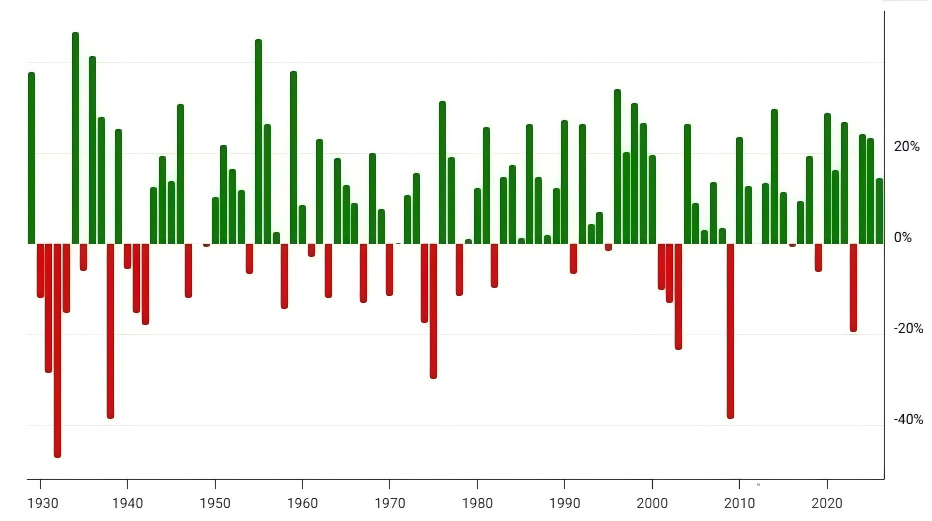
As shown in the chart, some years have exceptional returns exceeding 40%, while others perform poorly with declines of over -40%.
Now, let’s assume we encounter an outstanding year where the market rises 50% (an infrequent occurrence).
Translating a 50% annual return to monthly returns, compounded, requires about 3.5% monthly. Converting this to daily returns (assuming 22 trading days per month), you need approximately 0.15% daily.
In other words, achieving the kind of top-tier market performance that happens only a few times a century requires just about 0.15% daily returns. Expecting a stable 1% daily return, which is seven times that amount, is clearly unrealistic.
In short, while 1% daily sounds appealing, in the real trading world, it’s more of a marketing slogan than a sustainable goal. Traders who survive in the long term focus not on “how much they earn daily,” but on staying at the table by managing risks.
Can You Expect 0.15% Daily Returns?
Achieving a 50% annual return is not feasible for most people over the long term. While exceptional years with high returns may occur, sustaining such levels over several years is extremely challenging.
In certain trading methods, such as algorithmic trading, similar returns might be possible. However, for typical swing trading, achieving an annual return of 15%–30% without excessive risk is a more realistic and commendable goal.
Now, assuming you could theoretically achieve an average daily return of 0.15%, does this mean your account will grow at this rate every day?
The answer remains: No.
In reality, returns fluctuate significantly. Only after a prolonged period can you begin to discern your true average return. Often, most profits are concentrated in very short time windows. It’s not uncommon for two or three months of the year to contribute the majority of earnings.
Therefore, aiming for a consistent 0.15% daily return is not a goal you should pursue, as it is equally unattainable in reality.
How to Maximize the Probability of Positive Annual Returns
Since daily positive returns are unrealistic, the focus should be on maximizing the probability of earning consistently over a year. After all, taxes are calculated annually in most countries, making annualized returns the key metric.
Here are some useful suggestions:
1. Trade Multiple Strategies
Contrary to what many novice traders believe, there is no “perfect trading strategy” that never fails. All strategies will eventually face periods of underperformance. Diversifying risk across multiple strategies is a wise approach.
Moreover, if your strategies are based on different logic and market behaviors, the likelihood of simultaneous drawdowns decreases significantly. This results in smoother overall returns and may even allow for moderate position size increases under controlled risk, boosting overall returns.
If you aim to elevate your trading to a higher level and run up to 100 strategies, consider exploring algorithmic trading. This is a field we have extensively researched and practiced, and we genuinely believe it’s worth your attention!
2. Diversify Investments
While not directly related to pure trading, it’s worth mentioning.
Holding a diversified stock portfolio, ideally across several stocks from different sectors, is usually a more stable choice. This way, if one stock performs poorly in a given year, its losses can often be offset by gains from other stocks.
However, note that diversification isn’t always better. Excessive diversification might turn your portfolio into something resembling an index fund. While this typically offers higher stability, the downside is that it becomes challenging to outperform the market. In essence, you’re creating a “mini index fund.”
Conclusion
Unfortunately, earning 1% daily in the market is not a realistic goal. Those who succeed long-term don’t win every day; they manage drawdowns, control position sizes, and remain in the market by year’s end.
For a high-level, well-performing trader, a more realistic daily return expectation is around 0.15%. From an annual perspective, this translates to over 50% annual returns, which is already an exceptional achievement.
At this growth rate, you could double your trading account in less than two years. Extending the timeframe further, the compounding effect will produce even more impressive results.
In other words, what truly matters isn’t “how much you earn today,” but whether you can consistently stay in the market over a long period and steadily grow your capital.
It’s not that you calculated wrong; it’s that the goal itself doesn’t belong in the real world.