

Costco Stock Leads These Retail Names Tied To Higher Social Security Checks
Costco Wholesale COST | 0.00 |
Retirees may see a 3.2% to 3.6% Social Security cost of living adjustment for 2027, and that potential boost in monthly checks puts fresh attention on companies tied to everyday spending. If more income ends up in grocery aisles and discount chains, some stocks could sit closer to the checkout than others. This article walks through three stocks our screener flags as especially exposed to that story.
The stocks in this article are just a sample, and the full screen surfaced 25 more U.S. consumer staples and discount retailers with stories that may be just as tightly tied to retiree spending. To size up the full field and identify the ideas that fit your own criteria best, head straight to the U.S. Consumer Staples & Discount Retailers Leveraged to Retiree Spending screener.
Savers Value Village (SVV)
Savers Value Village is a Bellevue based thrift operator that sources donated clothing, household goods, books, and other items from non profit partners, then sorts, prices, and sells them across its Savers, Value Village, Unique, and other store banners in the U.S., Canada, and Australia. The business is heavily skewed to U.S. Retail at about $990 million of revenue, with Canada Retail contributing about $620 million and a segment adjustment of roughly $131 million taking total reported revenue above $1.7b. The stock sits in mid cap territory with a market value of about $1.7b.
Savers Value Village operates in a segment where value focused retirees may choose to shop when budgets are tight but modestly higher Social Security checks allow for some additional spending on apparel and household goods. The company is responding to that demand with its ThriftIQ pricing platform and a growing store base. At the same time, thin profit margins, a relatively high P/E, reliance on donated inventory, and pressure from online resale platforms mean the story involves real risks as well as potential opportunities. For investors who believe value shopping will remain central to how retirees spend, this mix of factors may make Savers Value Village worth a closer look.
Savers Value Village sits at the crossroad of retiree budgets and value shopping, yet the real story sits in the details investors often skip. Get the 1 key reward and 2 important warning signs (1 is major!)

Build your own value and retiree spending shortlist
Savers Value Village and the two other stocks in this article all came out of the same Simply Wall St screen, which you can easily tweak for your own approach. Use our flexible Screener to mix filters like valuation, balance sheet strength, and risks, or start with one of our curated Investing Ideas.
Ross Stores (ROST)
Ross Stores runs the Ross Dress for Less and dd’s DISCOUNTS chains in the U.S., offering branded apparel, footwear, accessories, and home goods at off price levels to middle and lower to moderate income shoppers. All of its roughly $23.8b in revenue comes from off price retailing in the U.S., which gives the company direct exposure to value focused retirees who may put any extra Social Security income toward discounted clothing and household items. With a market value around $79.6b, Ross Stores sits firmly in large cap territory.
Ross Stores is tightly linked to the retiree story because it focuses on value while still offering branded merchandise, which can be attractive if Social Security checks stretch a little further. Earnings quality is strong and return on equity is high, supported by store expansion and investments in distribution and self checkout. At the same time, the stock trades at a premium valuation and depends on access to closeout inventory, with no meaningful e commerce channel to fall back on if traffic softens. That mix of strengths and pressure points is exactly what makes Ross Stores worth a closer look for this theme, and the details behind those trade offs matter more than a quick glance suggests.
Ross Stores blends off price scale with a premium valuation, which many investors may be glossing over. See how the 2 rewards frames that balance and what might shake it up next.

Costco Wholesale (COST)
Costco Wholesale runs a global chain of membership warehouses that sell bulk groceries, household essentials, fuel, and services like pharmacies and optical centers, all designed to offer low prices in exchange for an annual membership fee. Virtually all of its roughly US$293.6b in revenue comes from its Membership Warehouses segment, with the United States accounting for about US$212.2b, Canada US$39.7b, and other international markets US$41.8b. The stock is a giant in retail with a market value of roughly US$421.1b.
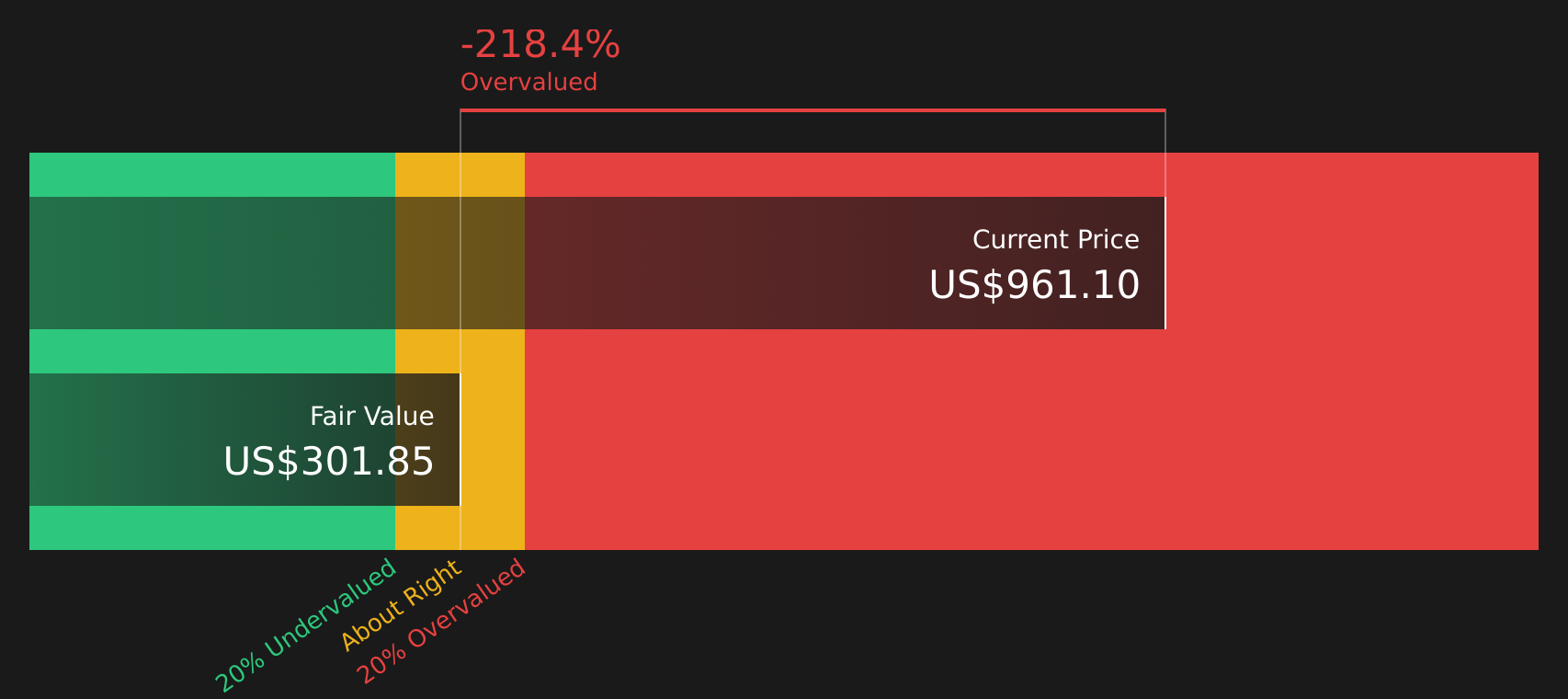
Costco Wholesale gives you a rare mix of high membership loyalty, steady traffic in staples, and clear appeal for retirees who stretch Social Security checks across groceries, fuel, and pharmacy in one trip. That combination helps support high returns on equity and recurring membership income, yet the stock already trades on a rich multiple and Simply Wall St’s cash flow model sits far below the current share price. Add in heavier use of external borrowing and the need to keep prices compelling even as wages and compliance costs rise, and Costco becomes a story where the quality is hard to question but the price tag deserves careful attention.
Costco’s rich multiple and powerful member model often look glued together, yet that gap between business quality and current pricing could be wider than it seems. See how the DCF valuation analysis for Costco Wholesale reframes the risk and what might finally rebalance it.
Curious About Alternative Stock Paths
Fresh ideas often move first when momentum builds, and the best entries are frequently found early while they are still under the radar. Do not delay; consider acting early.
- Target steadier momentum plays with strong fundamentals by scanning a curated list of solid balance sheet and fundamentals (49 results) that filters out weaker balance sheets before they impact returns.
- Look for income opportunities by reviewing a hand picked 11 dividend fortresses built around higher yielding companies that also focus on stability.
- Identify potential breakout operators in automation by working through a focused 39 robotics and automation stocks that highlights businesses connected to long term robotics demand.
This article by Simply Wall St is general in nature. We provide commentary based on historical data and analyst forecasts only using an unbiased methodology and our articles are not intended to be financial advice. It does not constitute a recommendation to buy or sell any stock, and does not take account of your objectives, or your financial situation. We aim to bring you long-term focused analysis driven by fundamental data. Note that our analysis may not factor in the latest price-sensitive company announcements or qualitative material. Simply Wall St has no position in any stocks mentioned.