

Costco Wholesale (COST), Why Is It Getting Attention Now?
Costco Wholesale COST | 0.00 |
Costco Wholesale (COST) is back in focus after client brands announced fresh product launches across its warehouses, from greenhouse-grown BrightFarms salad greens in Atlanta to reusable XL tote bags on the West Coast.
Recent product rollouts and strong sales updates have come as Costco Wholesale’s share price has risen 12.48% year to date, while the stock is down about 10.72% over the past 90 days and the 5 year total shareholder return sits at 120.96%. This points to long term momentum despite a softer recent patch.
If Costco’s growth story has you thinking about what else is moving, this is a good moment to broaden your watchlist with the 21 top founder-led companies
Bulls point to Costco Wholesale’s steady revenue and earnings growth, while bears focus on a P/E in the low to mid 40s and the recent pullback. Which side does the current valuation actually support next?
Most Popular Narrative: 11.3% Undervalued
The most followed narrative currently values Costco Wholesale at $1,082.94 per share, above the last close of $961.10. This frames the recent pullback as a potential valuation gap.
Analysts are assuming Costco Wholesale's revenue will grow by 7.4% annually over the next 3 years. Analysts assume that profit margins will increase from 3.0% today to 3.2% in 3 years time.
There is interest in understanding why Costco Wholesale might sustain a premium price tag. The narrative leans on steady revenue expansion, small margin gains, and a rich future earnings multiple, and raises the question of which assumptions would need to hold for that to add up.
Result: Fair Value of $1,082.94 (UNDERVALUED)
However, Costco Wholesale’s narrative can be challenged if foreign exchange swings continue to weigh on international results or if higher labor and supply chain costs squeeze margins.
Another View On Costco Wholesale’s Valuation
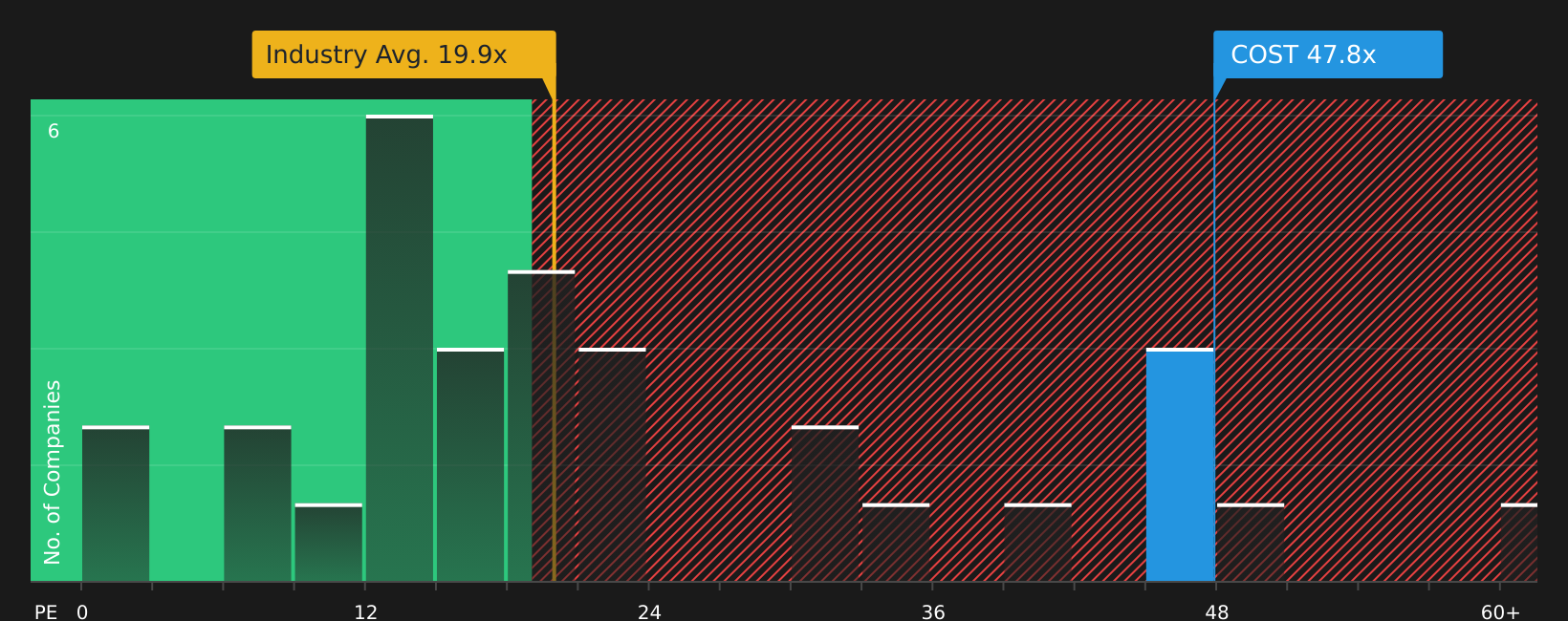
The 11.3% discount to the $1,082.94 fair value is based on earnings forecasts and a relatively high future P/E. On current numbers, however, Costco Wholesale trades on a 48.2x P/E, which is roughly double the US Consumer Retailing industry at 20.3x and above its own fair ratio of 40x. That suggests limited margin for error if growth or margins fall short of expectations.
For readers weighing this higher multiple against the earnings narrative, the valuation breakdown behind these ratios can help you judge whether the premium still feels comfortable or increasingly stretched, especially after a pullback and with other retailers trading on much lower multiples. See what the numbers say about this price — find out in our valuation breakdown.
Next Steps
If the mixed signals on Costco Wholesale leave you unsure, this is the time to move quickly and test the story against the data yourself. To see what is driving optimism, review the 2 key rewards
Looking for more investment ideas beyond Costco Wholesale?
If Costco Wholesale has sharpened your focus, do not stop there. Use the Simply Wall St Screener to quickly spot other stocks that fit your style.
- Target reliable income by checking out companies in the 10 dividend fortresses that could suit an income focused portfolio.
- Hunt for potential bargains by scanning the 52 high quality undervalued stocks that may trade below their estimated worth based on fundamentals.
- Prioritise capital preservation and steadier compounding by reviewing the 80 resilient stocks with low risk scores that score well on resilience.
This article by Simply Wall St is general in nature. We provide commentary based on historical data and analyst forecasts only using an unbiased methodology and our articles are not intended to be financial advice. It does not constitute a recommendation to buy or sell any stock, and does not take account of your objectives, or your financial situation. We aim to bring you long-term focused analysis driven by fundamental data. Note that our analysis may not factor in the latest price-sensitive company announcements or qualitative material. Simply Wall St has no position in any stocks mentioned.