

Does Amazon.com (AMZN) Still Look Cheap As AI Costs Rise?
Amazon.com, Inc. AMZN | 0.00 |
Amazon.com stock has delivered a strong 75.6% return over the past three years, yet recent weakness and a high overall value score suggest the market may still be pricing it below what many fundamental checks imply.
- Over the last three years, a 75.6% return highlights how strongly Amazon.com has rewarded investors who stayed invested over a longer window.
- Expectations around Amazon Web Services and broader AI related spending can support earnings power, while ongoing regulatory and legal scrutiny may weigh on how much investors are willing to pay for that growth.
- With the broader checks indicating Amazon.com screens as undervalued in 5 of 6 valuation tests, the stock currently looks more like a potential bargain than a fully priced giant, according to Simply Wall St's 5/6 value score.
The issue now is whether Amazon.com's current share price at US$232.11 offers enough margin of safety for investors who are focused on valuation rather than recent short term share price moves.
Does Amazon.com Look Undervalued on Earnings?
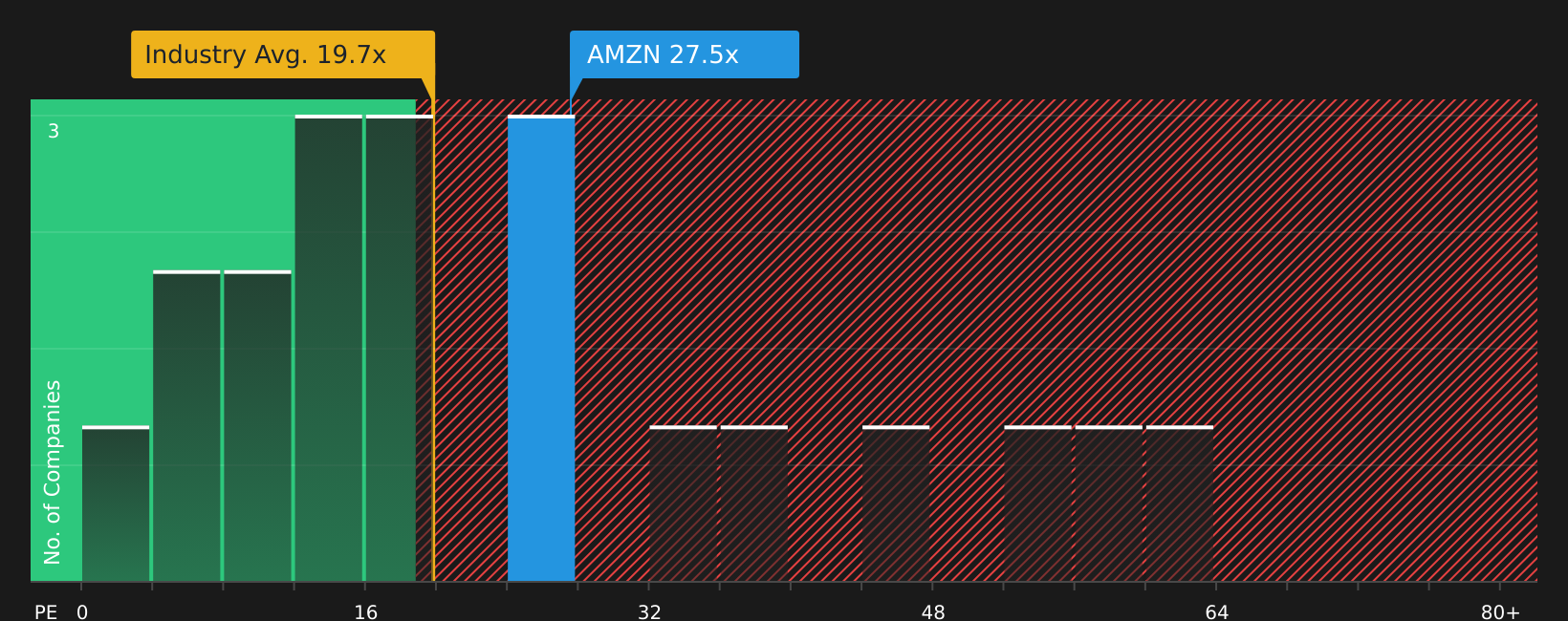
The P/E ratio is a useful way to think about Amazon.com because earnings are now a meaningful part of the story alongside revenue and cash flow. Amazon.com currently trades on a P/E of 27.5x, which is almost identical to the 27.6x peer average and above the 19.7x average for the wider Multiline Retail industry.
Based on Simply Wall St's fair P/E estimate of 43.9x, which reflects the profitability profile, business mix and risk factors, Amazon.com appears undervalued on this measure because its current 27.5x multiple is well below that fair ratio. Recent commentary around heavy AI and data center spending, including concern that big tech stocks have become riskier as AI exposure grows, has not pushed the P/E closer to that implied fair level, suggesting the market may still be applying a discount.
Overall, Amazon.com stock appears undervalued on the P/E multiple, with its current valuation sitting well below the fair P/E level suggested by this framework.
The Amazon.com Narrative: What Would Justify Today's Price?
Simply Wall St's Narratives for Amazon.com pick up where the valuation puzzle leaves off by spelling out which paths for growth, margins and earnings would need to play out for the stock to be worth meaningfully more or less than its current price, and they sit on the company’s Community page. Each Narrative ties its numbers to a specific view on how Amazon.com's growth, profitability and risks could evolve, giving you something concrete to revisit as new information comes through.
Community views on Amazon.com sit far apart, with some investors focused on the breadth of its growth engines and others fixated on valuation discipline.
Bull case: roughly fairly valued
"Their E-commerce platform is the undisputed leader especially with its robust options for customers and the scale of its logistics network..."
Bear case: 38% overvalued
"Another thing to watch out for is the difference between its ROIC and estimated cost of capital, they are both very close, meaning that the company may be struggling to earn more on its invested capital than its required..."
Do you think there's more to the story for Amazon.com? Head over to our Community to see what others are saying!
The Bottom Line
For investors looking at Amazon.com today, the key point is that the market multiple view still suggests the stock is undervalued relative to peers and the broader industry. The strong value checks indicate that, on balance, fundamentals support that signal rather than contradict it. From here, the debate largely comes down to whether Amazon.com can sustain earnings power from AWS and AI related spending while managing ongoing regulatory and legal risks, and whether the current P/E eventually re-rates closer to those fundamentals or remains capped by those concerns.
This article by Simply Wall St is general in nature. We provide commentary based on historical data and analyst forecasts only using an unbiased methodology and our articles are not intended to be financial advice. It does not constitute a recommendation to buy or sell any stock, and does not take account of your objectives, or your financial situation. We aim to bring you long-term focused analysis driven by fundamental data. Note that our analysis may not factor in the latest price-sensitive company announcements or qualitative material. Simply Wall St has no position in any stocks mentioned.