

Event Reminder | Get Ready for 15:30~23:00 Tonight (Wednesday, Aug. 26th)
NVIDIA Corporation NVDA | 0.00 | |
Apollo Global Management Inc APO | 0.00 | |
BlackRock, Inc. BLK | 0.00 | |
Blackstone Inc. BX | 0.00 | |
Brookfield Asset Management Inc BN | 0.00 |
01
Event and Background
At 15:30 Riyadh Time on Friday, the US' Bureau of Economic Analysis releases the July Personal Consumption Expenditures price index — the Fed's preferred inflation gauge and the last major data point before Chair Kevin Warsh's keynote at Jackson Hole on Friday.
Markets are positioning cautiously.
| Time (Riyadh) | Indicator | Previous | Consensus | Forecast |
|---|---|---|---|---|
| 03:30 PM | Core PCE Price Index MoM JUL | 0.1% | 0.2% | 0.3% |
| 03:30 PM | Durable Goods Orders MoM JUL | 0.3% | 0.7% | 0.5% |
| 03:30 PM | GDP Growth Rate QoQ 2nd Est Q2 | 2.1% | 1.5% | 1.5% |
| 03:30 PM | Personal Income MoM JUL | 0.2% | 0.3% | 0.2% |
| 03:30 PM | Personal Spending MoM JUL | 0.3% | 0.2% | 0.3% |
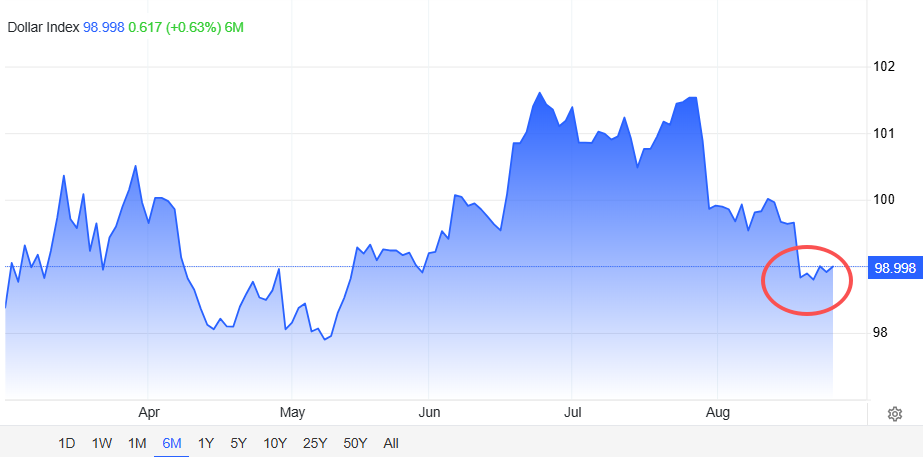
The US dollar has drifted near a three-month low around 98.996 on a basket of six currencies, with Standard Chartered warning that Treasury's recent attempts to cap long-end yields "present another headwind to the dollar."
Asian equities rallied overnight as US long-bond yields fell, with the Nikkei up 0.81%, the KOSPI gaining 1.47%, and the Hang Seng rising 0.54%.
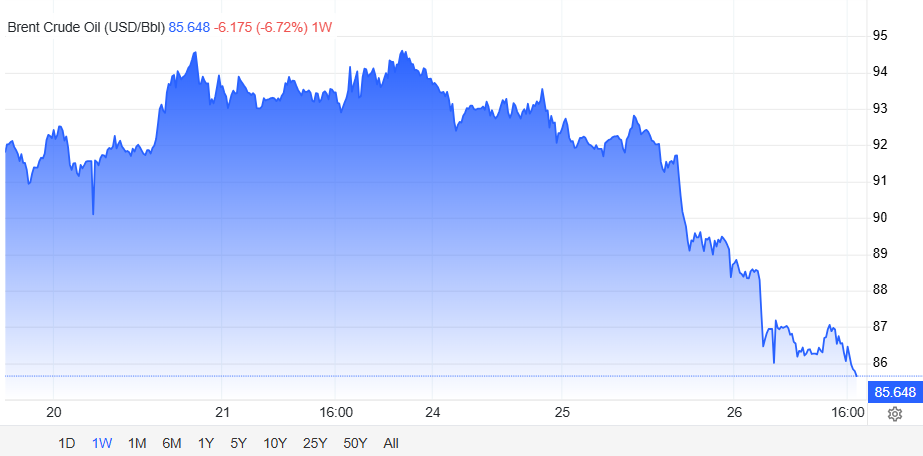
Brent crude slid to USD 85.648 on renewed Iran-Oman diplomatic signals.
The PCE print shares the spotlight with NVIDIA Corporation(NVDA.US)'s fiscal Q2 earnings after the closing bell. (NVDA Reports Wed.: The $92B Revenue Test, $500B Circular-Finance Debate, the “Sell-the-News” Curse, and 3 Ways to Trade the ±5.6% Move)
The twin-event risk — PCE at 3:30 a.m., Nvidia after the close — means Thursday is effectively a two-act drama for risk assets, with Warsh's Jackson Hole speech waiting in the wings as the third act.
02
Expectations and How to Read
The Street's base case for core PCE leans on recent disinflation momentum.
July CPI rose just 0.1% m/m with core at 0.2%; July PPI printed 0.0% vs. 0.2% expected, pulling the year-on-year rate from 5.5% to 4.7%. These downstream indicators suggest July core PCE should land in a similarly benign range.
Stifel, however, offers a cautionary framing: its base case is that Warsh will signal "progress in inflation and a continued policy pause even though core inflation remains above target," while explicitly arguing that "3% core inflation is the new 2%," sustained by sticky supercore services and AI-capex-driven goods inflation.
This is the interpretive fault line.
- A PCE print at or below 0.2% m/m validates the market's pricing of a September hold — CME FedWatch currently shows roughly 65% probability of no hike — and reinforces Goldman's "full-year on hold" thesis.
- A print at 0.3% or higher, particularly if supercore components surprise to the upside, would revive the hawkish camp led by Kashkari, Hammack and Logan, who dissented at the July meeting demanding an immediate hike.
The deeper context is the Treasury's attempt to cap long-end yields, which Citadel and others have criticized as a "fiscal intervention" that undermines the dollar.
DBS analysts note Warsh faces "a difficult balancing act: defending the Fed's independence and price-stability mandate while providing greater clarity on the Fed's reaction function without abandoning his preference for less forward guidance."
The PCE number will be his first hard data point to react to before Jackson Hole — if it comes in soft, he has cover to stay silent; if it surprises hot, the pressure to articulate a reaction function intensifies.
03
Impact on Equity Sentiment
Equity markets are walking a narrowing path.
| Ticker | Thesis | Logic Loop |
|---|---|---|
| Structural AI leader; circular-financing rebuttal + Rubin on track | Beat & Raise priced in → must retire $500B critique → margin durability + architecture cadence determine multiple | |
| Financing partners in $500B AI vehicle; fee income from third-party capital | Nvidia ecosystem expansion → third-party compute financing scale → asset-management fee compounding | |
| Momo-driven pre-event bid; long-end yield support | Yields cap → duration risk premium compresses → growth multiple expansion, but IV crush risk post-print | |
| Geopolitical + fiscal uncertainty hedge | Treasury buyback undermines confidence → deficit trajectory intact → but short-term Chinese demand exhaustion caps near-term upside |
The momo crowd is aggressively buying "Mag-7" names ahead of the dual event, with positive early money flows in Amazon.com, Inc.(AMZN.US), Alphabet Inc. Class C(GOOG.US), Meta Platforms(META.US), NVIDIA Corporation(NVDA.US) and Tesla Motors, Inc.(TSLA.US), plus ETF-S&P 500(SPY.US) and PowerShares QQQ Trust,Series 1(QQQ.US).
But smart money is notably absent from pre-event buying, recognizing that both PCE and Nvidia earnings pose asymmetric downside risk.
The Arora Report captures the tension: "a key event poses risk to the downside and reward to the upside," and the momo crowd's logic ignores that risk calibration.
For the broader market, a benign PCE print supports the ongoing rotation from mega-cap AI into value and international names, while keeping the 10-year Treasury yield from revisiting its recent highs above 4.7%.
This would relieve pressure on rate-sensitive growth stocks.
However, Nvidia's earnings present a separate, more acute risk. Even a clean beat may trigger the "sell-the-news" reflex that has governed the stock's last four post-earnings sessions.
More importantly, management must address two narratives that threaten the multiple: the USD 500 billion "circular financing" controversy — where Michael Burry has alleged that Nvidia effectively funds its own customers — and the production timeline for the Rubin architecture.