

Event Reminder | Get Ready for 3:30 PM Today (Friday, Aug. 7th)
S&P 500 index SPX | 0.00 | |
NASDAQ IXIC | 0.00 | |
Dow Jones Industrial Average DJI | 0.00 | |
NASDAQ-100 NDX | 0.00 | |
S&P 500 index GSPC | 0.00 |
01
Event and Background
At 15:30 Riyadh time on Friday, the US Bureau of Labor Statistics releases the July employment situation report.
| Time (Riyadh) | Indicator | Previous | Consensus | Forecast |
|---|---|---|---|---|
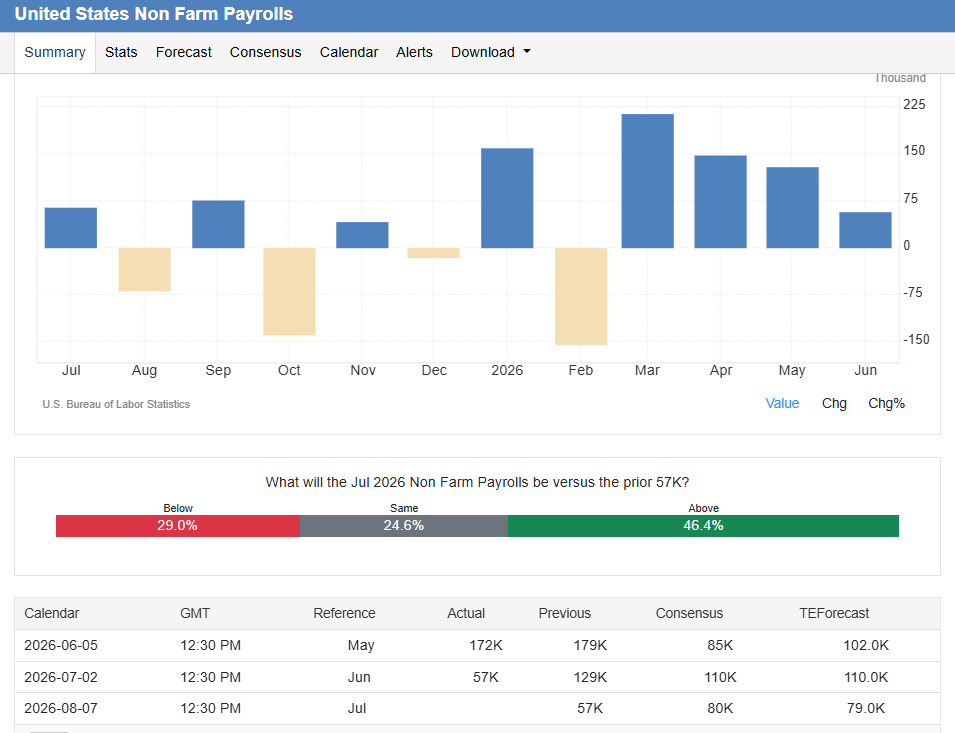
| 03:30 PM | Non-Farm Payrolls JUL | 57K | 80K | 79.0K |
| 03:30 PM | Unemployment Rate JUL | 4.2% | 4.2% | 4.2% |
| 03:30 PM | Average Hourly Earnings MoM JUL | 0.3% | 0.3% | 0.3% |
| 03:30 PM | Average Hourly Earnings YoY JUL | 3.5% | 3.5% | 3.5% |
| 03:30 PM | Participation Rate JUL | 61.5% | 61.6% | |
| 03:30 PM | Average Weekly Hours JUL | 34.3 | 34.3 | 34.3 |
| 03:30 PM | Government Payrolls JUL | 8K | 10.0K | |
| 03:30 PM | Manufacturing Payrolls JUL | 3K | 4.0K | 9.0K |
| 03:30 PM | Nonfarm Payrolls Private JUL | 49K | 78K | 69.0K |
| 03:30 PM | U-6 Unemployment Rate JUL | 7.9% | 7.9% |
This will be the first comprehensive labor market reading since the Fed held rates unchanged at 3.5%–3.75% at its July meeting, where three policymakers dissented in favor of a hike.

The print arrives at a delicate moment:
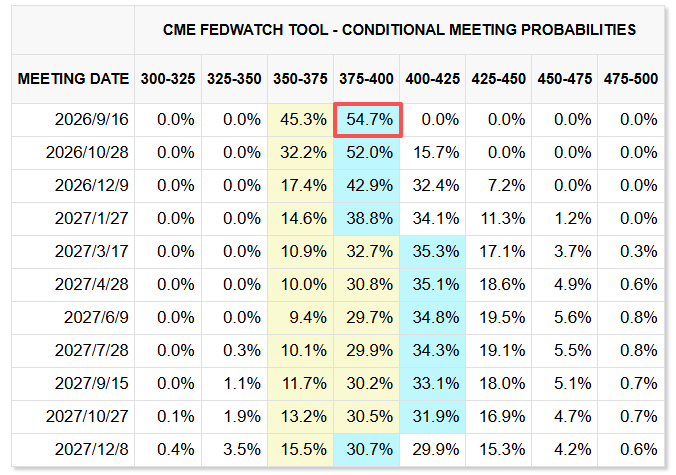
Rate-swap markets currently price a 54.7% probability of a September hike, down from as high as 80% earlier this month, as softening job data begins to pull the policy pendulum back toward "pause."
Yet the Fed's center of gravity remains squarely on inflation, and Chair Kevin Warsh's deliberate abandonment of forward guidance has made every major data release a market-moving event in its own right.
The pre-release environment is one of unusually high anxiety. With Warsh offering no reaction function, traders are forced to infer policy intent purely from the numbers.
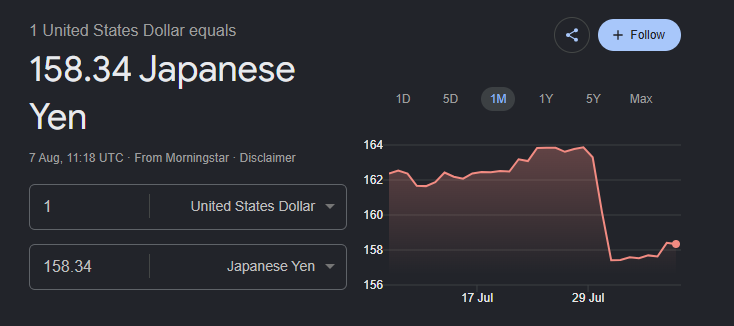
Ahead of the report, hedge funds have been buying short-dated USD/JPY put options — a direct bet that a weak payrolls print weakens the dollar — with the pair hovering near 158.34.
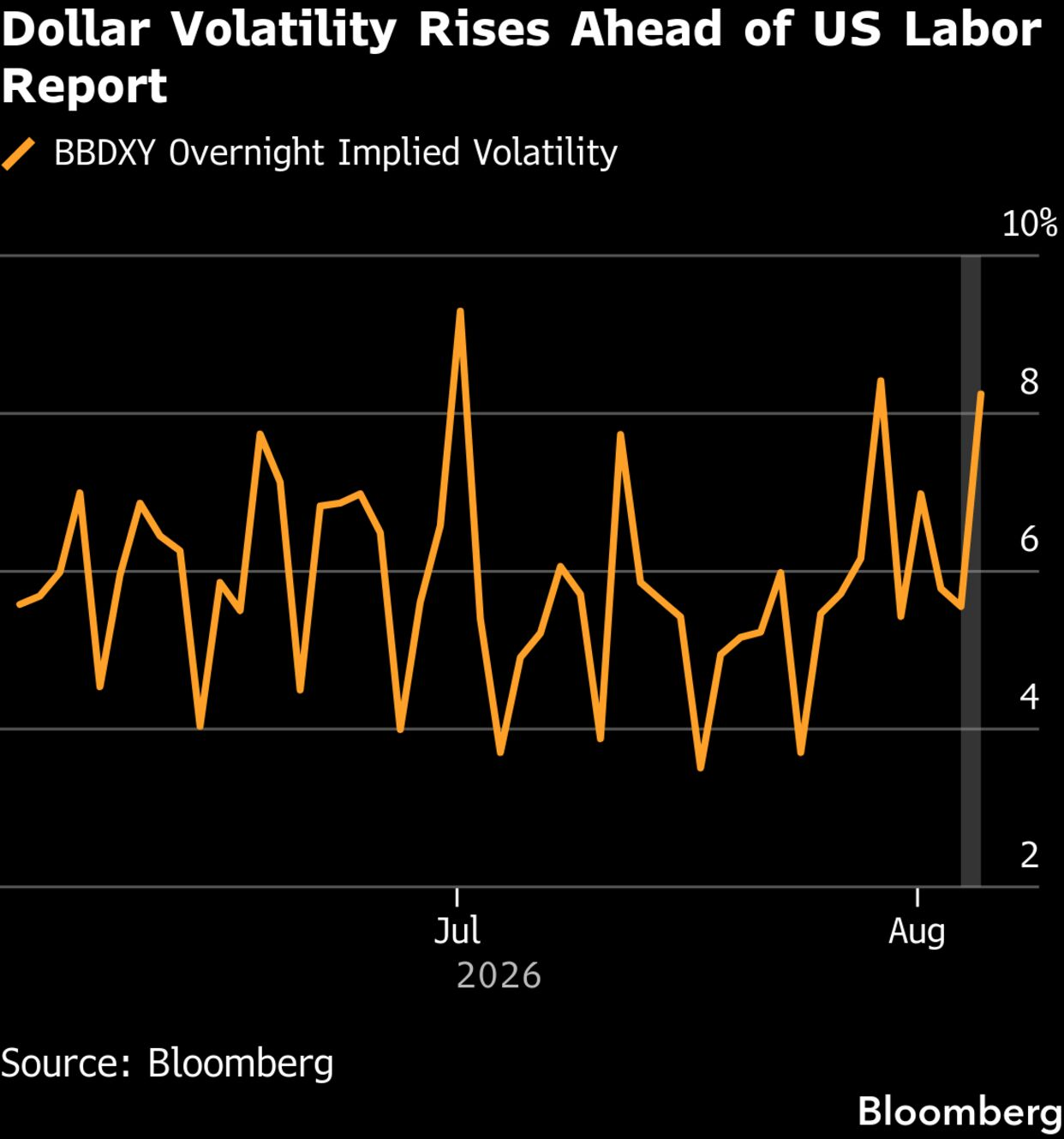
One-week implied volatility on the Bloomberg Dollar Spot Index rose to its highest since July 30.
As BMO Asset Management's Bipan Rai notes, "without forward guidance, economic data becomes the core driver of market pricing," and the market still does not know how Warsh reads the data or what the Fed's reaction function truly is.
02
Expectations and How to Read
The street consensus clusters around 80,000 to 83,000 new jobs for July, an improvement from June's disappointing 57,000 but still among the weakest monthly readings of the year, with the unemployment rate expected to hold at 4.2%.
Average hourly earnings are projected at +0.3% month-on-month and +3.5% year-on-year — a pace theoretically consistent with the Fed's 2% inflation target.
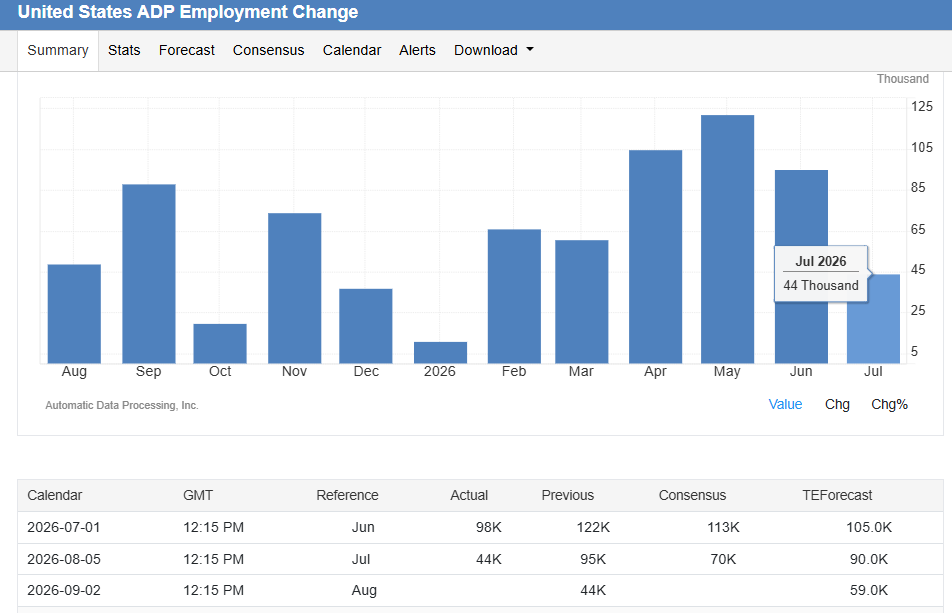
Leading indicators point to meaningful downside risk. Wednesday's ADP report showed private payrolls of just 44,000 in July, far below the 75,000 consensus and down sharply from June's revised 95,000 — the slowest pace since January, with nearly all gains concentrated in healthcare and education services (+36,000) while goods-producing industries shed 3,000 positions.
The ISM services employment index fell to 47.4 from 51.2, dropping back into contraction for the first time since March.
On the other hand, initial jobless claims stayed below 200,000 for a third straight week, with the four-week average at 198,800 — its lowest since September 2022 — and Challenger-reported layoffs fell to 33,429, the lowest since July 2024.
This is the classic "low hiring, low firing" equilibrium Fed Governor Lisa Cook described earlier this week: soft demand, but no surge in job losses, keeping the unemployment rate deceptively stable.
The hidden fragility lies in the labor force: the June participation rate dropped to 61.5%, the lowest since March 2021 and, excluding the pandemic, the weakest since 1976, with the prime-age 25–54 cohort suffering its largest one-month drop outside April 2020.
- Vanguard estimates July payrolls could be as low as 18,000, warning that "the risk of this weakness persisting into autumn is real."
- Citi's Veronica Clark goes further, projecting unemployment will break above 4.5% within months, triggering a policy pivot — she forecasts three cumulative rate cuts from now through January 2027.
- CICC adopts a cautious stance, penciling in roughly 50,000 jobs and an unemployment rate above 4.3%, arguing that the June World Cup-driven leisure & hospitality spike may reverse, that the divergence between weak household employment and strong establishment payrolls must eventually converge, and that downward revisions loom given July's seasonal tendency to disappoint.
- Goldman Sachs adds a technical caution: July nonfarm prints have frequently undershot expectations in recent years, often accompanied by large downward revisions to prior months. That pattern, combined with the 74,000 cumulative downward revision already applied to April and May data, means tonight's headline could surprise to the downside.
How to interpret the report depends less on the headline and more on its composition.
- A print near 80,000 with unemployment at 4.2% and earnings at 3.5% y/y would validate the "goldilocks" soft-landing narrative Haverford Trust's Hank Smith describes — strong enough to avoid recession fears, weak enough to cool September hike pricing.
- A print below 50,000, or any rise in unemployment driven by a participation-rate rebound rather than firing, would accelerate the market's shift toward rate-cut expectations.
- Conversely, a print above 100,000 would reignite hike bets and likely push the 10-year Treasury yield back above 4.7%, where it sat before the recent oil-driven repricing.
03
Impact on Equity Sentiment
The equity market's reaction function is asymmetric.
CICC explicitly notes that softer employment "provides continued support for the recent rate-cut trade, benefiting US Treasuries and gold." For equities, the immediate impulse is constructive: reduced rate anxiety lowers discount rates, particularly helping rate-sensitive growth and technology names that dominate index weights.
However, the sustainability of any relief rally hinges on two caveats embedded in the data itself. First, wage pressures remain surprisingly firm — ADP's job-switcher pay growth accelerated to 7% y/y, the fastest in nearly a year, even as hiring slows. If the official report confirms 3.5%+ earnings growth, markets must reconcile "weak hiring but sticky wages," which complicates the Fed's ability to pivot.
Second, the policy trade-off is shifting but not resolved. Citi argues the Fed's focus will migrate from inflation to employment in the coming months, but the central bank's public posture remains anchored on price stability.
The deeper vulnerability is that this is a market starved of guidance.
With Warsh refusing to telegraph intent, every data point triggers outsized repricing. JPMorgan's rates team has cautioned that any push of the 10-year yield above 4.8% would intensify pressure on rate-sensitive equities.