

Event Reminder | Get Ready for 9:00 PM Tonight (Wednesday, Aug. 19th)
S&P 500 index SPX | 0.00 | |
NASDAQ IXIC | 0.00 | |
Dow Jones Industrial Average DJI | 0.00 | |
NASDAQ-100 NDX | 0.00 | |
S&P 500 index GSPC | 0.00 |
01
Event and Background
At 9:00 PM Riyadh time on Wednesday, the Federal Reserve will release the minutes of its July 28–29 FOMC meeting — the second such document under Chair Kevin Warsh, and arguably the most scrutinized minutes release in years.
Also will released are the following gauges:
| Time (Riyadh) | Indicator | Previous | Consensus | Forecast |
|---|---|---|---|---|
| 08:00 PM | 20-Year Bond Auction | 5.163% | ||
| 09:00 PM | FOMC Minutes | |||
| 03:30 PM | Initial Jobless Claims AUG/15 | 209K | 210K | 201.0K |
| 03:30 PM | Philadelphia Fed Manufacturing Index AUG | 41.4 | 25 | 25 |
| 03:30 PM | Continuing Jobless Claims AUG/08 | 1777K | 1790K | 1808.0K |
| 03:30 PM | Jobless Claims 4-week Average AUG/15 | 199K | 200.0K |
The July meeting ended with a 9-to-3 vote to hold the federal funds target at 3.5%–3.75%, with Cleveland's Beth Hammack, Minneapolis' Neel Kashkari and Dallas' Lorie Logan dissenting in favor of an immediate 25bp hike — the most pronounced hawkish split since September 2016.

The timing could hardly be more charged.
Long-end Treasury yields have surged to multi-decade highs, with the 30-year breaching 5.28%, the highest in 19 years.
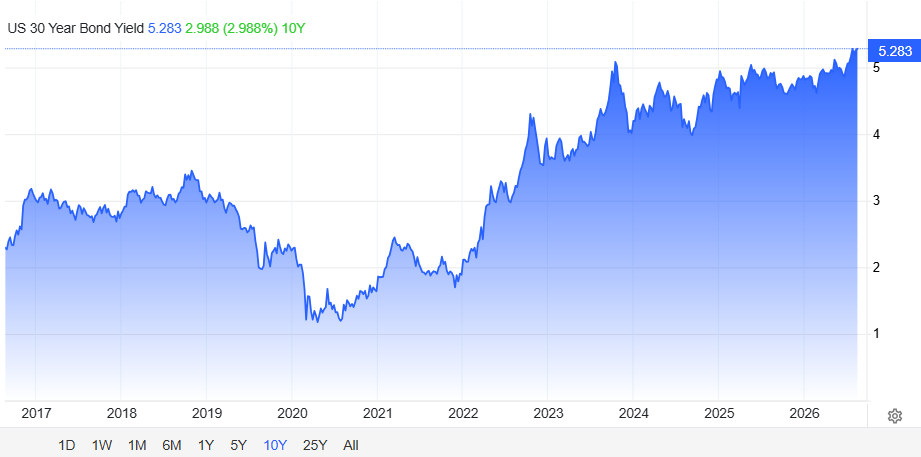
Citadel Securities' Nohshad Shah warns this reflects a market belief that both the Fed and the fiscal authority prefer the path of least resistance when facing difficult choices.
02
Expectations and How to Read
The street's base case is a hawkish-leaning document.
Mizuho's Alex Pelle argues the three dissents are merely "the tip of the iceberg" — that a larger bloc among the 19 Fed officials was already leaning toward hike in July, and that "since the start of the year, the hawkish camp has grown at every meeting."
The June minutes revealed that a majority of officials had modeled two scenarios: hold or eventually ease if inflation pressure eases, versus hike if AI spending, Middle East conflict and tariff effects keep inflation sticky.
Markets will parse whether July's text hardens that second scenario.
Two interpretive lenses will frame the reaction.
- The first is the San Francisco Fed's new medium-run neutral rate model, published Monday, which estimates the real policy rate at only ~0.5%–0.75% versus a ~1.5% neutral — implying policy is already in "accommodative" territory, ~50–75bp below neutral. Though the paper's author stresses "high uncertainty" and it is a research framework rather than an FOMC signal, it hands intellectual ammunition to the hawks: Hammack, Kashkari and Logan have all argued policy lacks sufficient restrictiveness.
- The second is the post-meeting data cascade that has already undercut the hawks:
- July payrolls unexpectedly fell by 23,000. July CPI rose just 0.1% m/m, with core CPI at 0.2% and year-on-year core down to 2.5%.
- July PPI came in at 0.0% m/m vs. 0.2% expected, with the yearly rate dropping from 5.5% to 4.7%.
- Retail sales also weakened.
The market has chosen "to believe the economic data more than the model" — CME FedWatch now shows a 67.4% probability of a September hold and 32.6% for a 25bp hike, a sharp retreat from the 52.2% hike probability priced just a week ago. Year-end federal funds futures embed only ~21bp of tightening.
Goldman Sachs' Jan Hatzius calls a September hike "very unlikely" unless data dramatically reverses.
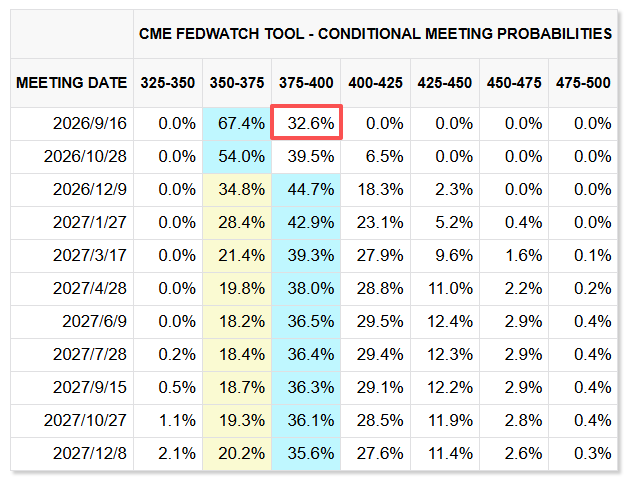
The tension is whether the minutes read as an "expired hawkish document" or a live threat.
- If the text reveals a majority already close to hiking, long-end yields and the dollar could re-price September as a live meeting despite soft data.
- If the majority merely expressed "sympathy" while waiting for one more round of data, the recent repricing toward "hold-then-tail-risk" will hold.
03
Impact on Equity Sentiment
For equities, the dominant transmission channel is the long end.
Citadel's Shah warns that over 55% of core goods prices are still rising, meaning the inflation threat is not extinguished; if the minutes reveal broad hawkish conviction, the 30-year yield's push above 5.28% could extend, pressuring rate-sensitive growth and technology names whose valuations depend on discounted long-duration cash flows. The AI complex — where hyperscalers have ramped debt issuance and capex — is uniquely vulnerable to further long-end repricing.
A balanced hawkish reveal that confirms a divided committee but no clear majority for imminent action would likely be the most equity-friendly outcome, validating Goldman's "full-year on hold" thesis and allowing the recent rotation into defensives and away from crowded AI trades to stabilize.
Conversely, any language that frames energy, tariff and AI-driven inflation as "entrenched" would revive the "bond vigilantes" dynamic Shah describes — investors effectively forcing the Fed's hand by selling long bonds — and compress equity valuations accordingly.
The deeper risk is the communication vacuum itself.
With Warsh refusing to articulate a reaction function, every minutes release becomes a binary event.
As the StreetAccount note observes, several non-voting members have publicly migrated toward hawkish arguments since July; the minutes will test whether those positions were already formed inside the room.
Growth stocks, having already "suffered from long-end yields this week," remain the most exposed.
Gold, trading both the "hike probability retreat" and "fiscal and geopolitical uncertainty," stands to benefit from whichever direction the document pushes ambiguity.