

Event Reminder | Get Ready for 9:00 PM Tonight (Wednesday, July 29th)
S&P 500 index SPX | 0.00 | |
NASDAQ IXIC | 0.00 | |
Dow Jones Industrial Average DJI | 0.00 | |
NASDAQ-100 NDX | 0.00 | |
S&P 500 index GSPC | 0.00 |
01
Event Preview and Background
At 21 p.m. Riyadh time on Wednesday, the Federal Open Market Committee will announce its July rate decision, with Fed Chair Kevin Warsh holding his press conference half an hour later.
The meeting is widely described as the most unpredictable Fed decision in years.
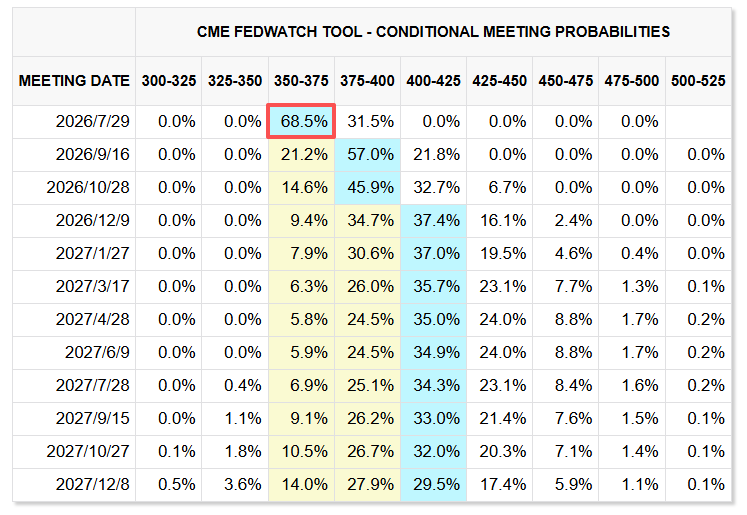
Markets broadly expect the federal funds target range to stay at 3.5%–3.75%, but the probability of a 25bp hike has climbed to around one-third — CME FedWatch puts hold at 68.5% and hike at 31.5% — up sharply from 13% a week ago.
The uncertainty stems from Warsh's deliberate dismantling of forward guidance.
Since taking office in May, he has refused to telegraph rate paths, skipped submitting his own dot plot, and cut the June post-meeting statement to roughly 130 words.
This "silence revolution" has left markets without their traditional compass.
Federal funds futures open interest exploded to a record 967,136 contracts on Monday, exceeding the previous high set in October 2024, as traders rush to hedge an unexpected hike.
02
Expectations and How to Read
The base case, endorsed by JPMorgan and most Street strategists, is a hold coupled with a hawkish tone — assigned a 50% probability by JPMorgan's Market Intelligence desk. The bank sees a 28% chance of a dovish hold, a 20% chance of a 25bp hike, and just 1% each for a 50bp hike or a cut.
The key variable is the number of dissents.
Governors Waller and Cook have signaled readiness to tighten if inflation stalls; among voters, Dallas Fed President Lorie Logan has argued for moderately higher rates to balance risks, while Cleveland's Beth Hammack has explicitly said the Fed may need to consider a hike.
JPMorgan expects at least two hawkish dissents — Hammack and Logan — with the possibility of 2–4 dissenting votes. If the actual tally exceeds two, equity and bond markets could react negatively, reading it as a signal that a hike is imminent.
- Citadel Securities, managing roughly USD 67 billion in assets, has gone further, publicly calling for a 25bp hike.
- Macro strategist Frank Flight argues that acting in July rather than September would "formally declare the end of the forward-guidance era" and cement the Fed's independence.
- Wrightson ICAP's Lou Crandall sees no reason not to hike;
- PGIM's Robert Tipp warns that delaying now only raises the odds of a 50bp move in September.
- Bond-market veteran Harley Bassman even advocates a 50bp hike to demonstrate that the new chair won't be beholden to President Trump's calls for lower rates.
The statement language will be scrutinized for any shift from June's bare-bones version.

Morgan Stanley expects minimal changes — reaffirming the "ample reserves" regime, describing economic activity as expanding at a solid pace "despite elevated uncertainty," and characterizing unemployment as little changed and inflation as "still somewhat elevated."
Warsh's own explanation will be decisive.
If he justifies a hold by pointing to June's cooling data while keeping the door open for September, markets will likely interpret it as a "hawkish pause" — precisely the base case.
If he surprises with a hike, the rationale matters enormously: framing it as a response to the Fed's prolonged failure to hit its 2% target would be read as the opening of a tightening cycle, potentially easing long-end Treasury yields as the market concludes the Fed is finally serious about inflation.
A poorly explained hike, in the words of Bank of America economist Stephen Juneau, risks market chaos, with investors questioning "why they chose to hike now in the context of inflation data that has already slowed."
03
Impact on Equity Sentiment
Equity markets are bracing for turbulence.
JPMorgan's scenario map is explicit:
- a hawkish hold (50% probability) would leave the S&P 500 somewhere between +0.25% and -0.5%;
- a dovish hold (28%) would lift it 0.5%–1%;
- a 25bp hike (20%) would drive the S&P down 1.5%–2%, with the Nasdaq 100 potentially doubling that loss as investors rotate away from momentum and AI names — though the Russell 2000 might prove relatively resilient.
- A 50bp hike would push the S&P down 2%–4%.
The vulnerability is concentrated in high-valuation technology and AI-linked stocks.
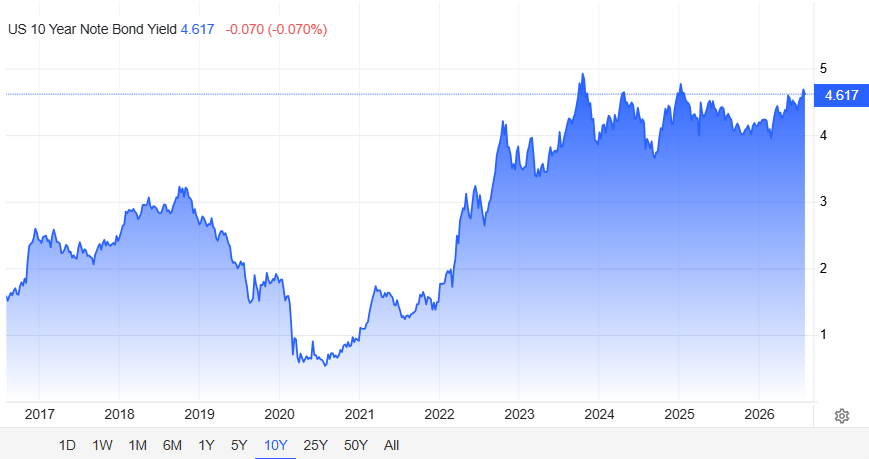
The 10-year Treasury yield has pierced 4.7%, its highest since early 2025, and JPMorgan warns that a further push above 4.8% would intensify pressure on rate-sensitive equities.
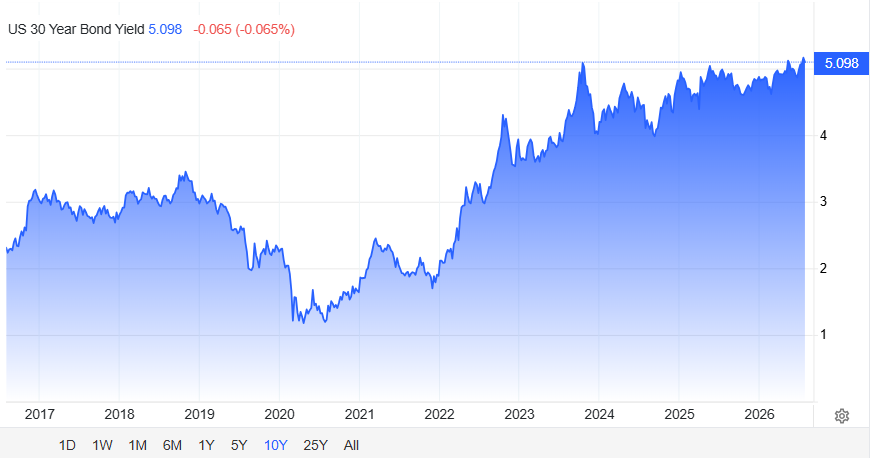
The 30-year yield sits above 5%, and US 30-year fixed mortgage rates have reached 6.58%, the highest since August 2025. Higher discount rates directly compress the valuations of growth stocks that depend on long-duration earnings.
Compounding the rate risk, mega-cap tech earnings are landing simultaneously with the decision, adding a second layer of volatility. Options markets are pricing roughly 0.78% single-day S&P 500 movement for July 29 expiries.

04
What's The Deeper Concern?
The deeper concern is that a hawkish hold — the most likely outcome — keeps the sword of Damocles hanging over risk assets.
BIS warned this week that AI is simultaneously boosting demand and supply, "blurring cyclical signals" and making it harder for central banks to read inflation.
This uncertainty could force Warsh to maintain a restrictive bias even longer.
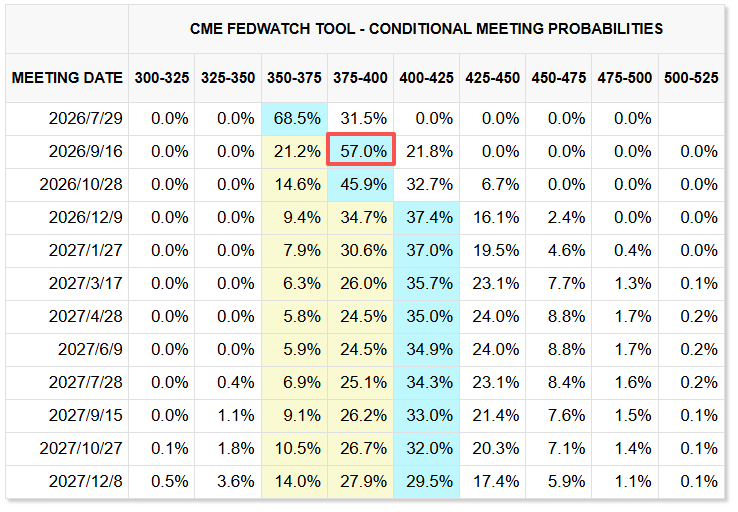
As long as the Fed refuses to provide a clear reaction function and the market continues to price a meaningful chance of September action — CME shows a 56.4% probability of at least one 25bp hike by September — equity valuations will struggle to expand.
The compression spring is wound tight; tonight's decision, and more importantly Warsh's words, will determine whether it releases upward or snaps downward.