

From $120 to $500 Million: How Blair Hull Turned Blackjack Card Counting into a Quantitative Trading Magic
Apple Inc. AAPL | 0.00 | |
PowerShares QQQ Trust,Series 1 QQQ | 0.00 | |
Ultrapro QQQ Proshares TQQQ | 0.00 | |
Microsoft Corporation MSFT | 0.00 | |
SAUDI ARAMCO 2222.SA | 0.00 |

Blair Hull, like many who started in gambling in the early 1970s, successfully transformed his skills into a remarkable investment and trading career, amassing over $500 million in wealth from humble beginnings.
As one of the most successful options traders in history, Hull achieved an average annualized return of about 100% at the peak of his career.
Hull entered the world of probability and betting after reading "Beat The Dealer" by Ed Thorp, a legendary figure in both trading and blackjack.
Blackjack, also known as 21, is a popular card game where the goal is to have a hand value closer to 21 than the dealer's without exceeding 21. Number cards (2–10) are worth their face value, face cards (J, Q, K) are worth 10, and an Ace can be worth 1 or 11. Players start with two cards and can choose to "hit" (take another card) or "stand" (keep their current hand). If the total exceeds 21, the player "busts" and loses. The dealer must follow specific rules, typically hitting until their hand reaches 17 or higher. Players can also make strategic moves like doubling down (doubling their bet and taking one more card) or splitting (dividing two identical cards into separate hands). The winner is the one closest to 21 without going over.
Starting as a blackjack player, Hull quickly recognized the similarities between gambling and trading—where strategy and discipline outweigh luck. He later shifted his expertise to the options market, founding Hull Trading Company in 1985, and systematically profited from market mispricings using probability theory.
The Life Story of Blair Hull
Blair Hull was born in 1942 in California, in what is now known as Silicon Valley. Coming from a modest, working-class family, Hull did not grow up with wealth. After graduating from high school, he worked at a local cannery to help support his family. During this time, the Vietnam War was escalating, and Hull served in the U.S. Army for six years.
After completing his military service, Hull initially worked as a high school math and physics teacher. However, he soon decided to pursue further education. Like many exceptional gamblers, Hull was highly gifted, particularly in mathematics. He went on to earn an MBA and later completed Harvard University's Owner/President Management (OPM) program.
It was during this period that Hull came across Ed Thorp’s book Beat the Dealer. Fascinated by the concept of a “calculable edge in blackjack” described in the book, Hull began experimenting with and refining his own strategies.
At the age of 29, Hull boarded a bus to Las Vegas with just $120 in his pocket, determined to test his blackjack strategy. He started at tables with betting limits of $1 to $4 and gradually moved up to $5 to $25 stakes.
Hull never viewed blackjack as “gambling.” During his studies, he was introduced to the theories of Nobel laureate and Stanford professor William Sharpe, who defined investment as “sacrificing current consumption for expected future returns.”
This idea deeply resonated with Hull. He believed that as long as he had a viable strategy and a measurable edge, and could execute it with discipline, he was an investor, not a gambler. In blackjack, the goal is to bet only when you have an advantage over the casino. Skilled card counters track the ratio of high cards (aces and 10s) to low cards as they are dealt from the shoe. When the proportion of high cards increases, the player’s odds of winning improve because these cards are more likely to form a blackjack.
From 1971 onward, Hull spent five years actively playing blackjack. By 1974 and 1975, he experienced a pivotal moment in his gambling career—he joined a professional card-counting team. The team was highly organized, and every member had to pass rigorous tests before being accepted.
In team play, roles were clearly defined. Some members were responsible for sitting at the tables and tracking the count of high and low cards. When conditions became favorable, they would signal the “big player,” who would step in to place large bets. This approach allowed the team to increase their wagers without drawing attention, thereby maximizing their advantage more efficiently.
By the end of 1976, the team’s activities were eventually discovered by Las Vegas casinos, and all members were blacklisted. The team’s operations were later chronicled in a now out-of-print book titled The Big Player, which has since become legendary in gambling circles.
From Gambler to Investor
After leaving the casino scene, Blair Hull turned his attention to a place that wouldn't ban him from betting—the stock market.
Using his blackjack winnings, Hull purchased a seat on the Pacific Stock Exchange and began trading. With his strong mathematical background, he became one of the pioneers in using quantitative models to identify and profit from option pricing errors.
In 1985, Hull founded Hull Trading Company. He assembled a forward-thinking team of PhDs, mathematicians, and computer scientists—individuals not typically seen on the trading floor. The company developed automated trading tools and technologies to execute trades in the options and broader markets.
Hull's innovative approach yielded impressive results. In 1999, he sold the company to Goldman Sachs for $531 million.
He then founded another trading firm and continued to manage his own fund using multi-factor models to predict market price movements.
It all began with just $120.

Blair Hull's Trading Strategy Analysis
Here are the core principles employed by Blair Hull in his trading strategy:
#1 Blair Hull on Building a Trading Edge
In Jack Schwager's renowned book "The New Market Wizards," Hull explains his understanding of "market edge":
“In the basic rules of blackjack, the casino has a slight edge. However, if many small cards have been dealt—meaning the deck has more tens and aces left—the odds tilt in the player's favor, offering about a 1% to 2% edge. I knew that if I kept betting when I had the advantage, I would eventually win. Following Thorp's advice, I started with $120 and bet $1 to $4 each time. Two years later, I had made about $10,000. Whether you’re playing blackjack or trading, your profitability depends on two factors: whether you have an edge and how often you can exploit that edge.
Team play provides two benefits. Suppose I play alone on weekends with a two-thirds chance of winning. If I pool funds with another person, the total trading days double, increasing the winning probability to three-quarters. The more players, the stronger the edge, and the higher the probability of success.”
A trading edge refers to a unique advantage that increases your probability of success in the market. It might stem from information asymmetry, superior technology or algorithms, or even stronger psychological resilience.
An effective way to find a trading edge is to deeply analyze market inefficiencies and identify exploitable opportunities. Think of the market as an ecosystem of varying participant strengths—your goal is to systematically exploit the weaknesses of less skilled traders for sustained profits.
Once you identify your trading edge, your success hinges on how frequently you can apply this edge in the market. The more you use your edge, the more you earn.
#2 Blair Hull on Risk Management in the Stock Market
Hull's standout performance in trading is also due to his exceptional risk control during drawdown periods—a skill he honed at the blackjack table:
“Having the confidence to stick with the system during extended losses greatly helped me when I entered trading. The same goes for risk control experience. In blackjack, even with an edge, you will face significant losing periods. At those times, you must reduce your bet size to avoid the risk of ruin. If you lose half your capital, you must halve your bets. This is very difficult during severe losses, but it is crucial for survival.”
When executing a mechanical trading system or strategy, you must not stop trading during losing periods. Pausing could cause you to miss opportunities when the market reverses—often the phase that can recover losses and yield greater profits.
Reducing position size during drawdowns is an effective strategy, as it not only protects your account funds but also preserves "psychological capital." As losses diminish and account decline slows, your psychological pressure eases, allowing for more stable execution.
#3 Blair Hull on Managing Emotions in Trading
Hull's core idea in handling emotions is managing one's ego:
“Those who aspire to be recognized as the ‘greatest trader’ often aren’t the greatest traders. Ego interferes with the trading process.”
To succeed in the market, you must remain objective and be willing to admit mistakes. This is often painful, and the pain stems from the ego.
However, if you don’t acknowledge your mistakes, as Ray Dalio says, you will never progress:
“Those who care about their image and fear embarrassment often conceal their ignorance and weaknesses, thus never learning how to truly address these issues, and these weaknesses will continue to hinder them in the future.”
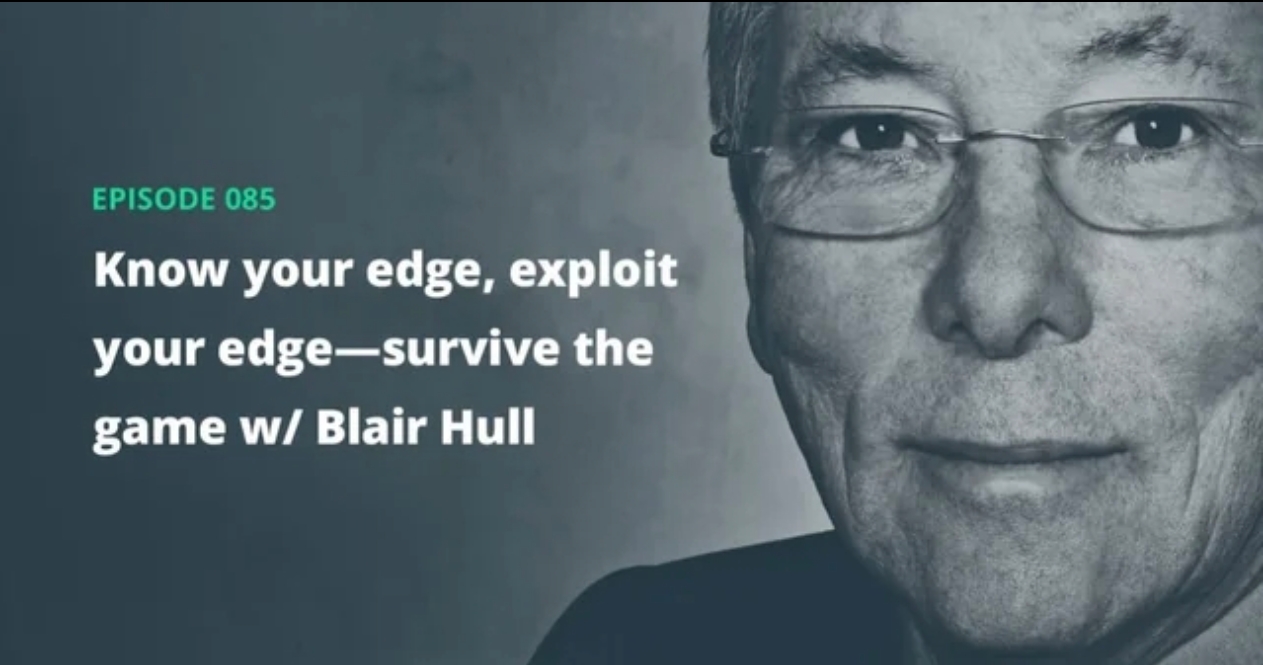
#4 Blair Hull's Options Trading Strategy
Hull’s options strategy centers on identifying options that deviate from their theoretical value.
“Every day, I run a computer program to generate tables of options’ theoretical values, which tell me what each option should be worth at a specific stock price. Essentially, I walk around the trading floor with these tables, and whenever I find an option whose market price doesn’t match the model’s theoretical price, I buy or sell. The real key is relative value. It doesn’t matter which model you use as long as you are consistent across all options pricing.
I focus on the relative prices between options. I first adjust the model’s implied prices to align the at-the-money option’s model price with the market price. For instance, if the model shows an at-the-money option price of 3, but the market trades at 3.5, I would increase the volatility assumption in the model to match the at-the-money option price to 3.5. Once this adjustment is complete, other options’ theoretical prices align with the market. Then, I simply buy undervalued options and sell overvalued ones.”
Market pricing models are far from perfect. Hull’s strategy profits from these imperfections. The principle is that options pricing models assume a normal distribution of prices, but real market prices often have fatter tails, meaning large swings occur more frequently.
This mismatch between models and reality is the advantage that traders can exploit.