

Geopolitical Shock Returns, Treasury Yields Surge—Are Market Alarms Ringing?
Alphabet Inc. Class A GOOGL | 0.00 | |
Alphabet Inc. Class C GOOG | 0.00 | |
Microsoft Corporation MSFT | 0.00 | |
Meta Platforms META | 0.00 | |
Amazon.com, Inc. AMZN | 0.00 |
Subscribe to Our The Trend Catcher Topic / The Value Anchor Topic Topics — Stay Tuned for More Trading Opportunities
Anyone who has glanced at their portfolio lately has probably felt it: the calm is breaking. Volatility is creeping back, and it isn't coming from one place. Geopolitics, the bond market, an earnings season entering its most dangerous stretch, and a Fed decision are all landing at once—each feeding the other. Here's how the pieces fit together.
A Ceasefire in Name, a Powder Keg in Practice
After 13 straight days of airstrikes, President Trump abruptly hit the brakes. According to the media, on July 25 he ordered U.S. forces to hold fire against Iran that day, ending nearly two weeks of daily strikes. Two people familiar with the matter said the pause was meant to create room for diplomacy—and reflected Trump's view that, short of relaunching a full-scale operation, the strikes had largely hit the ceiling of what they could achieve. An Omani delegation has arrived in Tehran to negotiate reopening navigation through the Strait of Hormuz, and the two sides could reach a deal by the weekend.
But investors shouldn't mistake a pause for peace. The conflict—jointly launched by the U.S. and Israel in late February—is now in its fifth month and has already blown past Trump's original expectations. The truce is fragile, the region remains volatile, and the risk of re-escalation hasn't gone away. Crucially, the damage is already in the tape: Brent crude punched above $100 a barrel intraday on Thursday, dragging U.S. gasoline prices up with it. As long as the geopolitical picture stays unresolved, crude's risk premium stays priced in—and oil sits stubbornly at elevated levels.
That's the real problem for markets. Higher oil isn't just a pricier tank of gas; it's the cleanest fuse for reigniting inflation expectations. And the political bill is already coming due: soaring pump prices are darkening Republicans' outlook ahead of November's midterms, with polls showing Democrats leading the generic ballot by 11 points.
An Unhappy Bond Market Compounds the Problem
Here's what's unusual about this episode. In a classic risk-off moment, you'd expect a stampede into Treasuries. Instead, investors sold them. Prices fell, yields jumped—a tell that the market is far more worried about U.S. fiscal health and future inflation than about finding a traditional safe harbor. The 10-year yield is now at its highest since January 2025, and the 30-year has pushed to 5.19%, holding above 5% for longer than at any point since 2007.
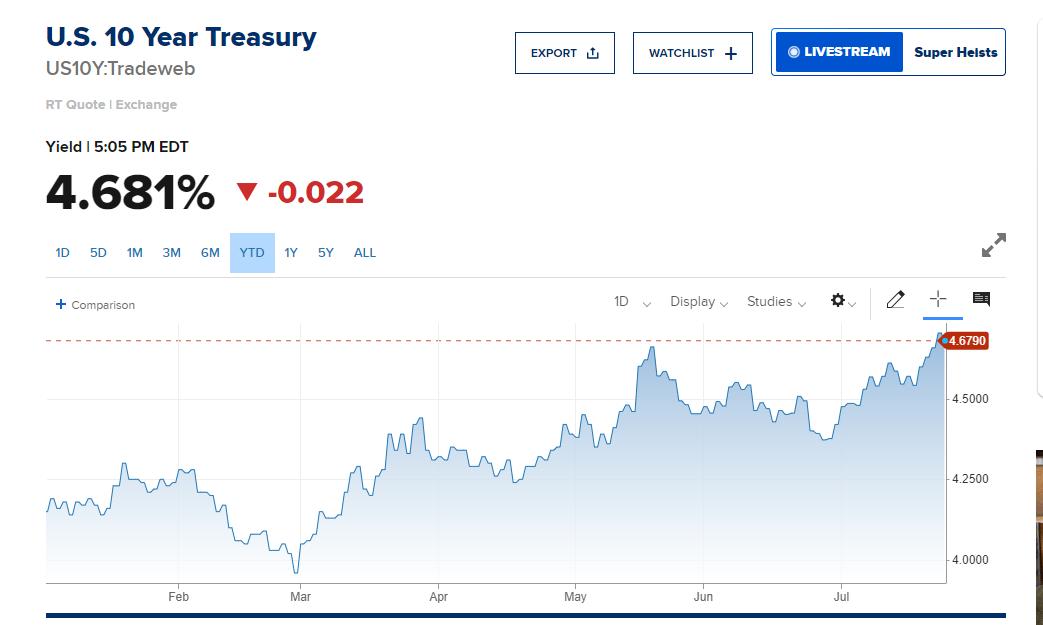
The trouble with sticky energy prices is that they seep into everything—transport, manufacturing, chemicals—quietly undoing the Fed's inflation progress. If oil stays high, don't be surprised to see CPI prints firm up in the months ahead, which would keep rates higher for longer. And because Treasury yields anchor the price of every other asset, the ripple effects are real: richer risk-free returns raise the bar for owning equities (punishing high-multiple growth and tech names most), lift corporate borrowing costs, and—via the mortgage link—press on housing as the long end breaks 5%.
The Next Catalyst: Big Tech's AI Spending and the FOMC
Earnings: does the AI "ghost story" keep going?
Google (Alphabet Inc. Class A(GOOGL.US) / Alphabet Inc. Class C(GOOG.US)) set the tone. Revenue was fine, but the market recoiled at its ballooning AI capex and marked the stock down—the now-familiar fear that AI spending is a hole with no near-term payoff. This week hands the mic to the other hyperscalers: Microsoft Corporation(MSFT.US) and Meta Platforms(META.US) after Wednesday close (July 29), followed by Amazon.com, Inc.(AMZN.US) on Thursday (July 30). Profit growth is almost secondary now; what matters is the capex guidance. If they all echo Google—more spending, slow monetization—large-cap tech, the engine of this entire bull run, could take a beating.
The Fed: how does Warsh split the difference?
Unlike the Powell years, Warsh has signaled he has little appetite for forward guidance, leaning toward a more old-school Fed. Because this isn't a quarter-end meeting, there's no fresh dot plot or SEP—so every word of the statement and press conference will carry weight. Watch three things: his read on the Middle East (the U.S.-Iran conflict and the Strait of Hormuz) and how it feeds energy and inflation; his take on AI-driven cost pressures in tech gear and electricity—notably the first time the Fed has flagged AI investment as an inflation risk; and how he frames the road ahead between holding and a modest hike.
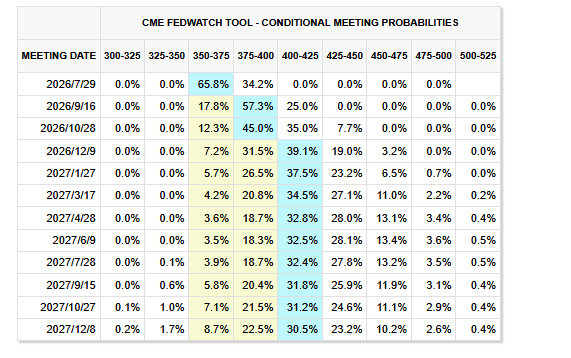
For now, CME data puts a July hold at roughly 66% versus about 33% for a hike—steady is still the base case—but a September hike has crept above 50%. Any hawkish surprise, especially emphasis on AI-fueled inflation or an energy shock, could be the straw that breaks the market's back. A more confident tone on cooling inflation, on the other hand, could hand risk assets some breathing room.
Playing Defense with Options
With so much converging at once—and a Middle East truce that could unravel at any moment—simply sitting long can test anyone's nerves. This is where ETF-S&P 500(SPY.US) and PowerShares QQQ Trust,Series 1(QQQ.US)—the two most liquid options underlyings in U.S. markets—offer an edge many overlook: daily expirations. You can line up an expiry with the exact event you're worried about (the FOMC decision, a specific earnings print), which sharpens both your flexibility and your capital efficiency instead of being boxed into monthly or weekly contracts.
Two ideas fit the moment:
- Protective puts — the straightforward insurance play. Pay the premium, cap your downside, keep your upside. If you only want to cover the FOMC, buy a short-dated put expiring the day after to minimize time decay; to ride out the whole earnings gauntlet, go two to four weeks out.
- Long straddle — for when a big move is coming, but the direction is a coin flip. Buy an at-the-money call and put at the same strike and expiry; a sharp move either way lets the winning leg outrun the loser. You're not betting on direction—you're going long volatility itself.
One caveat: both are premium-paying strategies. Implied vol on both ETFs is roughly neutral today, but if the ceasefire cracks or macro stress builds and volatility climbs, richer IV inflates option time value—and your cost of entry along with it.
The Bottom Line
Add it up: a fragile pause in the Middle East that could reverse without warning, oil still lodged at elevated levels, sticky inflation and record yields straining how the world prices everything, Big Tech's AI bill testing investors' faith, and an FOMC about to set the tone for policy from here. We can't call the next geopolitical move or steer the Fed—but we can control our own exposure. Fitting index positions with a little downside protection, and keeping cash on hand, is how you stay in the game when the ground stays this uncertain.