

Gold Crushes Bitcoin As 2025's True Inflation Hedge
ALBILAD GOLD ETF 9405.SA | 0.00 | |
SPDR Gold GLD | 0.00 |
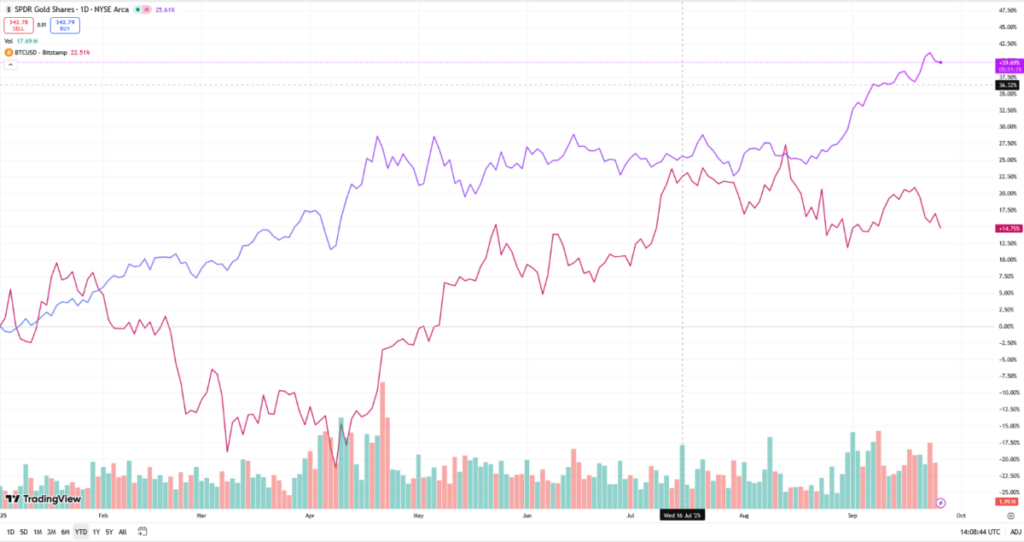
This year should prove once and for all that gold is definitely the preferred hedge against inflation and, for global institutional investors, a better way to play against declining dollar values.
China and India central banks have added gold to their reserves. Other emerging market central banks have also been buyers of gold, not Bitcoin. Investors here that were worried about tariffs pushing inflation well over 3% have also been buyers. And for this reason, the SPDR Gold Trust (NYSE: GLD) exchange traded fund is up over 40% year-to-date while Bitcoin (CRYPTO: BTC) is up 19%. Despite hitting an all time high this year, Bitcoin just does not come close to gold.
"Gold's surge past $3,650 per ounce reflects its enduring appeal as a safe-haven asset," said Ben Caselin, Chief Marketing Officer at VALR, a seven year old cryptocurrency exchange based in Johannesburg.
"Equities are riding the wave of robust tech earnings and anticipated liquidity boosts. Bitcoin, meanwhile, struggles to break free from its $115,000 range, weighed down by cautious market sentiment and capital rotation toward altcoins," Caselin said about why Bitcoin trails gold at a time when the market is still inflation-wary.
Gold is trusted more as "the stable hand" in managing price risks. Bitcoin has been around for less than 20 years and, arguably, has only been somewhat of a serious investment vehicle for the last 10. Only in recent years has Bitcoin been called "digital gold," thanks to the predetermined supply of 21 million coins and independence from central government control.
Most people felt the serious impacts of inflation during the pandemic, with government spending and record money printing by the Federal Reserve leading to 40-year high inflation levels of more than 9%, even higher for some items. Inflation has since fallen to about 2.7% over the last 12 months, but this is compounded on top of the 9%-plus from previous years, meaning prices have gone in one direction – skyward. Inflation chips away at the value of savings and low interest yielding bonds. That's why investors have historically purchased gold.
"Bitcoin's long-term thesis as a store of value remains compelling," said Caselin. "Its 10-year compound annual growth rate of 85% dwarfs gold's 11%, signaling its potential to outpace traditional assets over time," he said.
Bitcoin may have done better than gold over a 10-year horizon, but in the high inflation pandemic years, Bitcoin prices fell hard. During the 2022 inflation spike, gold prices rose, and Bitcoin dropped over 70% from its late-2021 peak.
Areas Where Bitcoin Might Gain Ground
Bitcoin isn't being ignored; there are arguments and signs that it could become more viable as part of an inflation‐hedging strategy. Rick Rieder, Chief Investment Officer of Global Fixed Income at BlackRock, said this month on CNBC that like gold, Bitcoin was a good hedge against currency depreciation.
- Its fixed supply (21 million cap) is often emphasized as fundamentally anti-inflationary vs fiat.
- Digital nature, ease of cross-border transfer, rising institutional demand, ETFs /derivatives of cryptocurrencies are improving its accessibility and legitimacy.
- In some academic work, inflation expectation shocks do lead to positive response in Bitcoin prices. That suggests at least under certain macro regimes Bitcoin may perform well as a hedge.
Gold was once the standard store of value, but it was difficult to transfer, which created the need for trusted institutions to hold it and issue gold-backed notes.
"That system evolved into paper money and eventually fiat currency once the gold standard was abandoned. Over time, the mismanagement of assets by those so-called trusted institutions created demand for something different," said Bryan Trepanier, Founder and President of On Demand Trading, a digital assets trade manager.
"Bitcoin emerged as that alternative, governed by mathematical algorithms rather than people or political agendas," Trepanier said. Its limited supply and ease of transfer make it a modern successor to gold."
Bitcoin's price volatility is what scares pro and retail investors away from it as a gold substitute.
But government spending, high debt, and persistent inflation being piled on top of record high inflation of three years ago is forcing investors to rethink hedging strategies beyond gold, said Lingling Jiang, Partner at Falcon Finance in Hong Kong. Falcon Finance is a DeFi protocol project that launched this year. It is focused on synthetic dollar creation, yield-bearing "stablecoins" (USDf) and staking.
"Bitcoin, while volatile in the short run, has acted more like gold over cycles: scarce, uncorrelated, and appealing in inflationary periods," Jiang said.
The Other Crypto Golds
Jiang said serious cryptocurrency investors that are using it as a hedge are not really focused on Bitcoin.
She names stablecoins and tokenized Treasuries as a favorite, when they are backed and audited. She said these coins function more like interest rate paying money market funds on a block chain. "The yield comes from traditional assets like government bonds, but with the added benefits of instant settlement and programmable payments," she said. "The important thing is not to lump all of crypto together. Each instrument plays a role. Bitcoin as a long-term inflation hedge, stablecoins and tokenized Treasuries as yield-bearing cash equivalents, and staking assets as infrastructure tied to network growth. Together, they give investors a broader toolkit to navigate uncertainty without relying solely on equities or bonds."
Rieder told CNBC's "Halftime Report" show on Sept. 10 that investors should have no more than 5% of their investments in cryptocurrency.
"Hard assets have to enter the equation," Rieder said, naming gold and Bitcoin. "Gold is a better currency hedge. Bitcoin tends to trade with the Nasdaq. Holding gold over crypto depends on where you are in life and how much risk you want to take."
The Federal Reserve cut interest rates by 25 basis points on Sept. 17. The overnight lending rate is now between 4% and 4.25%. BTC prices have fallen since, going from around $116,000 to $112,000 during intra-day trading at the start of the week on Monday.The Fed's own projections showed some members expect further rate cuts through the end of 2025.
"If the Fed adopts a more accommodating stance, Bitcoin could rally toward $135,000 by the first quarter of 2026," said Caselin. "A slower cutting cycle may push it back to $100,000–$105,000 before a sustained breakout. For now, investors must balance opportunity with caution. Long-term, Bitcoin's structural case remains strong, but strategic risk management is critical as markets await clearer signals from the Fed," he said.
The writer of this article holds Bitcoin through the Grayscale Bitcoin Trust.
Benzinga Disclaimer: This article is from an unpaid external contributor. It does not represent Benzinga’s reporting and has not been edited for content or accuracy.