

Google: Cloud Poised to Accelerate, But Will CapEx Become a Drag Again? How to Trade the Q2 Print
Alphabet Inc. Class C GOOG | 0.00 | |
Alphabet Inc. Class A GOOGL | 0.00 | |
PowerShares QQQ Trust,Series 1 QQQ | 0.00 | |
NVIDIA Corporation NVDA | 0.00 | |
Direxion Shares ETF Trust Direxion Daily GOOGL Bull 2X Shares GGLL | 0.00 |
Alphabet Inc. (Alphabet Inc. Class C(GOOG.US), Alphabet Inc. Class A(GOOGL.US) ) is scheduled to release its financial results after the US market closes on July 22 (Eastern Time). Market consensus projects revenue of $116.88 billion (up 21.21% YoY) and earnings per share (EPS) of $2.89 (up 25.04% YoY) under US-GAAP.
Investors are cautioned that GAAP EPS this quarter is highly susceptible to valuation changes in equity investments. Bank of America notes that Alphabet’s stake in Anthropic could generate a one-time paper gain, potentially pushing GAAP EPS to $8.38—far above the market’s core operational expectation. Since these gains do not improve core cash flows, investors should focus strictly on operating profit, Google Cloud margins, and free cash flow to avoid being misled by superficial EPS growth.

The "Whisper Number" for Cloud
Google Cloud, which now accounts for roughly 18% of the company's total revenue, is facing an increasingly high bar. After posting a 32.9% operating margin and $6.6 billion in profit last quarter, the division's valuation is now heavily tethered to its execution speed.
Although the public consensus for Q2 Cloud growth sits at 65%, recent notes from major financial institutions suggest the true trading hurdle is closer to 70%. Bank of America and Wells Fargo are projecting 70% and 72% growth, respectively, driven by robust enterprise AI demand, the deployment of new data centers, and a massive $462 billion order backlog reported at the end of Q1. Analysts warn that a slight beat above 65% may not be enough to trigger a positive reaction in the stock.
Capex Concerns and the AI ROI
As the artificial intelligence race enters its next phase, the focus is transitioning from capacity building to commercialization. Alphabet’s capital expenditures are a major flashpoint. The company has guided for $180 billion to $190 billion in 2026 capex, but banks like BofA anticipate this could be revised upward to $200 billion due to rising component costs. Furthermore, buy-side estimates for 2027 capex have already soared past $325 billion.
The market's reaction to potential capex hikes will depend entirely on management's ability to clearly articulate the return on investment. Investors are eager to see if Google can emulate its peers by transitioning its AI infrastructure—specifically its custom Tensor Processing Units (TPUs)—from an internal cost center to a revenue-generating asset available for external clients.
Gemini Delays and Market Sentiment
Complicating the narrative is the reported delay of Google's flagship AI model, Gemini 3.5 Pro. While Gemini's web traffic surged an impressive 341% year-over-year in June—affirming strong user interest alongside stable Search traffic—the delay is reportedly tied to the model falling short of internal coding benchmarks. While this won't materially impact Q2 revenue, which relies on existing enterprise contracts and older models, management's handling of this timeline during the earnings call will heavily influence market sentiment regarding Google's broader AI strategy.
Stock Drivers and Options Strategy
Despite a 13% pullback from May highs, Alphabet is not a weak stock, up 12% YTD (outperforming the S&P 500). At ~$351, the stock trades at a 27x forward P/E—down from May but above its 5-year average of 22x, meaning it is not in deep value territory.
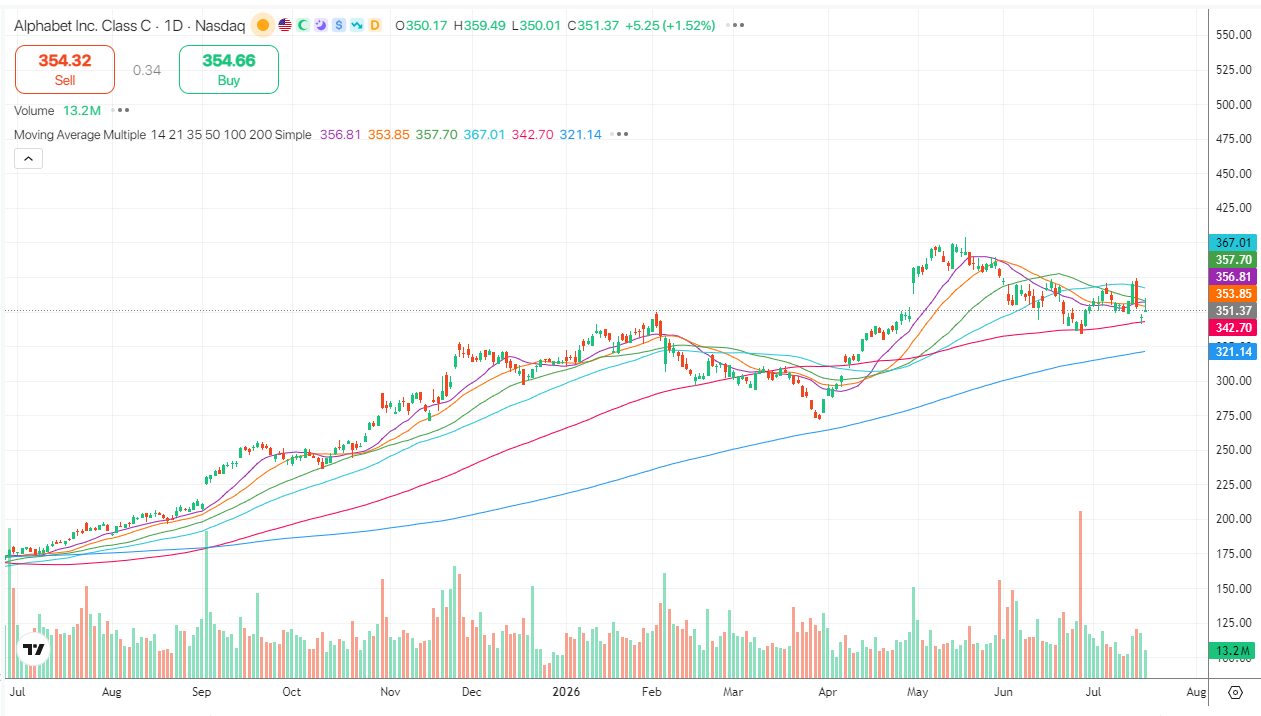
Options markets are pricing in a 5.6%–6% earnings move (an implied range of 331–372). Notably, large options blocks lean moderately bullish. On July 18, a massive Bull Call Spread was executed: buying 3,500 GOOGL 380 Calls and selling 3,500 450 Calls (expiring in 60 days). This limits downside cost while capturing upside up to $450, reflecting institutional belief in a medium-term rebound with capped upside.
For traders navigating earnings:
- Strategy 1: Bull Call Spread (Alternative to long Calls). Best for investors expecting a moderate beat (Cloud >70%, clear Capex ROI). It lowers the cost of entry and mitigates the impact of high implied volatility, though it caps the maximum profit.
- Strategy 2: Collar (For existing shareholders). Best for long-term holders worried about tail risks like unexplained capex hikes or severe Gemini delays. By buying a Put for downside protection and funding it by selling an upside Call, investors cap both extreme losses and outsized gains.
Risk Warning: Options trading and equity investments involve significant risk. Macroeconomic factors, semiconductor sector volatility, and broader market sentiment may heavily influence post-earnings price action.