

How Record AI Revenue, 40% Azure Growth And Massive Capex At Microsoft (MSFT) Have Changed Its Investment Story
Microsoft Corporation MSFT | 0.00 |
- In late April 2026, Microsoft reported fiscal third‑quarter results showing revenue of US$82.89 billion and net income of US$31.78 billion, alongside an AI business now exceeding a US$37 billion annual revenue run rate and Azure growth of 40%.
- At the same time, Microsoft reshaped its capital and AI model relationships by lifting 2026 capex guidance to US$190 billion and amending its OpenAI agreement, trading exclusivity for long-term, royalty‑free IP access and continued revenue sharing.
- We’ll now examine how this combination of very high AI‑driven growth and sharply higher capex reshapes Microsoft’s existing investment narrative.
Invest in the nuclear renaissance through our list of 91 elite nuclear energy infrastructure plays powering the global AI revolution.
Microsoft Investment Narrative Recap
To own Microsoft today, you need to believe that its AI and cloud engines can grow fast enough to justify unprecedented capital spending while preserving profitability. The latest results, with an AI revenue run rate above US$37 billion and 40% Azure growth, support that view, but the lifted 2026 CapEx outlook to US$190 billion sharpens the main near term tension: impressive AI driven momentum versus the risk that cash flow and margins stay under pressure longer than many shareholders may like.
Against that backdrop, the amended OpenAI agreement looks especially important. Microsoft gives up exclusivity but keeps non exclusive, royalty free access to OpenAI IP through 2032 and continues to collect revenue share through 2030. That slightly tilts the near term narrative away from “unique” model access and toward “scale and breadth” of AI offerings, reinforcing the core catalyst of embedding AI across Azure and Microsoft 365 while leaving concentration and returns on huge AI infrastructure spend as key open questions.
Yet even with strong recent numbers, investors should also weigh how quickly those higher CapEx commitments could pressure free cash flow if AI demand or pricing power were to soften...
Microsoft's narrative projects $504.4 billion revenue and $192.9 billion earnings by 2029. This requires 16.6% yearly revenue growth and about a $67.7 billion earnings increase from $125.2 billion today.
Uncover how Microsoft's forecasts yield a $561.93 fair value, a 33% upside to its current price.
Exploring Other Perspectives
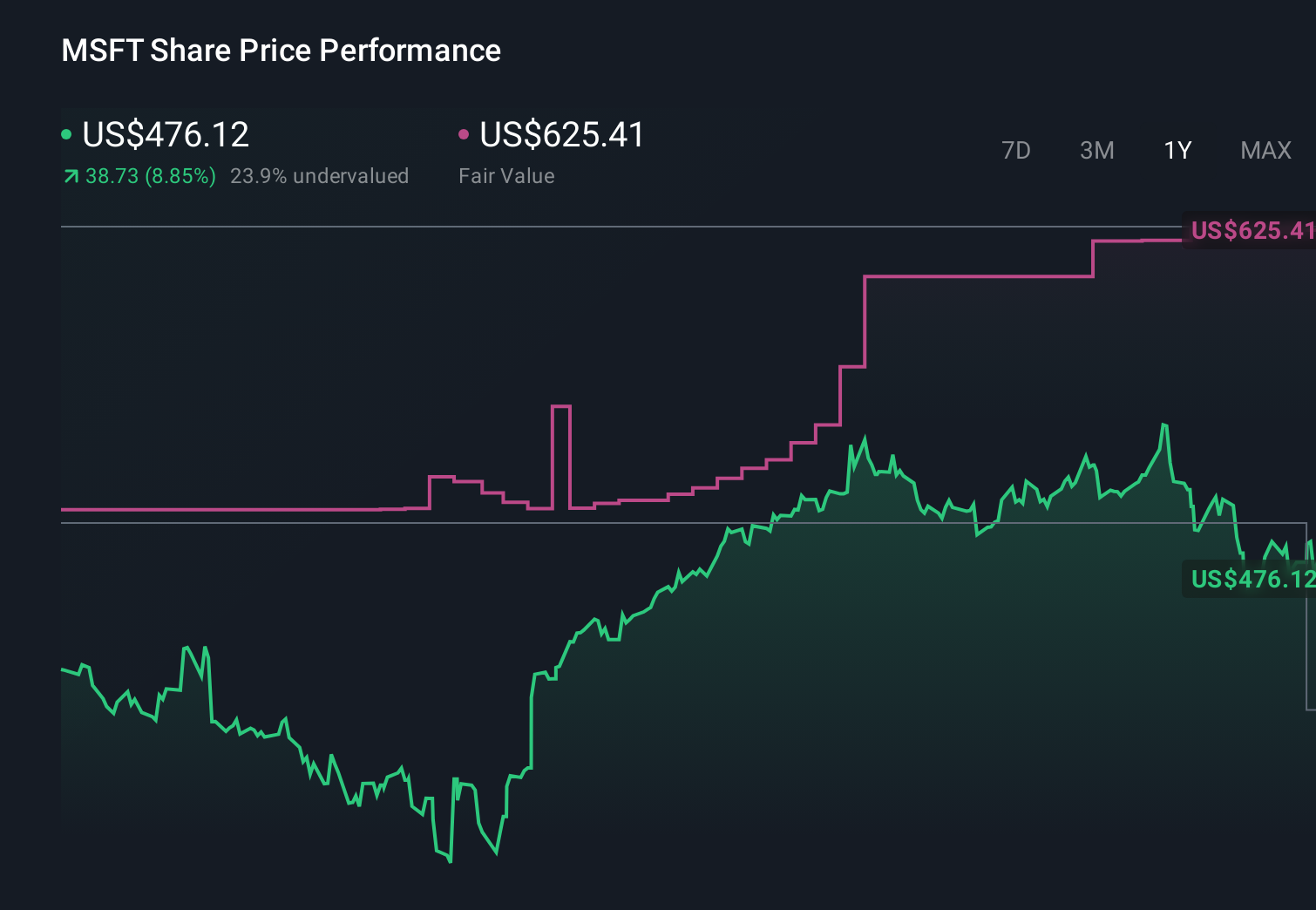
While consensus sees robust growth, the most pessimistic analysts were assuming only about US$456 billion of revenue and US$164 billion of earnings by 2029, so this CapEx surge and OpenAI reset could either validate their caution or push expectations higher, depending on how you think Microsoft’s AI investments and margins evolve from here.
Explore 95 other fair value estimates on Microsoft - why the stock might be worth 14% less than the current price!
Decide For Yourself
Disagree with existing narratives? Extraordinary investment returns rarely come from following the herd, so go with your instincts.
- A great starting point for your Microsoft research is our analysis highlighting 5 key rewards and 1 important warning sign that could impact your investment decision.
- Our free Microsoft research report provides a comprehensive fundamental analysis summarized in a single visual - the Snowflake - making it easy to evaluate Microsoft's overall financial health at a glance.
No Opportunity In Microsoft?
Our daily scans reveal stocks with breakout potential. Don't miss this chance:
- The future of work is here. Discover the 32 top robotics and automation stocks leading the charge in AI-driven automation and industrial transformation.
- The best AI stocks today may lie beyond giants like Nvidia and Microsoft. Find the next big opportunity with these 17 smaller AI-focused companies with strong growth potential through early-stage innovation in machine learning, automation, and data intelligence that could fund your retirement.
- Explore 27 top quantum computing companies leading the revolution in next-gen technology and shaping the future with breakthroughs in quantum algorithms, superconducting qubits, and cutting-edge research.
This article by Simply Wall St is general in nature. We provide commentary based on historical data and analyst forecasts only using an unbiased methodology and our articles are not intended to be financial advice. It does not constitute a recommendation to buy or sell any stock, and does not take account of your objectives, or your financial situation. We aim to bring you long-term focused analysis driven by fundamental data. Note that our analysis may not factor in the latest price-sensitive company announcements or qualitative material. Simply Wall St has no position in any stocks mentioned.