

Is First Watch Restaurant Group (NASDAQ:FWRG) Using Too Much Debt?
First Watch FWRG | 0.00 |
Legendary fund manager Li Lu (who Charlie Munger backed) once said, 'The biggest investment risk is not the volatility of prices, but whether you will suffer a permanent loss of capital.' So it seems the smart money knows that debt - which is usually involved in bankruptcies - is a very important factor, when you assess how risky a company is. Importantly, First Watch Restaurant Group, Inc. (NASDAQ:FWRG) does carry debt. But the real question is whether this debt is making the company risky.
Why Does Debt Bring Risk?
Debt assists a business until the business has trouble paying it off, either with new capital or with free cash flow. Ultimately, if the company can't fulfill its legal obligations to repay debt, shareholders could walk away with nothing. While that is not too common, we often do see indebted companies permanently diluting shareholders because lenders force them to raise capital at a distressed price. Of course, plenty of companies use debt to fund growth, without any negative consequences. The first thing to do when considering how much debt a business uses is to look at its cash and debt together.
What Is First Watch Restaurant Group's Debt?
As you can see below, at the end of December 2024, First Watch Restaurant Group had US$192.5m of debt, up from US$121.3m a year ago. Click the image for more detail. However, because it has a cash reserve of US$33.3m, its net debt is less, at about US$159.1m.
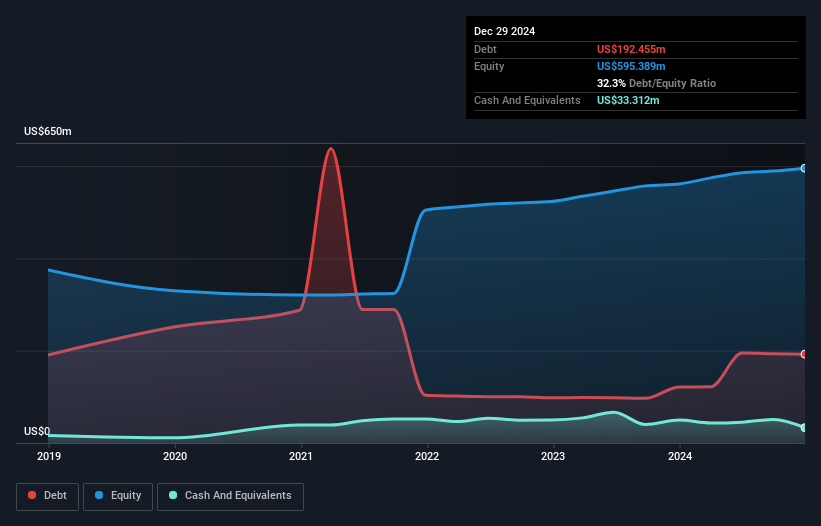
How Healthy Is First Watch Restaurant Group's Balance Sheet?
The latest balance sheet data shows that First Watch Restaurant Group had liabilities of US$138.5m due within a year, and liabilities of US$780.5m falling due after that. Offsetting this, it had US$33.3m in cash and US$7.24m in receivables that were due within 12 months. So it has liabilities totalling US$878.4m more than its cash and near-term receivables, combined.
This is a mountain of leverage relative to its market capitalization of US$1.09b. This suggests shareholders would be heavily diluted if the company needed to shore up its balance sheet in a hurry.
We measure a company's debt load relative to its earnings power by looking at its net debt divided by its earnings before interest, tax, depreciation, and amortization (EBITDA) and by calculating how easily its earnings before interest and tax (EBIT) cover its interest expense (interest cover). This way, we consider both the absolute quantum of the debt, as well as the interest rates paid on it.
First Watch Restaurant Group has net debt worth 1.6 times EBITDA, which isn't too much, but its interest cover looks a bit on the low side, with EBIT at only 3.5 times the interest expense. In large part that's due to the company's significant depreciation and amortisation charges, which arguably mean its EBITDA is a very generous measure of earnings, and its debt may be more of a burden than it first appears. Sadly, First Watch Restaurant Group's EBIT actually dropped 7.6% in the last year. If that earnings trend continues then its debt load will grow heavy like the heart of a polar bear watching its sole cub. The balance sheet is clearly the area to focus on when you are analysing debt. But ultimately the future profitability of the business will decide if First Watch Restaurant Group can strengthen its balance sheet over time.
Finally, while the tax-man may adore accounting profits, lenders only accept cold hard cash. So we clearly need to look at whether that EBIT is leading to corresponding free cash flow. Over the last three years, First Watch Restaurant Group recorded negative free cash flow, in total. Debt is far more risky for companies with unreliable free cash flow, so shareholders should be hoping that the past expenditure will produce free cash flow in the future.
Our View
We'd go so far as to say First Watch Restaurant Group's conversion of EBIT to free cash flow was disappointing. But at least it's pretty decent at managing its debt, based on its EBITDA,; that's encouraging. Looking at the bigger picture, it seems clear to us that First Watch Restaurant Group's use of debt is creating risks for the company. If all goes well, that should boost returns, but on the flip side, the risk of permanent capital loss is elevated by the debt. When analysing debt levels, the balance sheet is the obvious place to start. However, not all investment risk resides within the balance sheet - far from it.
If, after all that, you're more interested in a fast growing company with a rock-solid balance sheet, then check out our list of net cash growth stocks without delay.
This article by Simply Wall St is general in nature. We provide commentary based on historical data and analyst forecasts only using an unbiased methodology and our articles are not intended to be financial advice. It does not constitute a recommendation to buy or sell any stock, and does not take account of your objectives, or your financial situation. We aim to bring you long-term focused analysis driven by fundamental data. Note that our analysis may not factor in the latest price-sensitive company announcements or qualitative material. Simply Wall St has no position in any stocks mentioned.