

Is It Too Late To Consider Citigroup (C) After 51% One Year Share Price Jump?
Citigroup Inc. C | 0.00 |
- If you are wondering whether Citigroup still offers value at its current share price, or if most of the potential upside has already been reflected, this article breaks down what the numbers are really saying about the stock.
- Citigroup's share price recently closed at US$116.19, with returns of 0.6% over 7 days, 1.2% over 30 days, a 2.1% decline year to date and 51.1% over the past year, plus 150.9% over 3 years and 98.3% over 5 years for longer term context.
- Recent headlines around Citigroup have focused on its position among large U.S. banks, regulatory scrutiny across the sector and ongoing discussions about capital requirements and balance sheet resilience. This mix of regulatory focus and sector wide sentiment helps explain why investors are paying close attention to how the current share price lines up against underlying value.
- On our framework, Citigroup scores 3 out of 6 on valuation checks for potential undervaluation, giving it a value score of 3. Next we will look at what traditional valuation methods say about that score, before finishing with a different way to think about valuation that many investors overlook.
Approach 1: Citigroup Excess Returns Analysis
The Excess Returns model looks at how much value a company can create over and above the return that shareholders require. It starts with the book value of equity and then asks whether projected earnings justify a premium or discount to that equity base.
For Citigroup, the model uses a Book Value of US$110.01 per share and a Stable EPS of US$12.50 per share, based on weighted future Return on Equity estimates from 13 analysts. The implied Cost of Equity is US$10.38 per share, so the Excess Return is US$2.13 per share, meaning projected earnings are higher than the required return on shareholder capital.
The model also factors in a Stable Book Value of US$128.90 per share, guided by estimates from 10 analysts, alongside an average Return on Equity of 9.70%. Putting these inputs together, the Excess Returns valuation points to an intrinsic value of about US$174.73 per share.
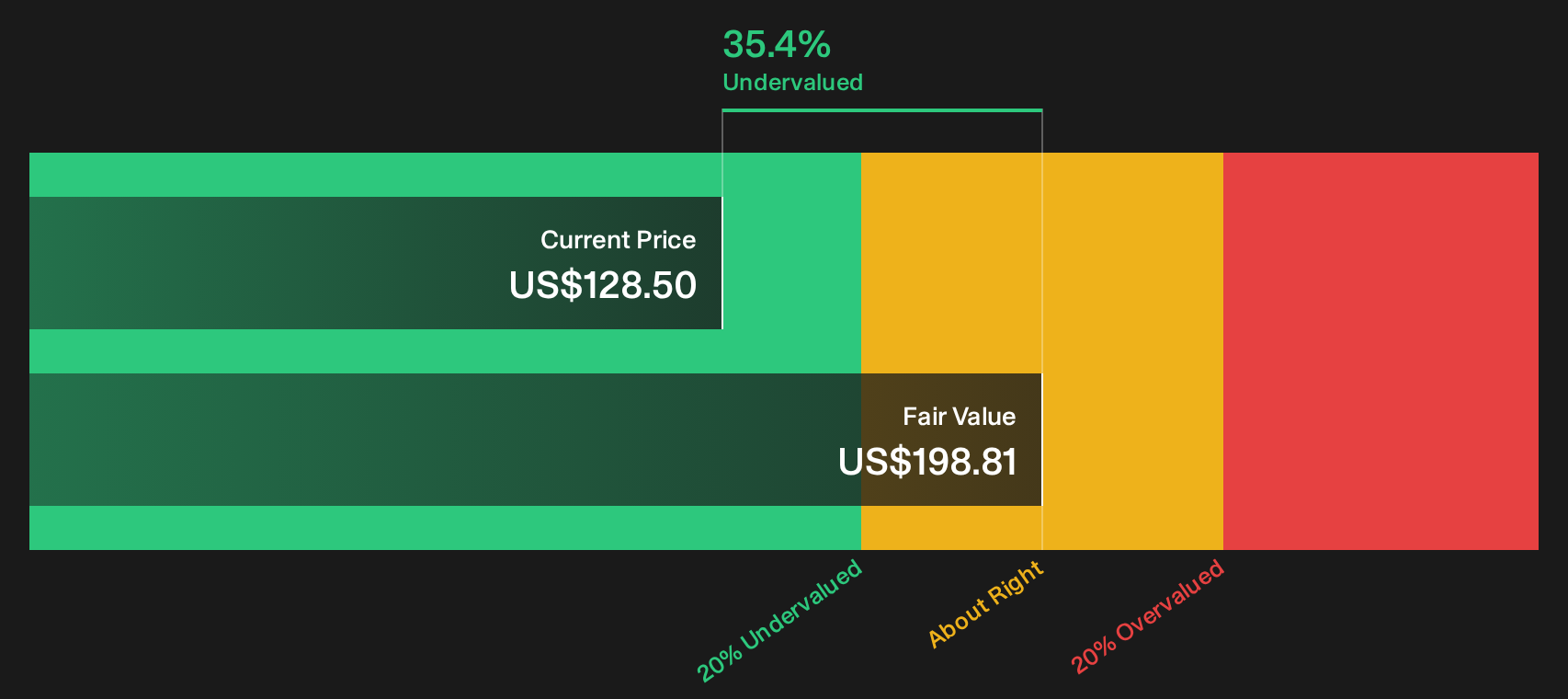
Compared with the recent share price of US$116.19, this suggests Citigroup trades at a 33.5% discount, which screens as materially undervalued on this framework.
Result: UNDERVALUED
Our Excess Returns analysis suggests Citigroup is undervalued by 33.5%. Track this in your watchlist or portfolio, or discover 54 more high quality undervalued stocks.
Approach 2: Citigroup Price vs Earnings
The P/E ratio is a common way to value profitable companies because it links what you pay for each share directly to the earnings that each share generates. It gives you a quick sense of how much the market is willing to pay today for one unit of current earnings.
What counts as a normal or fair P/E depends on what investors expect for future growth and how much risk they see in those earnings. Higher expected growth or lower perceived risk can justify a higher P/E, while lower growth or higher risk usually point to a lower multiple.
Citigroup currently trades on a P/E of 15.61x. That sits above the Banks industry average of about 11.75x and above the peer group average of 13.04x. Simply Wall St’s Fair Ratio for Citigroup is 17.19x, which is its proprietary view of what the P/E could be given factors such as earnings growth, profit margins, industry, market cap and company specific risks.
This Fair Ratio can be more informative than a simple comparison with peers or the industry because it adjusts for those company level characteristics instead of assuming all banks should trade at similar multiples. Compared with the current 15.61x P/E, the 17.19x Fair Ratio points to Citigroup trading below that fair multiple on this framework.
Result: UNDERVALUED

P/E ratios tell one story, but what if the real opportunity lies elsewhere? Start investing in legacies, not executives. Discover our 19 top founder-led companies.
Upgrade Your Decision Making: Choose your Citigroup Narrative
Earlier we mentioned that there is an even better way to understand valuation. On Simply Wall St you can use Narratives, where you connect your view of Citigroup’s story to your own forecast for revenue, earnings and margins, then see the Fair Value that falls out of those assumptions and compare it to the current price. Narratives are available on the Community page, used by millions of investors, and they update automatically when new information such as news, earnings or capital actions comes in. For Citigroup right now, one investor on the platform ties their story to a Fair Value around US$233 per share with assumptions like 6% revenue growth, a 34% profit margin and a future P/E of 14x. Another investor uses a more cautious story that leads to a Fair Value near US$75.85 based on 5.8% revenue growth, a 16.2% margin and a future P/E of 12.4x.
For Citigroup, we will make it really easy for you with previews of two leading Citigroup Narratives:
Each one takes the same company facts and runs with a different story, which you can compare against your own view before you make any decisions.
Fair Value: US$233.04 per share
Implied undervaluation vs last close: 50.1% below this fair value
Revenue growth assumption: 6%
- The author expects the GENIUS Act and Citi Token Services to support bank issued stablecoins and cross border payments, with Citi handling compliance and reporting complexity for clients.
- They highlight strong contributions from Markets, Wealth, Investment Banking, Services and U.S. Personal Banking, alongside an emphasis on capital efficiency and a multi billion dollar buyback plan.
- The narrative leans on ongoing transformation, automation and AI to support higher returns on tangible equity, while also pointing to dividends and buybacks as a meaningful part of total shareholder yield.
Fair Value: US$114.36 per share
Implied overvaluation vs last close: 1.6% above this fair value
Revenue growth assumption: 8.25%
- This author focuses on how simplification and automation could help expenses and margins, but sets expectations using a more cautious group of analyst assumptions.
- They point out that buybacks and wealth management expansion may support earnings per share, while heavy transformation spending, regulation and credit risk in cards could weigh on net income.
- The fair value of US$114.36 reflects a view that future earnings, margins and the assumed future P/E multiple leave less upside at current prices. Readers are encouraged to test those inputs against their own expectations.
If you want to see how other investors are joining the discussion around Citigroup, and build a version that reflects your own expectations, Curious how numbers become stories that shape markets? Explore Community Narratives.
Do you think there's more to the story for Citigroup? Head over to our Community to see what others are saying!

This article by Simply Wall St is general in nature. We provide commentary based on historical data and analyst forecasts only using an unbiased methodology and our articles are not intended to be financial advice. It does not constitute a recommendation to buy or sell any stock, and does not take account of your objectives, or your financial situation. We aim to bring you long-term focused analysis driven by fundamental data. Note that our analysis may not factor in the latest price-sensitive company announcements or qualitative material. Simply Wall St has no position in any stocks mentioned.