

Is It Too Late To Consider KKR (KKR) After Its Recent Share Price Recovery?
KKR & Co KKR | 0.00 |
- Wondering if KKR at around US$104 per share offers good value or just headline noise? This article breaks down what that price could mean for you as an investor.
- The stock has returned 2.7% over the past week and 12.8% over the last 30 days, while year to date it is down 19.1% and the 1 year return sits at an 8.3% decline, against a 3 year return of 115.1% and a 5 year return of 88.8%.
- Recent coverage has focused on KKR's position as a major alternative asset manager and its role in large scale deals. This helps explain why sentiment around the stock can shift quickly. Market commentary has also highlighted how changes in risk appetite across capital markets are influencing interest in firms like KKR that are active in private equity and credit.
- Right now, KKR has a valuation score of 1 out of 6. The key question is what different valuation approaches say about that price tag, and whether there is an even more complete way to think about value that will be covered at the end of this article.
KKR scores just 1/6 on our valuation checks. See what other red flags we found in the full valuation breakdown.
Approach 1: KKR Excess Returns Analysis
The Excess Returns model looks at how much profit a company can generate above the return that equity investors typically require, then capitalizes those “extra” earnings into an estimated value per share.
For KKR, the inputs are grounded in its balance sheet and earnings profile. Book value sits at $31.81 per share, while stable earnings are estimated at $7.29 per share, based on weighted future Return on Equity estimates from 7 analysts. The cost of equity is $6.10 per share, so the model points to an excess return of $1.19 per share. That is supported by an average Return on Equity of 10.96% and a stable book value assumption of $66.47 per share, sourced from 4 analysts.
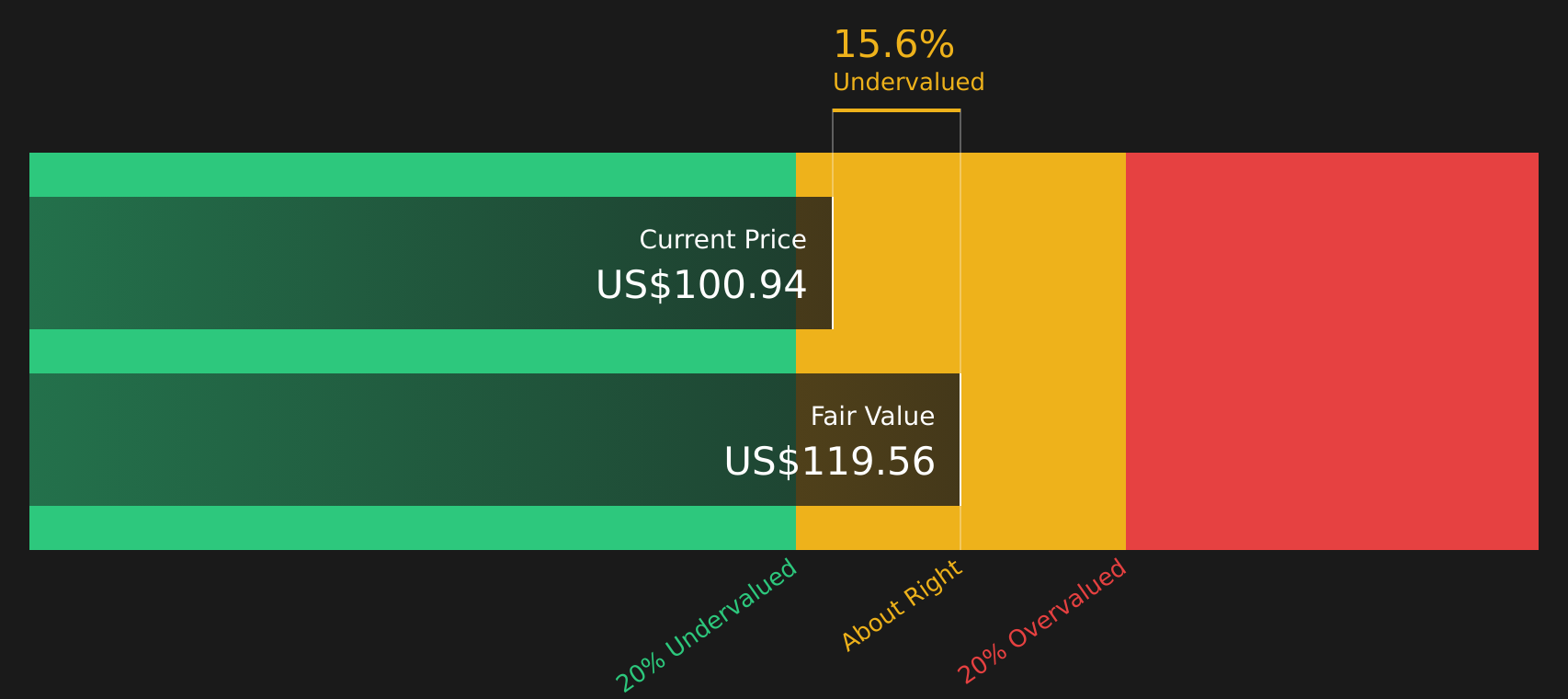
Running these figures through the Excess Returns framework produces an intrinsic value of about $87.04 per share. Against a market price around $104, this implies the shares trade at roughly a 19.9% premium to this model’s estimate, so the stock screens as overvalued under this approach.
Result: OVERVALUED
Our Excess Returns analysis suggests KKR may be overvalued by 19.9%. Discover 51 high quality undervalued stocks or create your own screener to find better value opportunities.
Approach 2: KKR Price vs Earnings
For a profitable company like KKR, the P/E ratio is a useful shorthand because it links what you are paying per share to the earnings that support that price. Investors typically accept a higher or lower P/E depending on what they expect for future earnings growth and how risky they perceive those earnings to be.
KKR currently trades on a P/E of 41.56x. That sits close to the broader Capital Markets industry average P/E of 42.43x, but above the peer group average of 30.97x. Simply Wall St also provides a proprietary “Fair Ratio” of 22.75x for KKR, which aims to capture what a more tailored P/E might look like after considering factors such as earnings growth profile, profit margins, industry, market cap and company specific risks.
This Fair Ratio is more targeted than a simple comparison with peers or the industry because it adjusts for differences in growth, risk and profitability rather than assuming that all Capital Markets firms should trade on similar multiples. Comparing KKR’s current P/E of 41.56x with the Fair Ratio of 22.75x indicates that the shares are pricing in a richer earnings multiple than this framework implies.
Result: OVERVALUED

P/E ratios tell one story, but what if the real opportunity lies elsewhere? Start investing in legacies, not executives. Discover our 18 top founder-led companies.
Upgrade Your Decision Making: Choose your KKR Narrative
Earlier it was mentioned that there is an even better way to understand valuation, so Narratives are introduced here as simple stories that you attach to your numbers, where you set out what you think KKR’s future revenue, earnings, margins and fair value should look like, and then link that story to a forecast and a fair value that can be compared with the current share price.
On Simply Wall St’s Community page, Narratives are available as an accessible tool used by millions of investors, helping you see how your view translates into a fair value, how that fair value compares to today’s market price, and therefore whether the stock looks expensive or cheap against your own assumptions rather than anyone else’s.
Narratives are also refreshed when new information such as earnings reports or news arrives, so your fair value and forecast stay aligned with the latest data instead of being fixed to a one off model.
For KKR, one investor might align with a more cautious Narrative that points to a fair value around US$106 per share, while another might lean toward a more optimistic Narrative closer to US$176. By seeing those two ends of the range side by side, you can decide where your own view sits and how that affects your decision to buy, hold or sell.
Do you think there's more to the story for KKR? Head over to our Community to see what others are saying!

This article by Simply Wall St is general in nature. We provide commentary based on historical data and analyst forecasts only using an unbiased methodology and our articles are not intended to be financial advice. It does not constitute a recommendation to buy or sell any stock, and does not take account of your objectives, or your financial situation. We aim to bring you long-term focused analysis driven by fundamental data. Note that our analysis may not factor in the latest price-sensitive company announcements or qualitative material. Simply Wall St has no position in any stocks mentioned.