

Is It Too Late To Consider Nvidia (NVDA) After Massive AI Data Center Momentum?
NVIDIA Corporation NVDA | 198.35 | -0.26% |
- If you are wondering whether NVIDIA's share price still makes sense after all the headlines, this article walks through what the current market price might be implying about the company.
- NVIDIA shares last closed at US$182.81, with returns of a 3.0% decline over the past week, a 1.8% decline over the last month, a 3.2% decline year to date, and a 31.2% gain over the past year, on top of a very large 3 year return and a gain of more than 10x over 5 years.
- Recent news flow has continued to focus on NVIDIA's central role in graphics and compute hardware, especially for data centers and complex AI workloads. Commentators frequently point to these areas when discussing why the stock remains widely followed and closely debated by investors.
- Our valuation checks give NVIDIA a score of 2 out of 6, which suggests some parts of the market's pricing look demanding while others appear more reasonable. Next we will look at how different valuation methods treat the stock and then finish with a framework that can help you put those numbers into a clearer context.
NVIDIA scores just 2/6 on our valuation checks. See what other red flags we found in the full valuation breakdown.
Approach 1: NVIDIA Discounted Cash Flow (DCF) Analysis
A Discounted Cash Flow, or DCF, model estimates what a company might be worth by projecting its future cash flows and then discounting those back to today, using the idea that cash received in the future is worth less than cash in your hand now.
For NVIDIA, the model uses a 2 Stage Free Cash Flow to Equity framework. The latest twelve month free cash flow is around $77.96b. Analysts provide explicit projections out to 2027, and Simply Wall St then extends those cash flows further using its own assumptions. By 2035, the extrapolated free cash flow used in the model is $424.48b, all expressed in US$ terms.
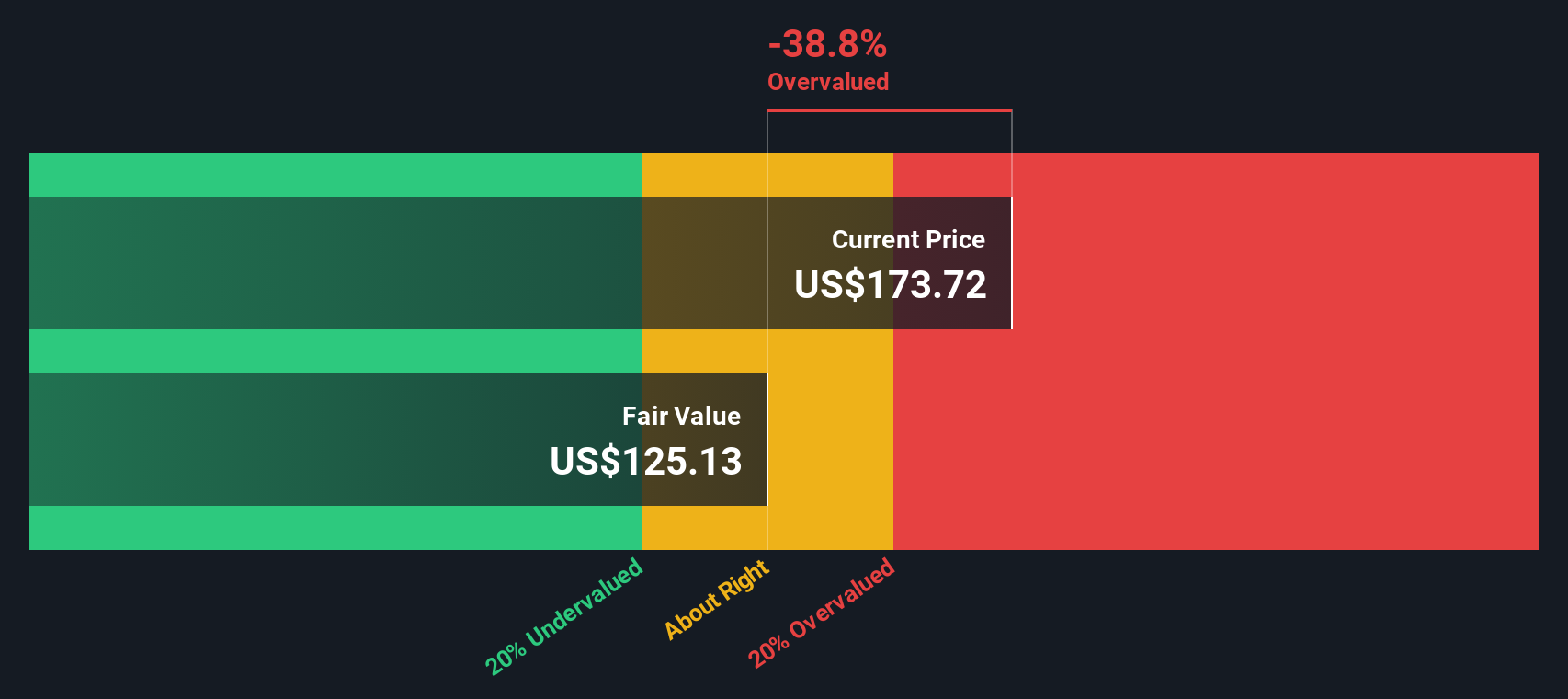
When these projected cash flows are discounted back to today, the DCF output is an estimated intrinsic value of about $160.10 per share, compared with the recent share price of $182.81. That gap implies the stock is around 14.2% overvalued on this measure.
Result: OVERVALUED
Our Discounted Cash Flow (DCF) analysis suggests NVIDIA may be overvalued by 14.2%. Discover 55 high quality undervalued stocks or create your own screener to find better value opportunities.
Approach 2: NVIDIA Price vs Earnings
For a profitable company, the P/E ratio is a useful shorthand because it links what you pay for the stock directly to the earnings it generates today. Investors usually accept a higher P/E if they expect stronger growth or see lower risk in those earnings, and a lower P/E if growth expectations or perceived risks are higher.
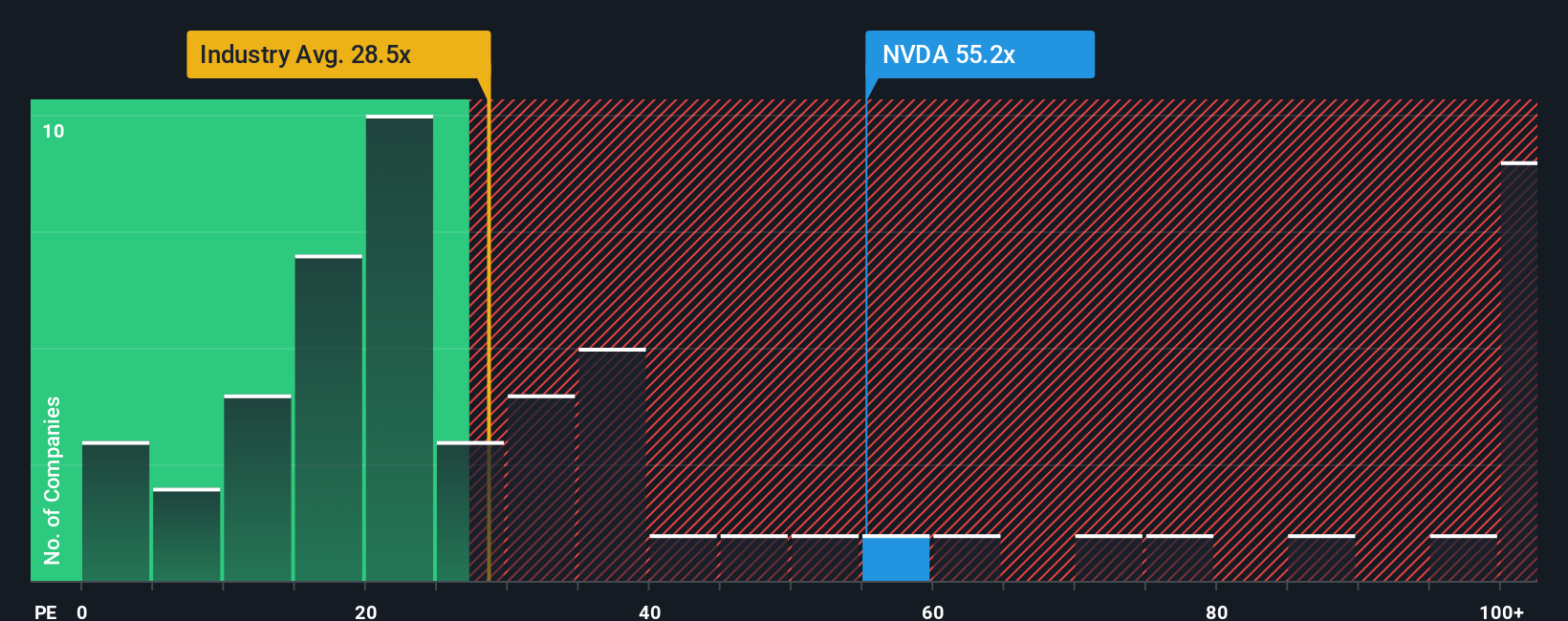
NVIDIA currently trades on a P/E of 44.8x. That sits above the broader semiconductor industry average P/E of 42.1x, while the peer average in its space is a much higher 87.7x. To give more tailored context, Simply Wall St calculates a proprietary “Fair Ratio” for NVIDIA of 57.0x, which is the P/E it might trade on given factors such as its earnings growth profile, industry, profit margins, market cap and risk characteristics.
This Fair Ratio can be more helpful than simple peer or industry comparisons, because it adjusts for company specific features instead of assuming all semiconductor stocks deserve the same multiple. Comparing NVIDIA’s current P/E of 44.8x with the Fair Ratio of 57.0x suggests the shares are pricing in less than what this framework would indicate.
Result: UNDERVALUED
P/E ratios tell one story, but what if the real opportunity lies elsewhere? Start investing in legacies, not executives. Discover our 23 top founder-led companies.
Upgrade Your Decision Making: Choose your NVIDIA Narrative
Earlier we mentioned that there is an even better way to understand valuation, so let us introduce you to Narratives, a simple way to connect your view of NVIDIA’s story with a set of financial estimates and a fair value you can compare with today’s share price.
On Simply Wall St, a Narrative is your own storyline for a company, where you spell out what you think is reasonable for future revenue, earnings and margins. The platform then turns that story into a forecast and a fair value that sits alongside the numbers from other investors and analysts.
This matters because Narratives link three things that often stay disconnected: what you think is happening in the business, how that might flow through to the financials, and what that could mean for a fair value relative to the current price. This can help you decide whether the gap between price and value looks attractive, uninteresting or stretched for your goals.
Narratives on the Simply Wall St Community page update automatically when new data, news or earnings are added to the company’s profile. You are therefore not trying to reconcile a static spreadsheet with a fast moving story, because the fair value attached to each Narrative moves as the inputs change.
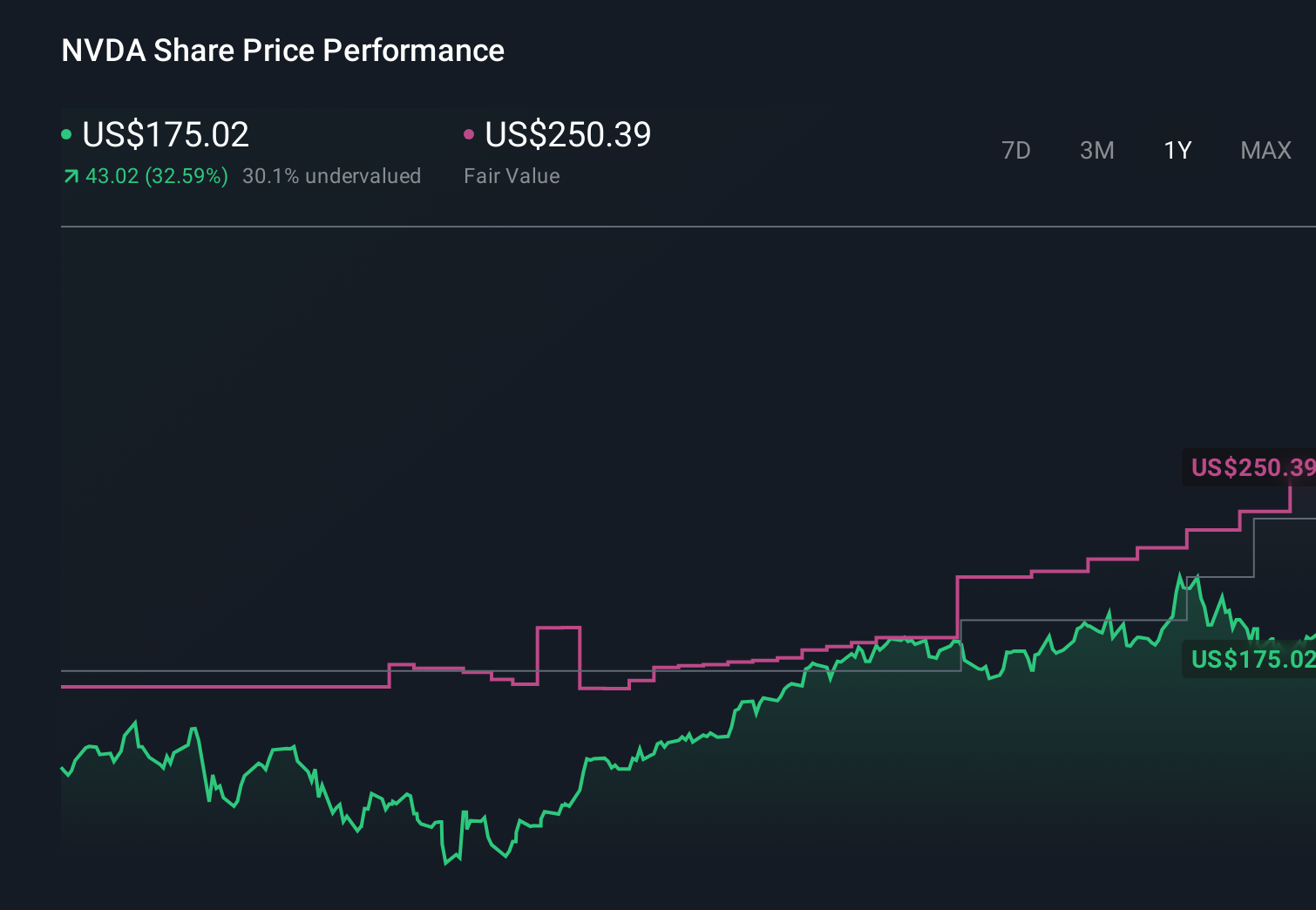
For NVIDIA, for example, one community Narrative currently assumes a fair value around US$67.95 per share while another sits closer to US$346.28. This shows how different investors can look at the same company and, using their own assumptions about growth, margins and risk, arrive at very different but fully quantified views that you can compare to the current market price and to your own thinking.
For NVIDIA, however, we'll make it really easy for you with previews of two leading NVIDIA Narratives:
Both are built on detailed assumptions about future growth, margins and risks, but they land in very different places on what today’s share price might mean.
Fair value in this bullish Narrative: US$253.02 per share
Implied undervaluation vs last close: approximately 27.8%
Assumed annual revenue growth: 30.90%
- Expects a multi year AI infrastructure build out to support sustained demand for NVIDIA’s data center and full stack AI offerings, with a focus on platforms like Blackwell, GB300 and Rubin.
- Assumes expanding margins, supported by high value software ecosystems such as CUDA and TensorRT, recurring software revenue and deep customer lock in across sectors from cloud to automotive and healthcare.
- Flags risks around geopolitics, custom accelerators and ASICs from large cloud customers, supply chain concentration and power or regulatory constraints, but still sees these as manageable within a higher fair value.
Fair value in this bearish Narrative: US$67.95 per share
Implied overvaluation vs last close: approximately 62.6%
Assumed annual revenue growth: 14.40%
- Argues that rapid GPU performance gains and competing chiplet based designs could lead to abundant compute capacity, tighter pricing and lower long run margins, especially as rivals like AMD, Intel and Samsung push cheaper alternatives.
- Sees hyperscalers and large customers increasingly designing their own chips, which could limit NVIDIA’s addressable market, increase cyclicality and reduce pricing power across data center, AI and automotive segments.
- Highlights concerns that long term demand expectations may be too optimistic, with potential for oversupply, slower capex from cloud providers, margin compression and a lower future P/E as the business matures.
Together, these Narratives bracket a wide range of fair values and growth paths. They can be a useful prompt to decide which assumptions about AI demand, competition and margins feel closest to your own view of NVIDIA’s future earnings power and risk profile.
Do you think there's more to the story for NVIDIA? Head over to our Community to see what others are saying!
This article by Simply Wall St is general in nature. We provide commentary based on historical data and analyst forecasts only using an unbiased methodology and our articles are not intended to be financial advice. It does not constitute a recommendation to buy or sell any stock, and does not take account of your objectives, or your financial situation. We aim to bring you long-term focused analysis driven by fundamental data. Note that our analysis may not factor in the latest price-sensitive company announcements or qualitative material. Simply Wall St has no position in any stocks mentioned.