

Is It Too Late To Consider Walmart (WMT) After A 34.8% One Year Share Price Jump?
Walmart Inc. WMT | 0.00 |
- If you are wondering whether Walmart's share price still offers value after a strong run, the key is understanding how its current market price compares to what the business might reasonably be worth.
- At a last close of US$130.20, Walmart's stock has a 1 week return of a 1.3% decline, a 30 day return of 6.3%, a year to date return of 15.5%, a 1 year return of 34.8% and a 3 year return that is described as very large. The question is whether today's price still stacks up against the fundamentals.
- Recent headlines around Walmart have focused on its role as a major US retailer, as investors continue to weigh how its size and market position might support long term performance. This context helps explain why the stock's recent gains and pullbacks are drawing extra attention from investors who care about valuation and risk.
- According to Simply Wall St's valuation checks, Walmart currently scores 0 out of 6 for being undervalued. Next you will see how different valuation approaches assess the stock and then finish with a more rounded way to think about value that goes beyond a single score.
Walmart scores just 0/6 on our valuation checks. See what other red flags we found in the full valuation breakdown.
Approach 1: Walmart Discounted Cash Flow (DCF) Analysis
The Discounted Cash Flow model takes projected future cash flows and discounts them back to today to estimate what the stock could be worth right now. It is essentially asking what a stream of future cash flows is worth in today’s dollars.
For Walmart, the model used is a 2 Stage Free Cash Flow to Equity approach. The latest twelve month free cash flow is reported at about US$16.76b. Simply Wall St then uses analyst estimates where available and extrapolates further out, with projected free cash flow reaching US$39.12b by 2031 according to the model’s ten year projections.
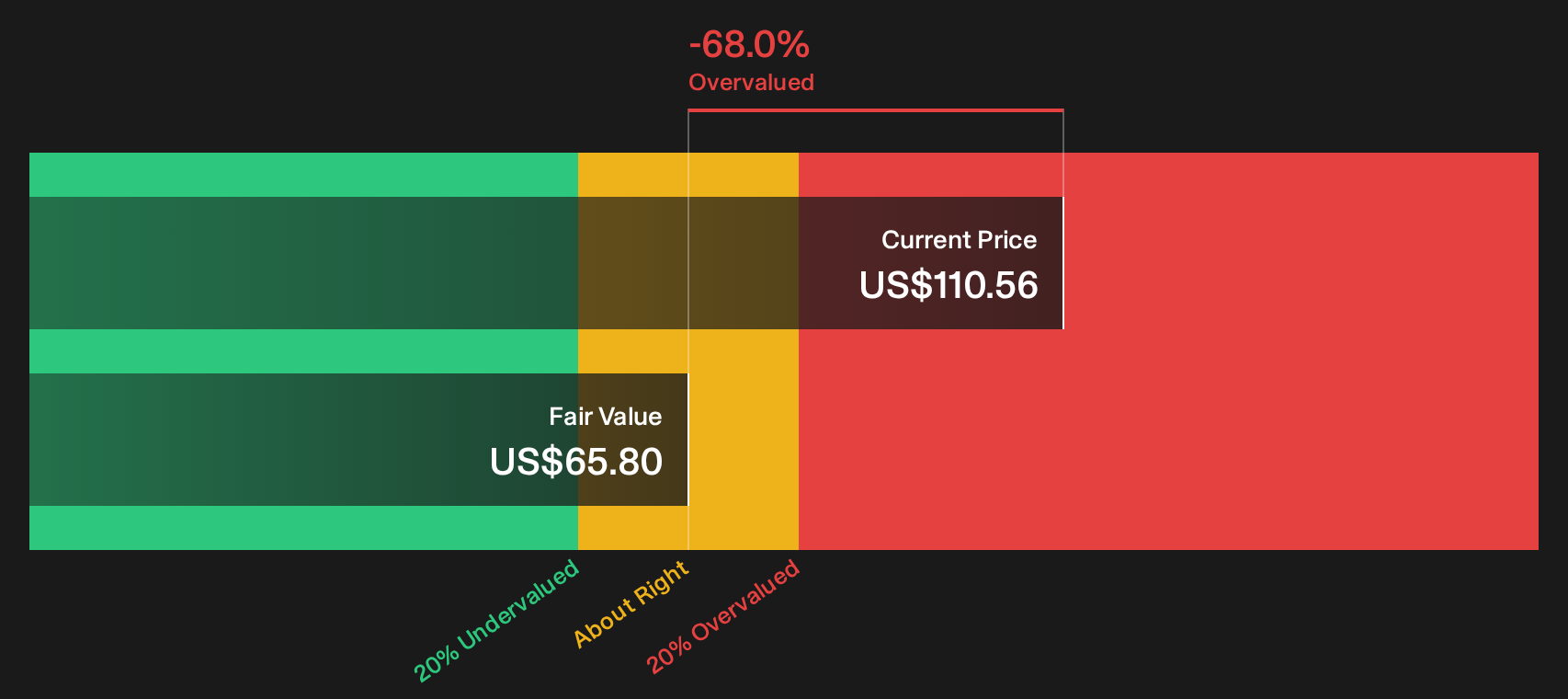
Bringing all those projected cash flows back to today gives an estimated intrinsic value of US$125.99 per share, compared with the recent share price of US$130.20. That comparison implies the stock is around 3.3% overvalued based on this DCF output, which is a relatively small gap.
Result: ABOUT RIGHT
Walmart is fairly valued according to our Discounted Cash Flow (DCF), but this can change at a moment's notice. Track the value in your watchlist or portfolio and be alerted on when to act.
Approach 2: Walmart Price vs Earnings
For a profitable company like Walmart, the P/E ratio is a useful way to judge how much you are paying for each dollar of earnings. Investors typically accept a higher P/E when they expect stronger earnings growth or see lower risk, and look for a lower P/E when growth expectations are more modest or risks are higher.
Walmart’s current P/E is 47.4x, which is well above the Consumer Retailing industry average of 17.9x and also above the peer group average of 25.1x. At face value, that points to a rich valuation compared with both its sector and similar companies.
Simply Wall St’s Fair Ratio metric is designed to refine that comparison. It estimates what a “normal” P/E might be for Walmart at around 44.7x, based on factors such as earnings growth, industry, profit margins, market cap and risk profile. Because it adjusts for these company specific features, Fair Ratio can be more informative than a simple industry or peer comparison.
Comparing Walmart’s actual P/E of 47.4x with the Fair Ratio of 44.7x suggests the stock is trading somewhat above what this model would consider fair.
Result: OVERVALUED

P/E ratios tell one story, but what if the real opportunity lies elsewhere? Start investing in legacies, not executives. Discover our 19 top founder-led companies.
Upgrade Your Decision Making: Choose your Walmart Narrative
Earlier it was mentioned that there is an even better way to understand valuation, so Narratives are introduced as a simple way for you to attach a clear story about a company to the numbers behind your own fair value, revenue, earnings and margin assumptions.
A Narrative on Simply Wall St links what you believe about Walmart’s business, such as the impact of AI automation or international expansion, to a set of forecasts and then to a fair value that you can compare directly with today’s share price.
These Narratives live in the Community section of Simply Wall St, are used by millions of investors, and are updated automatically when new data, news or earnings are added so your valuation view can adjust without you rebuilding everything from scratch.
For Walmart, one investor might build a Narrative that focuses on margin expansion, strong e commerce growth and higher future P/E assumptions, which leads to a higher fair value. Another might stress risks like retail theft, international uncertainty and rising costs, which leads to a lower fair value. Seeing those side by side helps you decide how comfortable you are with where the stock is trading today.
For Walmart, however, we will make it really easy for you with previews of two leading Walmart Narratives:
Each one ties a clear story about the business to specific numbers on growth, margins and fair value, so you can see how different assumptions line up against today’s share price.
Fair value in this narrative: US$136.56 per share.
Implied discount to this fair value at US$130.20: about 4.7% undervalued.
Revenue growth assumption: about 4.76% a year.
- Focus on AI assisted omnichannel retail, advertising and memberships as higher margin growth areas alongside core stores and e commerce.
- Relies on steady revenue growth, a modest lift in net profit margins and a relatively high future P/E multiple to support the fair value.
- Flags risks around e commerce profitability, tariffs, wage and claims costs, competitive intensity and international execution that could limit margins.
Fair value in this narrative: US$71.70 per share.
Implied premium to this fair value at US$130.20: about 81.5% overvalued.
Revenue growth assumption: about 4.40% a year.
- Highlights Walmart’s efforts in automation, multi cloud infrastructure and international expansion, but treats them as already well reflected in the current price.
- Uses more conservative margin and valuation multiples, with a lower future P/E and a fair value that sits well below the recent share price.
- Points to risks such as higher labor costs, execution on automation, competition in retail and e commerce, and exposure to international and supply chain shocks.
Seeing these side by side gives you a clear range of what different investors think Walmart could be worth based on the same set of business facts. This allows you to decide which set of assumptions feels closer to your own view before making any moves.
To see how these results tie into long-term growth, risks, and valuation, check out the full range of community narratives for Walmart on Simply Wall St. Add the company to your watchlist or portfolio so you'll be alerted when the story evolves.
Do you think there's more to the story for Walmart? Head over to our Community to see what others are saying!

This article by Simply Wall St is general in nature. We provide commentary based on historical data and analyst forecasts only using an unbiased methodology and our articles are not intended to be financial advice. It does not constitute a recommendation to buy or sell any stock, and does not take account of your objectives, or your financial situation. We aim to bring you long-term focused analysis driven by fundamental data. Note that our analysis may not factor in the latest price-sensitive company announcements or qualitative material. Simply Wall St has no position in any stocks mentioned.