

Is United Parcel Service (UPS) A Bargain Following Its Latest Bond Offering?
United Parcel Service, Inc. Class B UPS | 0.00 |
UPS bond offerings put capital structure in focus
United Parcel Service (UPS) has recently completed two fixed income offerings totaling about US$1.3b, including long dated floating rate notes due 2076. This refinancing activity gives stock investors additional insight into the company’s funding mix and priorities.
At a share price of US$101.93, United Parcel Service has seen its 1 month share price return decline 13.41%, although the 1 year total shareholder return of 23.72% still points to stronger longer term gains. Recent headlines have featured fresh bond issuance, approval to shift Hong Kong flying rights to Clark in the Philippines, and the latest US$1.64 quarterly dividend affirmation. Together, these developments keep attention on how UPS is balancing growth investment with shareholder payouts as sentiment cools in the short term but remains supported over the past year.
If this kind of steady but shifting momentum has you thinking about what else is moving, it could be a useful moment to scan 39 power grid technology and infrastructure stocks
After a 13.41% pullback over the past month but a 23.72% total return over the past year, United Parcel Service sits at an interesting crossroads. Has most of the easy upside already played out, or does the valuation still suggest room ahead?
Most Popular Narrative: 12.1% Undervalued
On the latest close at $101.93, the most followed narrative pegs United Parcel Service fair value at $115.96 using an 8.48% discount rate. This frames the current pullback as a discount to that long term view.
UPS anticipates $3.5 billion in annual cost reductions for 2025 through variable, semi-variable, and fixed cost savings, positioned to exceed the revenue loss from Amazon. This should improve profitability and free cash flow.
If you want to see what is really driving that $115.96 figure, look at how UPS margins, revenue mix and future earnings power are wired into the model. The entire narrative focuses on how much profit UPS can pull from fewer low margin volumes and a more automated network.
Result: Fair Value of $115.96 (UNDERVALUED)
However, United Parcel Service still faces meaningful risks related to global trade policy changes and the large planned reduction in Amazon volumes, which could challenge this bullish narrative.
Another View on United Parcel Service Valuation
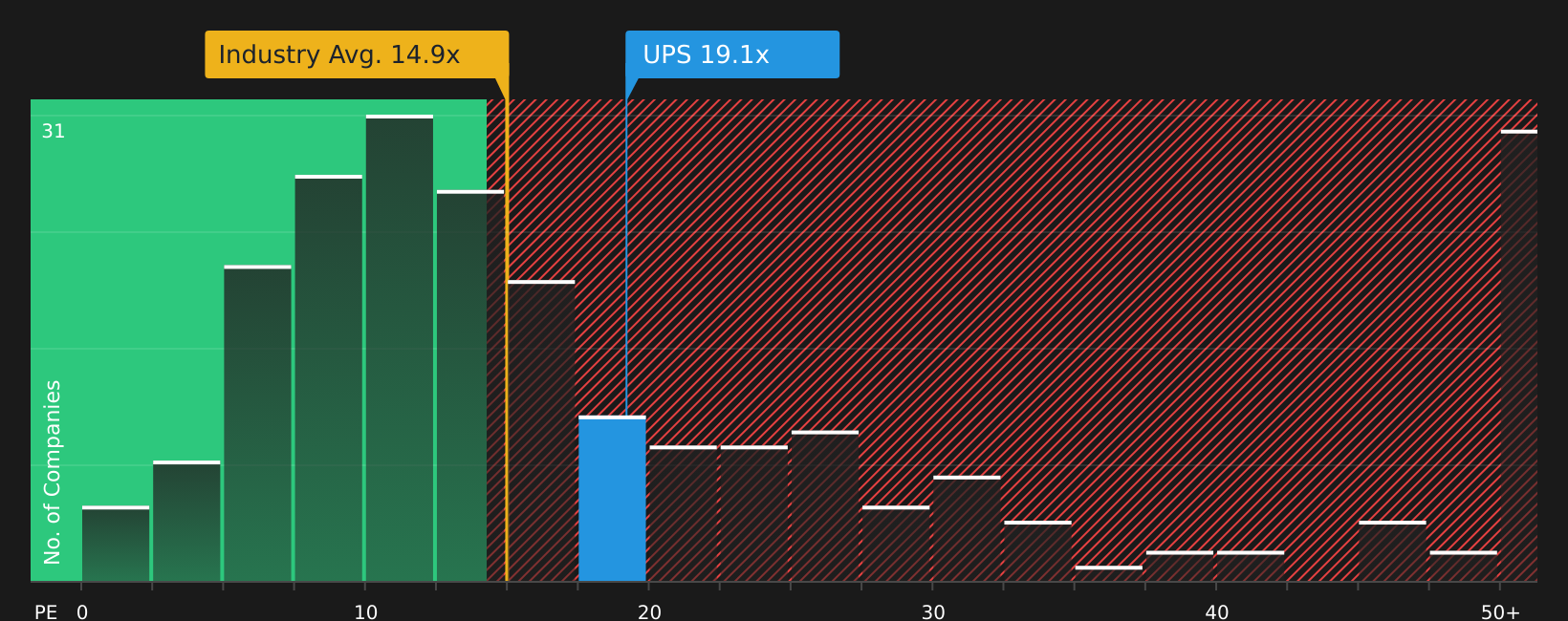
The popular narrative has United Parcel Service trading about 12.1% below a fair value of $115.96. On simple P/E math, the story is less one sided. UPS trades on roughly 19x earnings compared with 15.1x for the global logistics industry and a fair ratio of 29.1x.
This means UPS screens more expensive than the broader industry, yet cheaper than where the fair ratio suggests the multiple could sit. For investors, that split raises a practical question. Is the extra price over peers a reasonable trade off for what the model calls a potential opportunity, or a sign to be cautious about how much is already in the price.
Next Steps
If the mixed tone of this United Parcel Service story leaves you unsure, take a closer look at the full risk and reward balance yourself. A good place to start is by reviewing the 2 key rewards and 3 important warning signs
Looking for more investment ideas beyond United Parcel Service?
Do not stop with United Parcel Service. The market is full of other opportunities, and a quick scan of focused stock lists can help you spot what others might miss.
- Target stable income by reviewing companies in the 11 dividend fortresses that may offer meaningful yield with substantial cash returns to shareholders.
- Seek value with substance by scanning the screener containing 20 high quality undiscovered gems that pair strong fundamentals with less crowded investor attention.
- Limit downside risk by focusing on businesses in the 79 resilient stocks with low risk scores that combine resilient balance sheets with more measured volatility.
This article by Simply Wall St is general in nature. We provide commentary based on historical data and analyst forecasts only using an unbiased methodology and our articles are not intended to be financial advice. It does not constitute a recommendation to buy or sell any stock, and does not take account of your objectives, or your financial situation. We aim to bring you long-term focused analysis driven by fundamental data. Note that our analysis may not factor in the latest price-sensitive company announcements or qualitative material. Simply Wall St has no position in any stocks mentioned.