

KIS Downgrades SK Hynix, Shares Tumble Over 10% Pre-Market: Memory Peak or Emotional Oversell?
SK hynix Inc. Sponsored ADR SKHY | 0.00 | |
Micron Technology, Inc. MU | 0.00 | |
NVIDIA Corporation NVDA | 0.00 | |
VanEck Vectors Semiconductor ETF SMH | 0.00 | |
PHLX Sox Semiconductor Sector Ishares SOXX | 0.00 |
Subscribe to The Trend Catcher Topic / The Value Anchor Topic —unlock the full historical archive and never miss a weekly pick again.
Shares of SK Hynix plummeted by over 15% in South Korea, dropping below the 2,000,000 KRW mark and marking a roughly 35% retracement from its June peak.
SK hynix Inc.(SKHY.US) shares rose 12.76% on their first day of trading on Friday, but fell more than 10% in pre-market trading today.
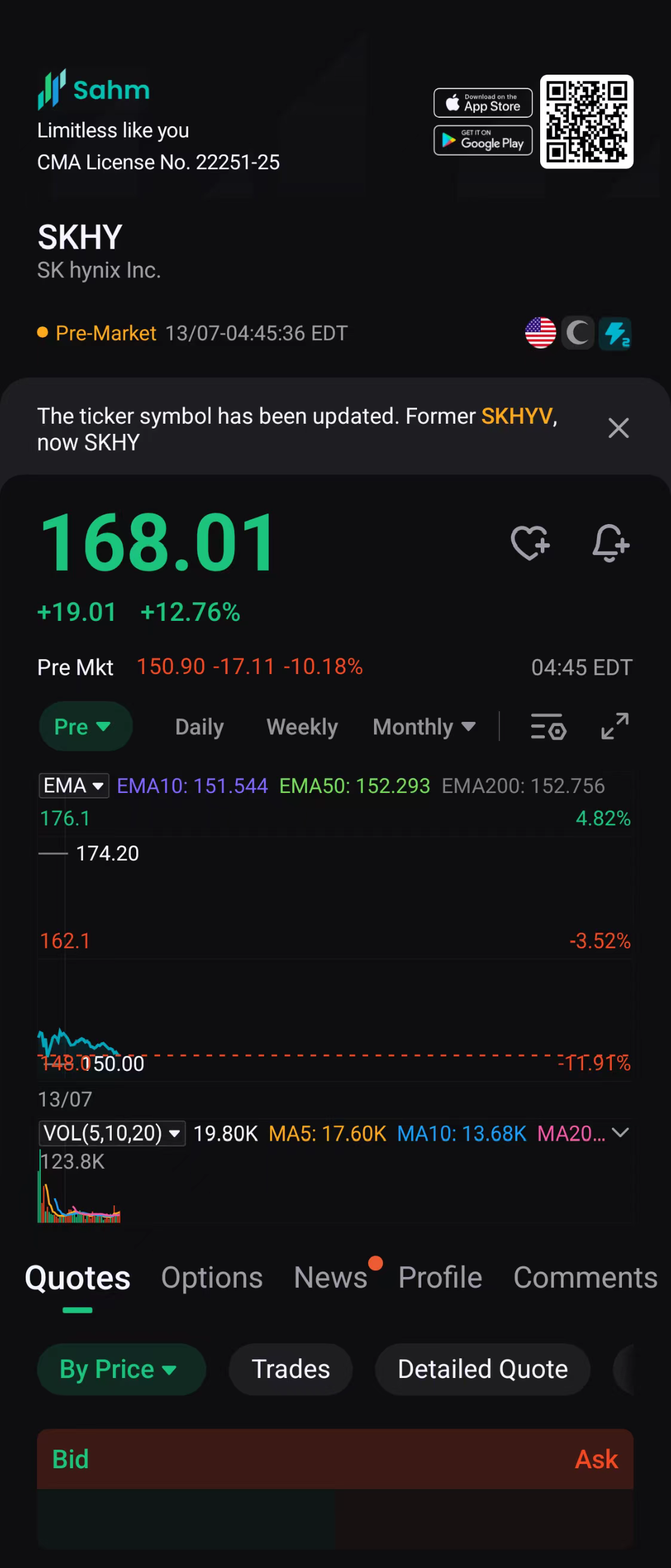
Despite a highly successful ADR listing in the U.S., the company's domestic shares have faced substantial selling pressure, further amplified by a recent report from Korea Investment & Securities (KIS) adjusting its 2026 and 2027 earnings forecasts downward.
Behind the Earnings Revision
At first glance, the market interpreted the KIS report as a sign of peaking memory stocks and exhausted positive catalysts. KIS projected Q2 revenue at 80.9 trillion KRW (up 264% YoY) and operating profit at 60.4 trillion KRW (up 556% YoY). However, the profit estimate was about 8% lower than the market consensus of 65 trillion KRW.
According to KIS, this adjustment does not signal deteriorating fundamentals or slowing High Bandwidth Memory (HBM) demand. Instead, it reflects a shift in the memory sector's business model. Because SK Hynix has locked in HBM prices through Long-Term Agreements (LTAs), it is missing out on the explosive short-term margins currently seen in the spot pricing of traditional DRAM and NAND. Essentially, the company is sacrificing peak margin elasticity in exchange for higher revenue certainty over the next 3 to 5 years. Consequently, KIS maintained its target price of 3.8 million KRW, noting that Q3 will bring large-scale shipments of higher-value HBM4, which will improve the Average Selling Price (ASP).
Why Did the Stock Drop So Drastically?
The severe stock drop—far exceeding the 8% earnings revision—was driven by a convergence of several factors:
- The Short-Term Cost of High HBM Exposure: The market realized that high reliance on HBM LTAs means SK Hynix’s short-term ASP growth might lag behind competitors like Samsung during rapid spot price rallies.
- "Sell the News" on the ADR Listing: The highly anticipated US ADR listing had already been priced in. Once the listing occurred, event-driven funds began profit-taking.
- Cross-Market Arbitrage: A 15% premium on the US ADRs compared to the Korean common stock invited arbitrage and hedging sell-offs in the Korean market.
- Leveraged Liquidations: Mechanical sell-offs were triggered by leveraged products linked to SK Hynix, as retail and institutional investors were forced to deleverage during the downturn.
- Macro and Sector Headwinds: A broader tech sell-off saw the KOSPI and Samsung drop over 6%, indicating a generalized de-risking of AI assets in Korea rather than an isolated issue with SK Hynix.
Has the Memory Cycle Peaked?
Industry data suggests the memory cycle has not yet ended. TrendForce still projects quarter-over-quarter price increases for traditional DRAM and NAND in Q3. Key indicators of a cyclical top—such as dropping contract prices, ballooning inventory, and slashed AI capital expenditures by Big Tech—have not yet materialized. While the rate of price and profit growth may be peaking, absolute prices and profits are still climbing.
Subscribe to The Trend Catcher Topic / The Value Anchor Topic —unlock the full historical archive and never miss a weekly pick again.
Investment Strategy and Outlook
While SK Hynix's risk-to-reward ratio has improved after a 35% pullback, a "low valuation" does not immediately guarantee a market bottom. Analysts advise investors to watch crucial support levels around 1.9 to 2.0 million KRW.
- For Long-term Holders: The fundamental logic of AI demand and HBM growth remains unbroken. Investors should hold but wait for stabilization before adding to positions, focusing on upcoming earnings reports regarding HBM4 shipments and LTA terms.
- For Leveraged/Heavy Positions: Immediate risk management is advised due to extreme intraday volatility and volatility decay.
- For Bottom Fishers: Staggered entry is recommended—wait for price stabilization at key support levels, confirmation of an upward reversal, and fundamental validation from upcoming earnings reports.
Ultimately, the current market narrative has shifted from celebrating short-term profit explosions to evaluating long-term profit sustainability. The underlying Korean memory industry remains robust, though short-term market clearing is still underway.
Related Investment Opportunities / Tickers to Watch:
For investors looking to navigate the current memory cycle and AI hardware trends, several related assets are worth monitoring:
- Direct Memory Peers:
- Samsung Electronics: SK Hynix's primary domestic rival, which currently benefits more from the spot price surge in traditional DRAM and NAND.
- Micron Technology, Inc.(MU.US): The major US-based memory manufacturer, offering another play on global HBM and traditional memory demand without the Korean market dynamics.
- AI & HBM Downstream Demand:
- NVIDIA Corporation(NVDA.US): The primary consumer of SK Hynix’s HBM chips for its AI accelerators. Its capital expenditure and demand directly dictate HBM's market health.
- Broader Semiconductor ETFs:
- VanEck Vectors Semiconductor ETF(SMH.US) or PHLX Sox Semiconductor Sector Ishares(SOXX.US): For investors who want exposure to the AI and memory boom while diversifying away from single-stock volatility.