

Known Worries And Unknown Unknowns
ETF-S&P 500 SPY | 0.00 | |
Vanguard S&P 500 Etf VOO | 0.00 | |
S&P 500 Index Ishares IVV | 0.00 |
There are two main types of risk.
There are well-known risks that are at least somewhat priced into the markets. They are the lingering fears that are covered regularly in the news and surfaced in surveys. As long as new developments related to these risks aren’t much worse than what’s in the range of likely outcomes, markets can handle bad news relatively well.
And there are risks that are not well known, not widely discussed, and not priced into the markets. They often emerge as an unexpected shock event, which is when many market participants decide it’s time to price it in. The nature of the risk isn’t always the most problematic issue for investors. But the introduction of uncertainty alone is enough to send prices lower.
With that in mind, let’s talk about some risks.
What people are worried about
A bunch of firms recently conducted surveys asking people what they’re worried about.
Let’s go through some of the findings.
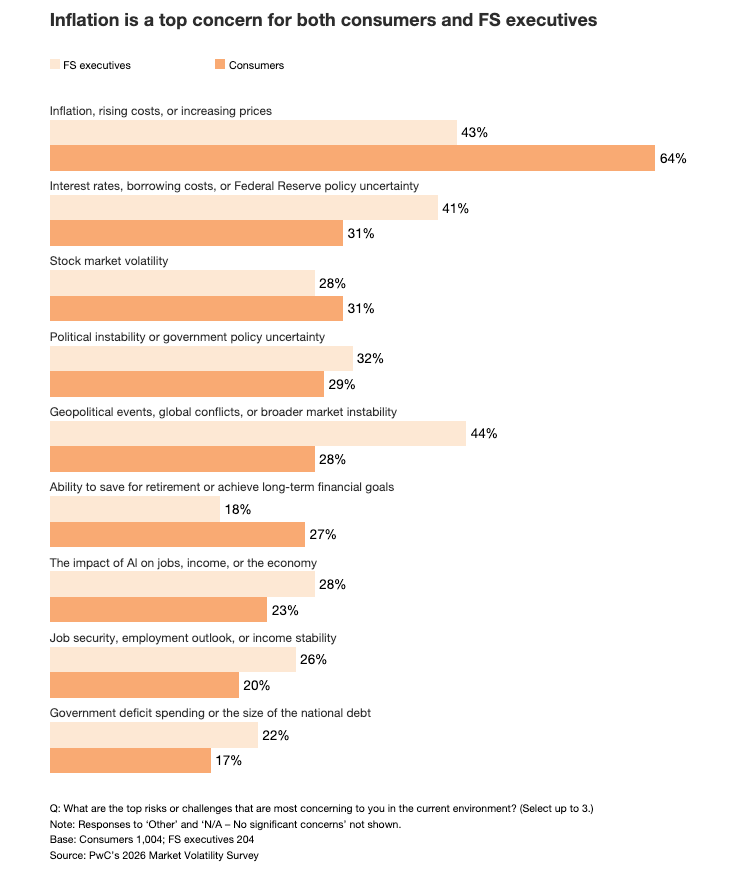
According to PwC’s Market Volatility Survey released last week, financial services executives’ top concerns include geopolitical events, inflation, interest rates, and government policy uncertainty. Consumers are particularly concerned about inflation, followed by interest rates and stock market volatility.
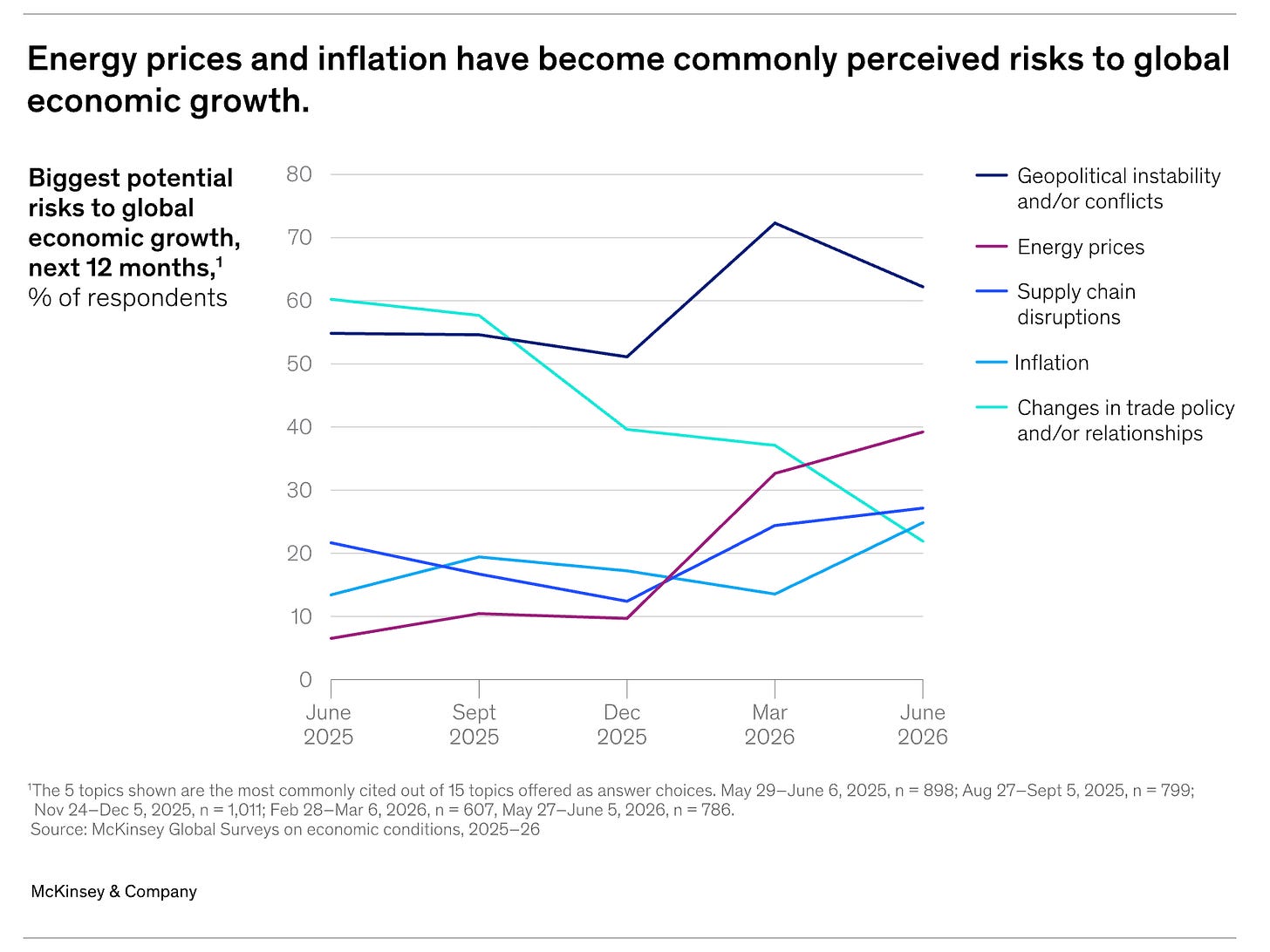
McKinsey’s June Economic Conditions survey revealed that executives saw geopolitical instability and energy prices as leading risks to global economic growth.
Natixis surveyed market strategists about their top concerns. Leading the way was inflation and the Iran war’s impact on oil prices. Strategists were also broadly concerned about how weak consumer confidence could hinder consumer spending.
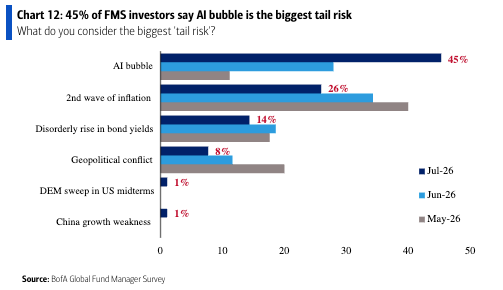
Meanwhile, BofA’s July Global Fund Manager Survey showed that participants ranked "AI bubble" as their biggest "tail risk." That was followed by inflation, bond yields, and geopolitical conflict.
Each survey covers different types of people, and they all word questions differently.
That said, it seems people are generally concerned about inflation, geopolitics, and the stability of the stock and bond markets.
None of this is particularly surprising, as they are the stories dominating the news cycle in business media.
What’s worrisome is what’s not on these lists ⚖️
As TKer Stock Market Truth No. 7 reminds us, there will always be something to worry about.
It’s an inescapable reality of investing in the stock market.
On the bright side, these worries get priced into the market as a discount, which helps to explain why investor returns in the stock market tend to be relatively high.
When investors and traders are aware of a certain risk, they tend to adjust market prices in a way that anticipates the likelihood that a risk event could materialize to some degree. If the event comes to fruition and it’s not as bad as feared, markets tend to react positively. In other words, there are scenarios where bad things happen, and stocks rally.
It may seem counterintuitive. But it’s a positive for investors that there are many things the market is actively worried about. It keeps the market in check and less vulnerable to stomach-churning price swings.
On the other hand, the most destabilizing risks are the ones people aren’t talking about. The unknown unknowns. This is TKer Stock Market Truth No. 8.
Every once in a while, we get an event that’s out of mind or considered extremely unlikely. Consider the attacks on Iran earlier this year, the announcement of sweeping tariffs last year, the failure of Silicon Valley Bank three years ago, or the emergence of COVID-19 six years ago.
Even if these sudden shock events prove benign to economic activity and corporate earnings, the introduction of uncertainty alone is enough to compress valuations and send stock prices lower.
Unfortunately, there’s not much you can do about these unknown unknowns. There’s no knowing what’s coming and when they’ll emerge (unless you’ve got some inside information). There’s also the possibility they’ll never emerge.
The best we can do is understand that sometimes, things will come out of nowhere and send shockwaves through the markets. And given a little time, these things become another one of those more manageable risks that surface on many surveys for months.
The good news is that the stock market has a long history of recovering from unexpected shock events, which means any drop in prices has proven to be a buying opportunity for long-term investors.
An important note on consumers, businesses, and earnings
It’s not just markets that adjust when traders become aware of new risks. Given time, consumers and businesses adjust as well.
Consumers will make tweaks to their spending and saving behavior. Maybe they’ll work more or change jobs to address new realities.
Businesses will reorganize and restructure their operations, including adjusting supply chains and moving workforces, all with the intent of preserving earnings growth and creating shareholder value.
All this is to say that the economy doesn’t take risks lying down. So, in addition to considering the challenges presented by risks, investors should also think about what could go right.
Benzinga Disclaimer: This article is from an unpaid external contributor. It does not represent Benzinga’s reporting and has not been edited for content or accuracy.