

Lockheed Martin (LMT) Stock Trades At A Discount To Fair Value And Earnings
Lockheed Martin Corporation LMT | 0.00 |
Lockheed Martin stock has delivered a 62.4% return over the past five years, and at a last close of US$538 the valuation checks now suggest the market price is below an updated intrinsic value estimate based on a Discounted Cash Flow (DCF) approach.
- A 62.4% five year return signals investors have already been rewarded, so the key issue is whether the current price still leaves a margin against estimated intrinsic value.
- Recent large missile and defense contract wins, alongside integration risks from deals such as the Ultra Maritime acquisition and ongoing margin pressures in aeronautics, can both influence how much of Lockheed Martin's future cash flow strength is already reflected in the share price.
- On Simply Wall St's broader valuation checks, Lockheed Martin screens as undervalued in 5 of 6 areas. This points to a stock that still leans cheap on multiple measures despite its run.
The issue now is whether that apparent discount, including an intrinsic value estimate that indicates the shares may be undervalued by about 28.4%, is enough to compensate you for the contract, execution, and margin risks around Lockheed Martin at today’s price.
Does Lockheed Martin Look Undervalued on Cash Flow?
The Discounted Cash Flow (DCF) model here uses projected free cash flows to gauge what Lockheed Martin might be worth today.
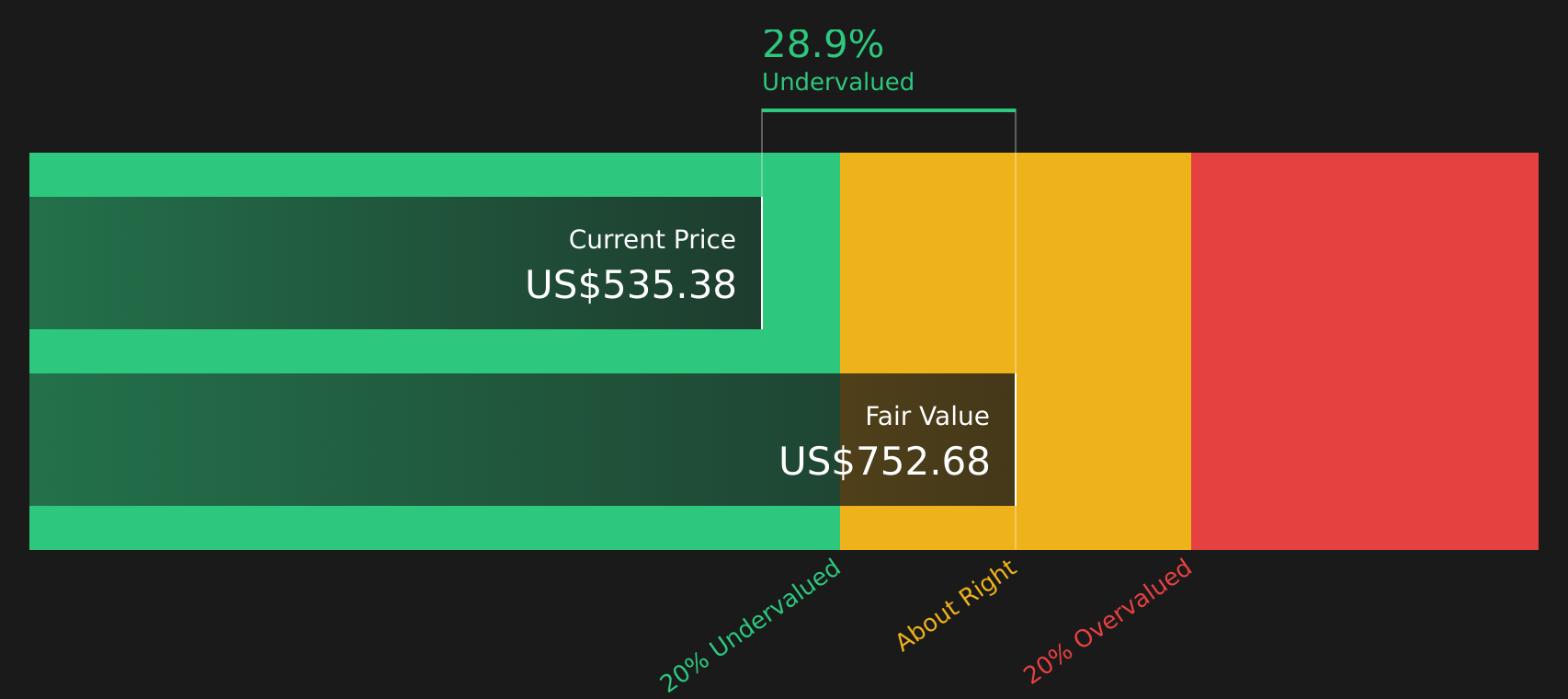
On this model, Lockheed Martin generated about $5.6b of free cash flow over the last twelve months, with the projection set assuming growing cash flows from this base. That stream of cash, discounted back to today, yields an estimated intrinsic value of about $751 per share, compared with the recent share price of $538.
That gap implies the stock is 28.4% undervalued on this set of assumptions. Citi’s recent upgrade following a series of large missile and radar contract awards helps explain why some investors see room for the share price to move closer to what the cash flows suggest.
On these DCF assumptions, Lockheed Martin stock currently screens as undervalued relative to its estimated intrinsic value.
Our Discounted Cash Flow (DCF) analysis suggests Lockheed Martin is undervalued by 28.4%. Track this in your watchlist or portfolio, or discover 41 more high quality undervalued stocks.
Is Lockheed Martin Still Cheap on Earnings?
The P/E multiple is a useful yardstick for Lockheed Martin because earnings remain a key way investors think about defense contractors with long contract backlogs.
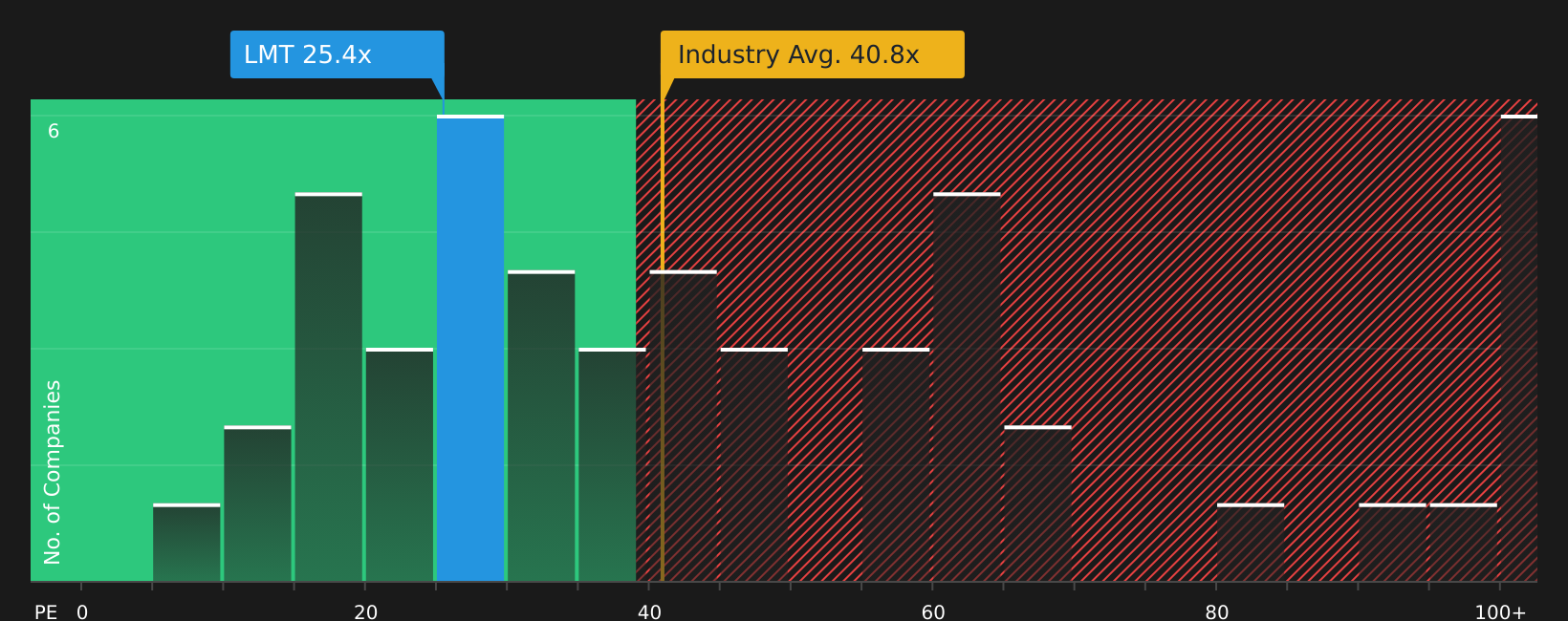
Lockheed Martin trades on a P/E of about 25.9x, compared with an Aerospace & Defense industry average of roughly 40.6x and a peer average near 50.1x. On Simply Wall St’s model, a P/E of about 36.2x would be more in line with what you might expect given the company’s size, profitability profile, and sector risks, so the current multiple sits well below that reference value.
This gap suggests the stock is pricing in more caution than both the tailored fair P/E and broader sector benchmarks imply, even after a run of sizeable contract awards and index reclassification.
On this earnings-based yardstick, Lockheed Martin stock appears inexpensive relative to both its sector and a more tailored fair P/E estimate.
The Lockheed Martin Narrative: What Would Justify Today's Price?
Simply Wall St Narratives for Lockheed Martin pick up where the valuation puzzle leaves off, explaining what kind of future for Lockheed Martin's growth, margins, and earnings would need to occur for the stock to be worth materially more or less than today’s price. Each narrative presents fair value as a thesis about how the business develops over time, so you can see how that view holds up as new information appears on the Community page.
One of the top community narratives on Lockheed Martin: 14% undervalued
"Demand for advanced platforms such as the F-35, PAC-3, THAAD, and hypersonic weapons is being reinforced by actual combat use and rising geopolitical tensions..."
Do you think there's more to the story for Lockheed Martin? Head over to our Community to see what others are saying!
The Bottom Line
For Lockheed Martin, both the Discounted Cash Flow (DCF) intrinsic value estimate and earnings multiples currently point to an undervalued stock on the assumptions used here. The key question is whether contract execution, integration of recent deals, and margin pressures in aeronautics stay contained enough for that intrinsic value to be realised over time. From here, the crux of the bull versus bear debate is whether the current discount reflects an opportunity in Lockheed Martin or whether the market is correctly pricing the operational and contract risk that comes with its order book.
This article by Simply Wall St is general in nature. We provide commentary based on historical data and analyst forecasts only using an unbiased methodology and our articles are not intended to be financial advice. It does not constitute a recommendation to buy or sell any stock, and does not take account of your objectives, or your financial situation. We aim to bring you long-term focused analysis driven by fundamental data. Note that our analysis may not factor in the latest price-sensitive company announcements or qualitative material. Simply Wall St has no position in any stocks mentioned.