

Memory Giants Are Writing Record-Size Checks, but Are Buybacks Enough to Kill the Cycle?
SK hynix Inc. Sponsored ADR SKHY | 0.00 | |
Sandisk Corporation SNDK | 0.00 | |
Micron Technology, Inc. MU | 0.00 | |
Apple Inc. AAPL | 0.00 |
Subscribe to The Value Anchor Topic / The Trend Catcher Topic —unlock the full historical archive and never miss a weekly pick again.
The semiconductor industry has one perennial boogeyman: the cycle. Boom, overbuild, glut, price collapse. Nowhere is that rhythm more violent than in memory chips. But over the past two months, the majors — SK hynix Inc. Sponsored ADR(SKHY.US), Sandisk Corporation(SNDK.US), Kioxia, Micron Technology, Inc.(MU.US), and now Samsung — have launched a coordinated shareholder payoff unlike anything the sector has attempted before. The question for investors is not whether the cash is real, but what it actually proves.
A buying spree of historic scale
Samsung set the tone with the largest capital-return program in its history: up to KRW 110 trillion returned to shareholders, including roughly KRW 30 trillion in a Q3 cash dividend and about KRW 15 trillion in buybacks earmarked for employee incentives.
SK hynix Inc. Sponsored ADR(SKHY.US) — a KRW 40 trillion (≈$28.6B) repurchase to be canceled entirely within ~3 months, covering ~24.07M shares (3.3% of float). Payout target lifted from "≤50% of cumulative FCF" to ">50%" for 2025–27. Net cash: ~₩69 trillion.
Sandisk Corporation(SNDK.US) — fresh $14B authorization lifts remaining executable buybacks to $15.5B; pledges 100% excess-cash return post-investment.
Kioxia — burned through a full 800B Yyen repurchase in just 10 days.
Micron Technology, Inc.(MU.US) — long-term 100% excess-cash return; raised quarterly dividend.
SK Hynix jumped as much as 13% on its announcement — hard proof that, after a brutal drawdown, canceled shares speak louder than any "we're undervalued" press release.
Why now — and why it's different
The immediate trigger is a sharp derating. As memory stocks fell from their highs, the market began questioning whether AI capex is sustainable, whether prices have peaked, and whether eye-popping margins can last. When a stock's fall diverges violently from the company's cash-generation power, buybacks become the most direct signal a board can send.
But the deeper reason the checks clear is structural: AI has rewritten memory's economics. Historically, demand came from PCs, phones, and consumer electronics — fragmented buyers, wild swings, near-commodity products haggled over spot and short contracts. Today HBM, enterprise SSDs, and high-bandwidth flash are the binding constraints inside AI servers. Memory is no longer a capacity add-on; it directly sets compute utilization, bandwidth, power draw, and inference efficiency. Higher value per bit, longer qualification cycles, and concentrated supply have handed the leaders pricing power and cash-flow visibility they rarely enjoyed.
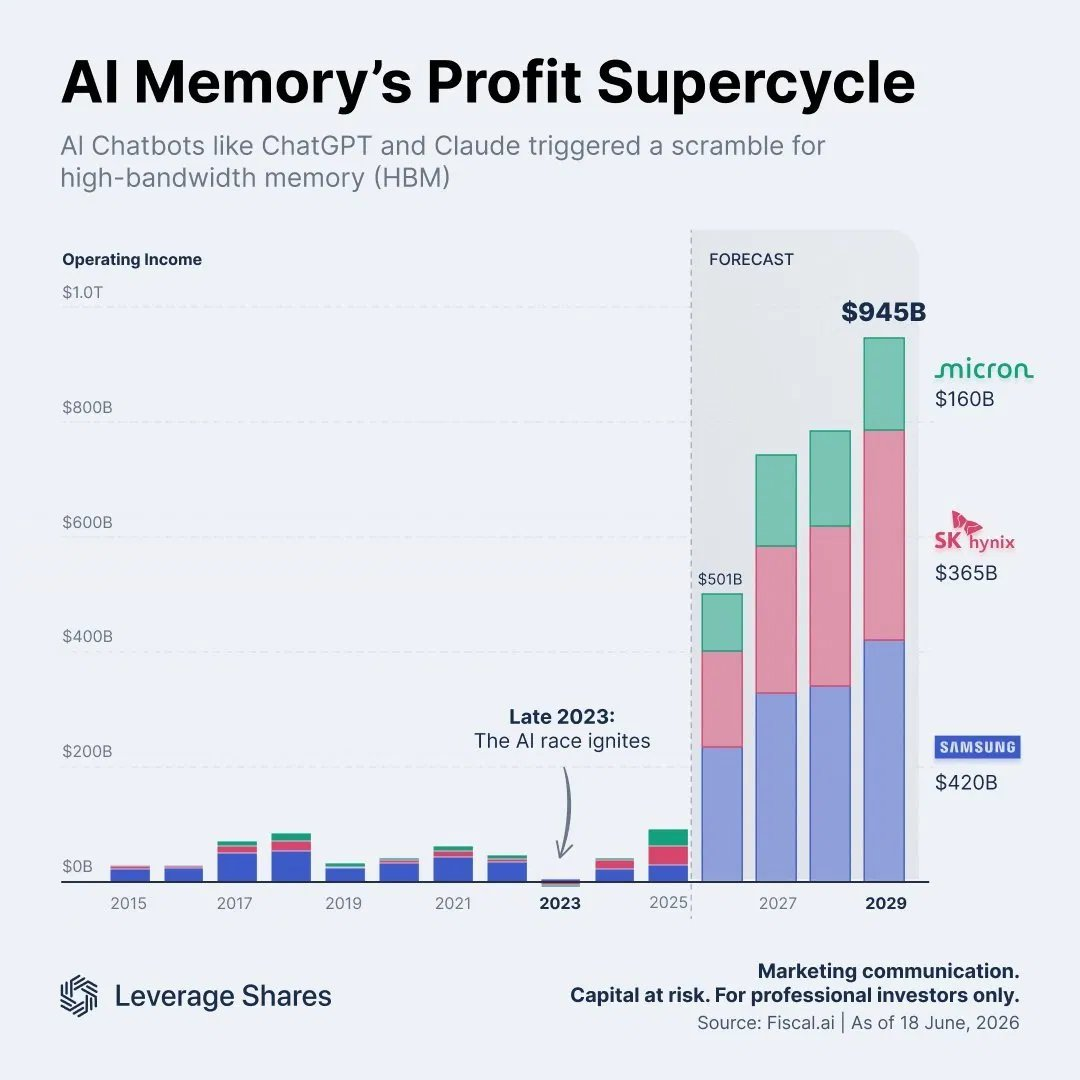
SanDisk's frame: adjusted FCF >$5B in fiscal Q4 2026, 84.6% non-GAAP gross margin, and a 2028–30 model promising mid-to-high-teens revenue growth, ~80% margins, ~50% FCF conversion. Caveat: forward targets, not locked results.
The Real Paradigm Shift: The "Long-Term Agreement"
Buybacks alone would make this just a well-funded defense. What could genuinely soften the cycle is the quiet replacement of quarterly price negotiations with multi-year supply agreements. SanDisk calls its version the "New Business Model" (NBM): committed volumes, minimum financial guarantees, structured pricing. It has signed eight customers covering roughly half of FY2027 bit shipments and about two-thirds of FY2028. Micron says multi-year strategic deals lift the durability and predictability of revenue and earnings; three-to-five-year contracts increasingly carry prepayments, floor prices, or penalty protection.
Think of it as demand insurance. It covers uncertainty — not the cycle itself.
Buyers secure supply, so AI buildouts don't stall on shortages; vendors get visibility that dulls the risk of abrupt price crashes; investors can model on contract coverage and mid-cycle FCF instead of spot prices.
Can memory become an "Apple-style blue chip"? Not yet.
No. Apple Inc.(AAPL.US)'s buybacks rest on brand, ecosystem, and durable cash flow. Memory remains capital-intensive, and its prices are still hostage to supply and demand. Canceling shares lifts EPS per share, but it cannot stop a price decline; an authorization is not execution and certainly not a permanent floor. Long contracts cut both ways — better visibility today can embolden premature capacity adds, turning today's stabilizer into tomorrow's overbuild if demand undershoots. And Sandisk Corporation(SNDK.US)'s ~80% margin / ~50% FCF targets are 2028–30 aspirations, not a proven mid-cycle baseline.
So buybacks, contracts, and product upgrades can compress the cycle's amplitude. They have not yet shown that the cycle is gone. Whether memory earns a re-rating ultimately depends on whether the giants restrain equipment spend and bit-output growth while times are good.
The bottom line
This is more than a post-selloff cushion. The notable turn is that vendors now weight free cash flow, long-term contracts, and shareholder returns alongside technology and capacity — a rare capital-allocation pivot that could lift the sector's valuation center of gravity.
But the ability to buy back is not proof the cycle is broken. The real test arrives when the next wave of capacity hits the market: can the majors resist the urge to expand, and can contracts and buybacks hold earnings and per-share value when the air comes out? The memory industry hasn't shed its "cyclical" label — but it may be trading violent price crashes for a shallower, cash-steadier cycle. The verdict lands in the second half of 2027 through 2028.