

Microsoft (MSFT) Stock After 20% Slide This Year Is The Valuation Case Compelling
Microsoft Corporation MSFT | 0.00 |
- Wondering whether Microsoft stock still lives up to its reputation at today’s price, or if expectations have run ahead of reality.
- The share price recently closed at US$379.40, after falling 5.1% over the past week, 9.4% over the past month and 19.8% year to date, even though the 3 year and 5 year returns of 18.2% and 47.1% show longer term shareholders have still seen gains.
- These recent moves come as Microsoft continues to draw attention around its role in AI, cloud computing and enterprise software, with investors weighing long term demand against nearer term sentiment. Broader tech sector swings and changing expectations for growth and interest rates are also affecting how the stock is being priced.
- Against that backdrop, Microsoft currently scores a full 6 out of 6 on our valuation checks, which sets up a closer look at how different valuation methods stack up for the stock and points to an even richer way to think about value later in this article.
Approach 1: Microsoft Discounted Cash Flow (DCF) Analysis
A Discounted Cash Flow, or DCF, model estimates what Microsoft stock could be worth by projecting the company’s future cash flows and then discounting them back to today’s dollars. It is essentially asking what those future cash streams are worth right now.
Based on this 2 Stage Free Cash Flow to Equity model, Microsoft’s latest twelve month Free Cash Flow stands at about $93.7b. The model then uses a mix of analyst inputs and extrapolations by Simply Wall St to project Free Cash Flow over the coming decade, with one reference point being an estimated $181.1b in 2030. All cash flows are assessed in $ and then discounted to reflect their value today.
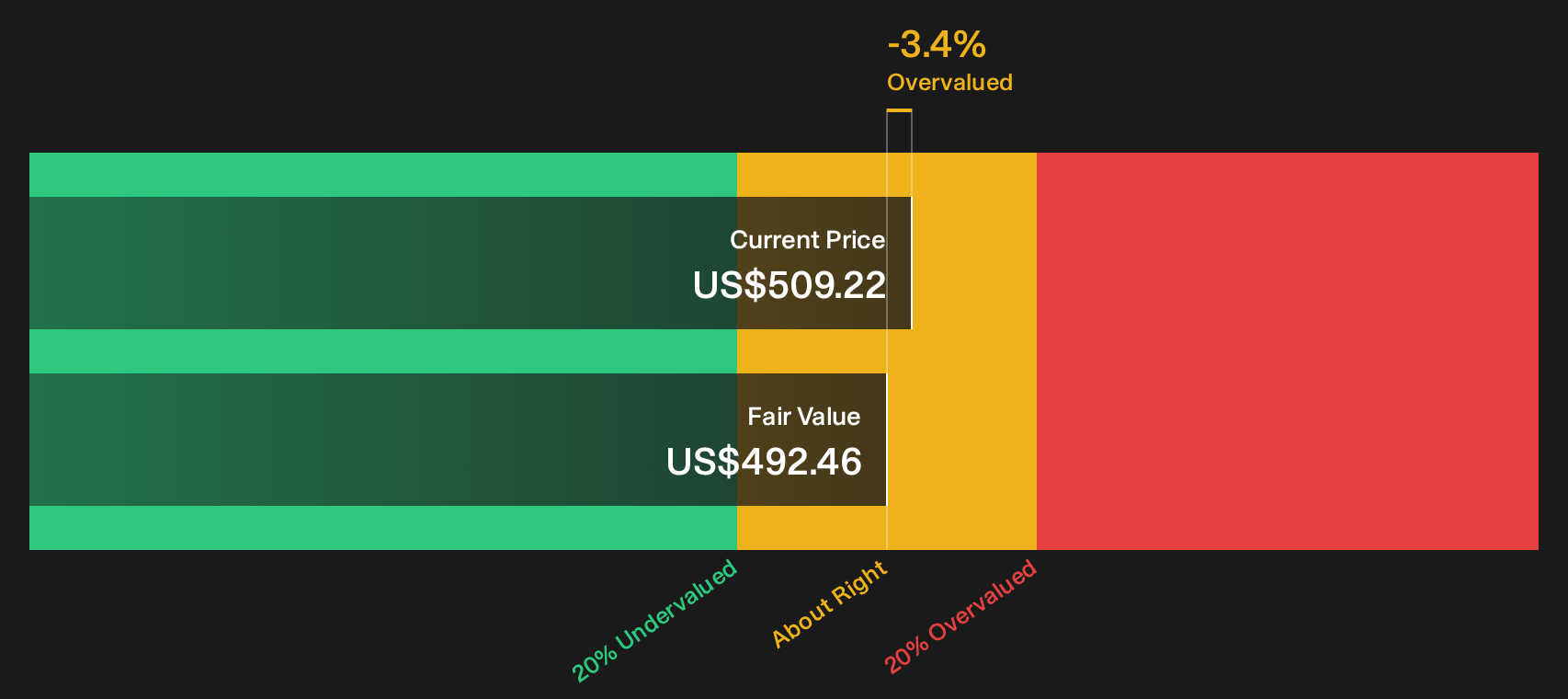
Pulling those projections together, the DCF model arrives at an estimated intrinsic value of $557.83 per share. Compared with the recent share price of $379.40, the DCF suggests Microsoft is trading at about a 32.0% discount. This indicates the stock appears undervalued on this measure.
Result: UNDERVALUED
Our Discounted Cash Flow (DCF) analysis suggests Microsoft is undervalued by 32.0%. Track this in your watchlist or portfolio, or discover 45 more high quality undervalued stocks.
Approach 2: Microsoft Price vs Earnings
For a profitable company like Microsoft, the P/E ratio is a straightforward way to think about what you are paying for each dollar of earnings. A higher or lower P/E often reflects how the market is weighing growth expectations against risk, so what counts as a “normal” or “fair” P/E can vary widely between companies and sectors.
Microsoft currently trades on a P/E of 22.51x. That sits below the average Software industry P/E of 25.94x and also below the peer group average of 28.93x. On the surface, those comparisons suggest the stock is priced more conservatively than many similar companies in its space.
Simply Wall St’s Fair Ratio aims to go a step further. It is a proprietary estimate of what Microsoft’s P/E might be, given its earnings growth profile, profit margins, industry, market cap and risk factors. Because it looks at these fundamentals directly, the Fair Ratio is designed to be more tailored than a simple peer or industry comparison. For Microsoft, the Fair Ratio stands at 45.08x, which is materially above the current P/E of 22.51x. On this metric, the stock screens as undervalued.
Result: UNDERVALUED

P/E ratios tell one story, but what if the real opportunity lies elsewhere? Start investing in legacies, not executives. Discover our 20 top founder-led companies.
Upgrade Your Decision Making: Choose your Microsoft Narrative
Earlier it was mentioned that there is an even better way to understand valuation. Narratives take that idea further by letting you attach a clear story about Microsoft, including your view on its fair value and future revenue, earnings and margins, directly to a financial forecast that then links to a fair value per share.
On Simply Wall St’s Community page, Narratives are an easy tool you can use to pick or build a Microsoft story, connect it to the numbers, and then see in one place how your Fair Value compares with today’s price so you can judge whether the stock looks expensive or cheap against your own assumptions.
Narratives also update automatically when new information such as earnings, news or analyst estimates is added, so your story and valuation stay in sync rather than going stale the moment the next quarter is reported.
For Microsoft, one investor might focus on enterprise cash flow durability and assign a fair value around US$330 to US$360 per share, while another leans into a view of a stronger AI and cloud trajectory and lands closer to US$550 per share. Narratives simply make those different viewpoints explicit, comparable and trackable over time.
For Microsoft however we will make it really easy for you with previews of two leading Microsoft Narratives:
Fair value: US$466.00 per share
Implied discount to this fair value: 18.6% based on the recent US$379.40 share price
Revenue growth assumption: 9.8%
- Frames Microsoft as a financially robust business where recent spending on AI and cloud infrastructure is treated as an investment signal rather than a problem.
- Emphasizes strong free cash flow, high margins and a sizable net cash position alongside large committed commercial backlogs.
- Highlights regulatory and partnership risks, but argues these are manageable in the context of the overall business strength and long term cash generation.
Fair value: US$359.78 per share
Implied premium to this fair value: 5.5% based on the recent US$379.40 share price
Revenue growth assumption: 3.6%
- Anchors Microsoft’s worth in resilient enterprise cash flows and subscription moats, but sets a lower real terms base value of about US$330 to US$360 per share.
- Points to heavy AI, data center and silicon spending and margin pressure, alongside a US$627b commercial backlog and a US$37b AI revenue run rate.
- Views OpenAI partnership changes, high capital intensity and regulatory scrutiny as factors that could limit long term upside if real earnings growth stays closer to 4%.
Do you think there's more to the story for Microsoft? Head over to our Community to see what others are saying!

This article by Simply Wall St is general in nature. We provide commentary based on historical data and analyst forecasts only using an unbiased methodology and our articles are not intended to be financial advice. It does not constitute a recommendation to buy or sell any stock, and does not take account of your objectives, or your financial situation. We aim to bring you long-term focused analysis driven by fundamental data. Note that our analysis may not factor in the latest price-sensitive company announcements or qualitative material. Simply Wall St has no position in any stocks mentioned.