

Microsoft (MSFT) Stock May Be 1% Undervalued On Fresh AI Revenue News
Microsoft Corporation MSFT | 0.00 |
Microsoft stock has delivered a strong 69.3% gain over the past 5 years, yet current valuation checks send a more muted signal, with the Discounted Cash Flow (DCF) intrinsic value estimate sitting close to the recent market price and earnings multiples still screening as supportive.
- The 69.3% return over 5 years highlights that long term holders have already seen substantial gains, so fresh buyers are coming in after a solid run rather than at depressed levels.
- Expectations around AI driven revenue from OpenAI and Azure can support the outlook for cash flows, while questions about the durability of AI spending and higher infrastructure costs may weigh on how much investors are willing to pay for that growth.
- Microsoft scores 3 out of 6 on our valuation checks, which points to a mixed picture rather than a clear bargain or clear overvaluation.
The issue now is whether Microsoft’s current price already reflects most of the AI and cloud optimism that has built up over recent years, or if there is still room relative to its intrinsic value estimate and earnings multiples.
Does Microsoft Look Fairly Valued on Cash Flow?
The Discounted Cash Flow model looks at the cash Microsoft is expected to generate for shareholders and brings those future dollars back to today. Microsoft currently produces about $96.0b in free cash flow over the latest twelve months in $. The model assumes that free cash flow keeps growing from this already large base, which fits with ongoing investment in cloud and AI related infrastructure and services.
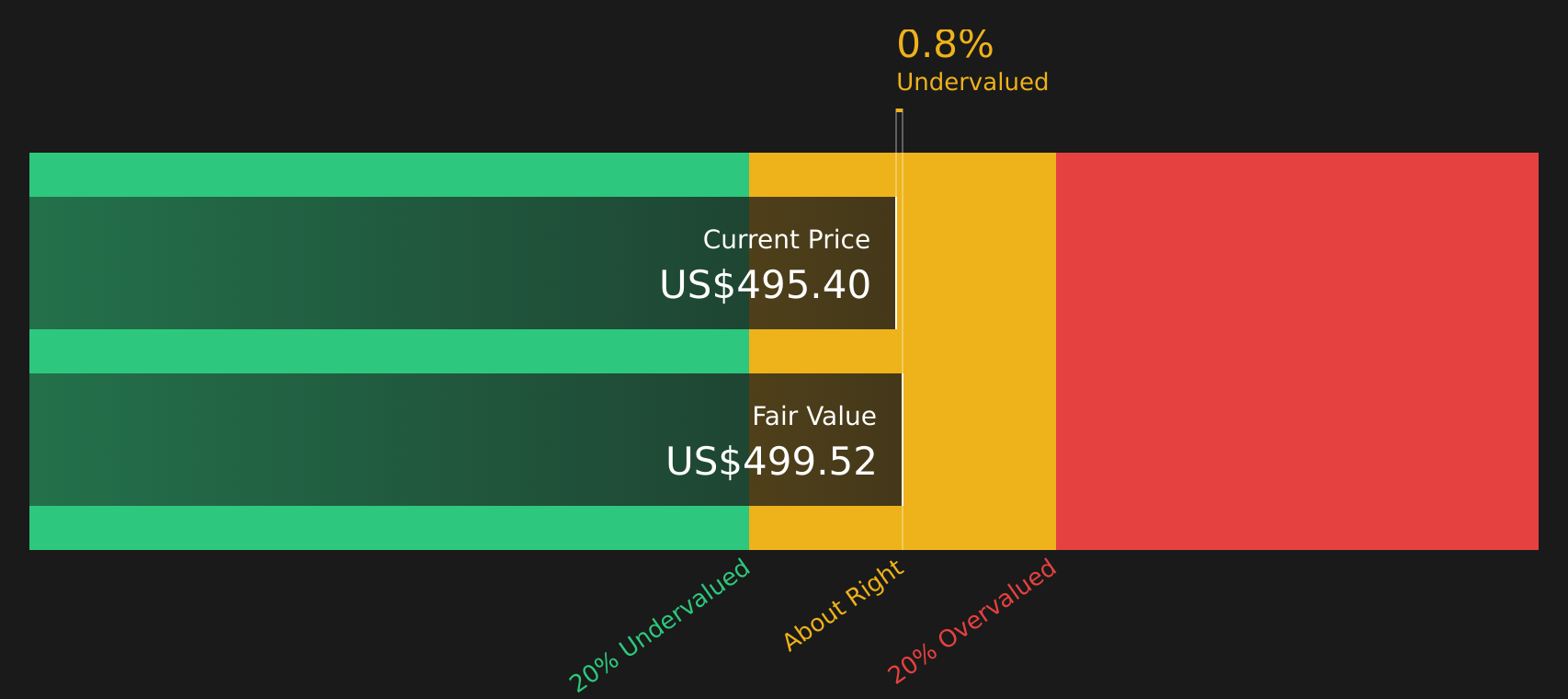
On these assumptions, the DCF model points to an intrinsic value of about $499 per share, which is only around 0.8% above the recent market price. Because Microsoft derives a large share of its AI revenue through OpenAI and faces questions about how sustainable that demand will be, the very small discount helps explain why the stock does not screen as a clear bargain or an obvious outlier.
Overall, Microsoft stock comes out as roughly fairly valued on this cash flow based view, with the current price sitting very close to the DCF estimate.
Microsoft is fairly valued according to our Discounted Cash Flow (DCF), but this can change at a moment's notice. Track the value in your watchlist or portfolio and be alerted on when to act.
Is Microsoft a Bargain on Earnings?
The P/E ratio suits Microsoft because earnings are a key driver of how investors look at mature, highly profitable software stocks. Microsoft currently trades on a P/E of 27.5x, which is below the Software industry average of 31.4x and only modestly above the peer group average of 24.9x. That places the stock at a premium to direct peers, but not at the top end of the broader sector.
The tailored fair P/E ratio for Microsoft is 48.8x based on its mix of growth profile, margins, scale and business risk. Compared with the current 27.5x, this is a wide gap and indicates that the stock is pricing in less than the framework would imply for those fundamentals. For investors who put more weight on earnings-based valuation, Microsoft appears attractively priced on this model relative to both the fair ratio and the industry average.
Overall, Microsoft stock appears undervalued on its current P/E multiple when compared with this earnings-based fair value framework.

The Microsoft Narrative: What Would Justify Today's Price?
Simply Wall St Narratives pick up where the Microsoft valuation puzzle above leaves off. They explain which combinations of future growth, margins and earnings would need to occur for the stock to be worth significantly more or less than it is today. Each one ties a fair value estimate to a clear story about Microsoft's potential catalysts and risks so you can track over time which version seems to be unfolding on the Community page.
Community views on Microsoft sit far apart, with one side leaning into the AI and cloud buildout story while the other fixates on the cash and capex profile.
Bull case: 12% undervalued
"The accelerated adoption and integration of AI capabilities across Microsoft's infrastructure and application stack including Azure AI, Copilot, Dynamics 365, GitHub, and Fabric are driving new revenue streams and usage intensity…"
Bear case: 25% overvalued
"Free cash flow fell, not slowed, fell in the same twelve months that operating profit went up $26.7 billion…"
Do you think there's more to the story for Microsoft? Head over to our Community to see what others are saying!
The Bottom Line
Microsoft looks roughly fairly valued on the Discounted Cash Flow (DCF) view, since the intrinsic value estimate sits very close to the current share price. The earnings multiple view is more generous and points to the stock as undervalued relative to its tailored fair P/E and the wider software industry. That mixed read fits with the broader valuation checks and keeps the focus on a single question: the key issue now is whether AI and cloud related spending can translate into cash flows that justify both the current valuation and any further uplift in the P/E investors are willing to pay.
This article by Simply Wall St is general in nature. We provide commentary based on historical data and analyst forecasts only using an unbiased methodology and our articles are not intended to be financial advice. It does not constitute a recommendation to buy or sell any stock, and does not take account of your objectives, or your financial situation. We aim to bring you long-term focused analysis driven by fundamental data. Note that our analysis may not factor in the latest price-sensitive company announcements or qualitative material. Simply Wall St has no position in any stocks mentioned.