

Musk Says Memory Demand Is Growing 200%—So Why Are SNDK and WDC Down 8%–13% Today
Sandisk Corporation SNDK | 0.00 | |
Western Digital Corporation WDC | 0.00 | |
SK hynix Inc. Sponsored ADR SKHY | 0.00 | |
SpaceX SPCX | 0.00 | |
Tesla Motors, Inc. TSLA | 0.00 |
SanDisk and Western Digital delivered blockbuster quarters, yet both stocks sold off. For investors, the message is clear: strong AI demand is no longer enough when valuations already assume near-perfect execution.
A major earnings beat is no longer guaranteed to lift a memory stock.
After the U.S. market closed on August 5, Sandisk Corporation(SNDK.US) and Western Digital Corporation(WDC.US) both reported stronger-than-expected fiscal fourth-quarter results. SanDisk also announced a $14 billion share repurchase program.
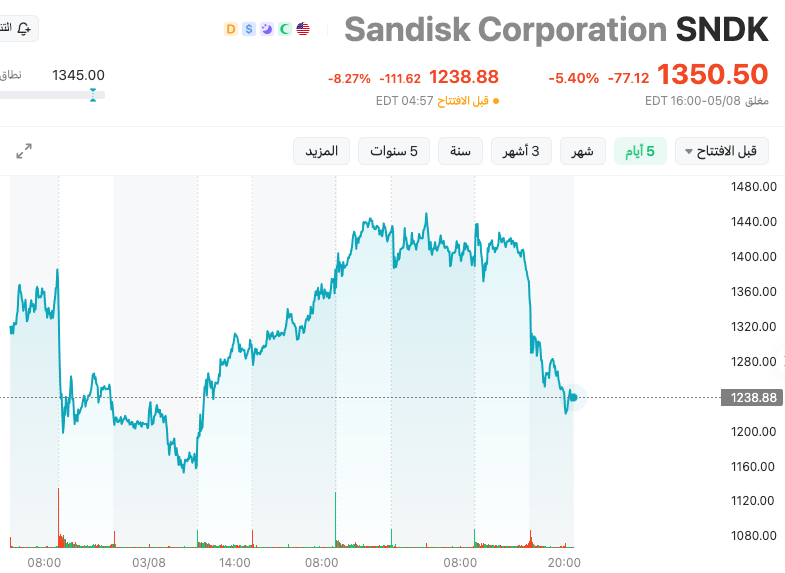
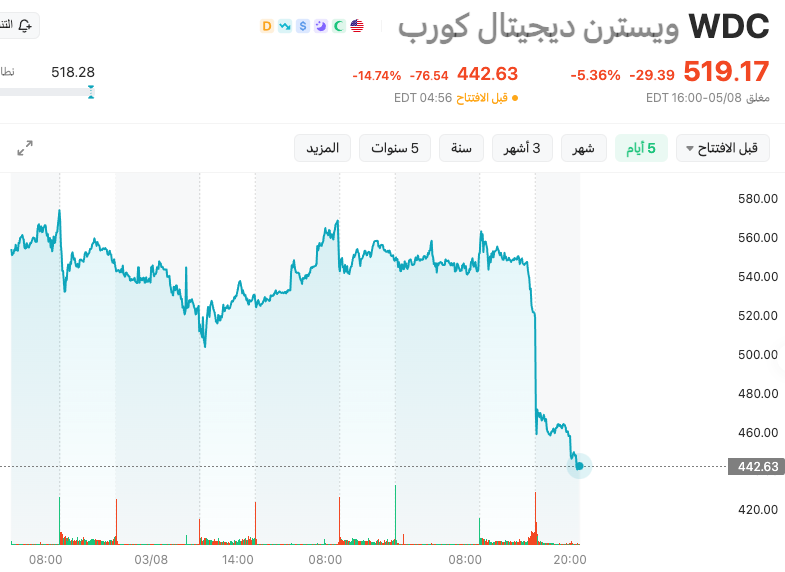
Yet both stocks fell more than 8% in pre-market trading today.
@ Sandisk Corporation(SNDK.US)
@ Western Digital Corporation(WDC.US)
The sell-off quickly spread across Asia. SK hynix Inc. Sponsored ADR(SKHY.US) dropped more than 8%, Samsung Electronics fell over 5%, and Japan’s Kioxia plunged by more than 10%.
The problem was not a sudden deterioration in business fundamentals. According to Goldman Sachs analyst James Schneider’s team, investor expectations had simply moved too far ahead of reality.
When share prices already assume flawless execution and continuous upside surprises, even solid guidance can be treated as a disappointment.
The investor takeaway
The latest results point to three different conclusions:
- Near-term sentiment remains fragile: Strong earnings may not protect stocks if guidance fails to clear an exceptionally high bar.
- AI-related storage demand remains robust: Corporate customers are still competing for memory and storage capacity.
- Future returns will depend on durability: Investors now need evidence that pricing, contracts and technology advantages can support earnings beyond the current cycle.
Western Digital: Strong execution, but not enough surprise
Western Digital Corporation(WDC.US) reported quarterly revenue of $3.747 billion, up nearly 44% year over year. Non-GAAP gross margin reached 54.4%, while non-GAAP EPS came in at $3.56—both above expectations.
Its next-quarter outlook was also respectable. Revenue guidance centered on $4.1 billion, gross margin was projected at 55% to 56%, and non-GAAP EPS guidance had a midpoint of $4.00.
The difficulty was that investors had already priced in continued HDD price increases, further margin expansion and durable demand from major cloud providers. Guidance that was merely in line with—or modestly above—expectations offered little reason to push the valuation higher, especially after the stock had nearly doubled this year.
Investors should also look beyond the headline GAAP profit.
Western Digital reported GAAP net income of $3.195 billion, but approximately $2.05 billion came from mark-to-market gains on its remaining SanDisk stake. Excluding such items, non-GAAP net income was $1.382 billion.
Operationally, Western Digital Corporation(WDC.US) is now highly concentrated in the cloud market, which generated 89% of quarterly revenue. This provides strong demand visibility but also leaves the company heavily dependent on a relatively small group of major customers.
CEO Irving Tan argues that AI creates a structural tailwind for HDD demand: training produces data, inference produces even more, and AI agents generate intermediate data that must be stored. As he put it, compute capacity can be reused, but data continues to accumulate.
The company is also advancing its capacity roadmap. Its 40TB ePMR drives are already shipping, while 44TB HAMR drives are scheduled for mass production in the first half of 2027, followed by 50TB products in the second half.
Goldman Sachs maintains a Neutral rating on Western Digital Corporation(WDC.US) and a 12-month price target of $650, implying approximately 18.5% upside from the price referenced in its report.
SanDisk: A spectacular quarter overshadowed by guidance
SanDisk’s quarterly numbers were even more striking.
Revenue reached $8.965 billion, up 372% year over year. Gross margin rose to 84.6%, while non-GAAP EPS of $39.25 comfortably exceeded Wall Street expectations.
Pricing was the biggest contributor. SanDisk said roughly two-thirds of its sequential revenue growth came from higher NAND wafer prices, while one-third came from shipment growth.
Its customer mix also shifted rapidly toward AI infrastructure. Data center revenue doubled quarter over quarter to $2.977 billion, and data center products accounted for 38% of total bit shipments, up from 12% one year earlier.
Meanwhile, consumer revenue fell 32% sequentially as SanDisk redirected capacity toward enterprise customers. CEO David Goeckeler said the consumer business could not keep pace with the transactional market’s pricing environment.
Despite the strong quarter, Sandisk Corporation(SNDK.US)’s outlook disappointed investors.
Its next-quarter revenue guidance midpoint was $10.55 billion, 5.4% below consensus and 9.5% below Goldman Sachs’ forecast. Gross margin guidance centered on 84%, below the 86.7% consensus estimate, while EPS guidance of $45 was broadly in line with Wall Street expectations but below Goldman’s projection.
The market had entered earnings season expecting robust NAND pricing, rapid AI data center adoption and continued upside following strong peer results. Sandisk Corporation(SNDK.US)’s shares had already fallen roughly 40% from their June peak, but the softer guidance showed that expectations still had room to reset.
Goldman nevertheless retains a Buy rating and a 12-month target of $2,200, representing approximately 54% potential upside from the price cited in its report.
Can SanDisk become less cyclical?
A key part of SanDisk’s long-term case is its “New Business Model,” under which cloud customers commit to future volume and pricing.
The company has signed 10 agreements with eight customers, representing minimum contracted revenue of $93.9 billion. These agreements are supported by $16.5 billion in cash deposits and other financial guarantees, with a weighted average duration exceeding four years.
Around 50% of SanDisk’s expected FY2027 bit shipments are already covered by these arrangements, rising to approximately two-thirds in FY2028.
If these commitments remain durable through industry downturns, Sandisk Corporation(SNDK.US) could become less dependent on short-term NAND market swings. Execution and contract durability, however, remain essential tests for investors.
Musk sees scarcity—not oversupply
While markets are increasingly worried about the sustainability of the memory cycle, Elon Musk sees a very different supply-demand picture.
During SpaceX(SPCX.US)’s earnings call, Musk described memory as the current limiting factor for AI expansion. He argued that memory production is growing by roughly 20% annually, while demand may be increasing by 200% or more.
That view carries weight because Tesla Motors, Inc.(TSLA.US) and SpaceX(SPCX.US) are both major purchasers of AI chips, memory and data center infrastructure.
It also contrasts with concerns that capacity expansion by producers such as SK hynix Inc. Sponsored ADR(SKHY.US) could eventually create oversupply. In Musk’s view, demand is expanding far too quickly for current production growth to catch up.
Projected 2026 capital expenditure of more than $800 billion across major global cloud providers also supports the structural demand case. AI training and inference clusters are consuming significantly more memory and storage than previously expected.
Strong demand can coexist with slower pricing
The biggest near-term risk may not be an outright collapse in demand. It may be a slowdown in the pace of price increases.
TrendForce expects third-quarter DRAM contract prices to rise 13% to 18% sequentially, while NAND Flash prices could increase 10% to 15%. Those would still be significant gains, but far below the explosive increases seen in earlier quarters.
Jefferies has also reduced its estimate for third-quarter price increases from 25%–30% to 15%–20%, warning that peak pricing could arrive sooner than previously expected.
Consumer resistance is another signal to monitor. OPPO and vivo have reportedly rejected Samsung’s proposed third-quarter prices, while Sandisk Corporation(SNDK.US)’s consumer revenue has already declined sharply.
For investors, the distinction matters: memory demand can remain structurally strong even as pricing momentum and earnings growth begin to normalize.
Four signals investors should watch next
- Actual memory contract prices
If price increases slow toward the TrendForce and Jefferies estimates, the market may conclude that the steepest part of the cycle has passed. - Sandisk Corporation(SNDK.US)’s contract execution
Its long-term agreements could reduce cyclicality, but investors need evidence that committed volumes, pricing and financial guarantees remain dependable under different market conditions. - Western Digital Corporation(WDC.US)’s technology roadmap
The ramp-up of 40TB products and the transition to 44TB and 50TB HAMR drives will determine whether the company can sustain higher capacity, pricing and margins. - Spillover into Micron and other peers
Goldman Sachs expects SanDisk’s weaker-than-anticipated guidance to pressure Micron Technology, Inc.(MU.US) because of their overlapping end-market exposure. Peer guidance may therefore matter as much as individual earnings beats.
The bottom line
The latest sell-off does not necessarily mean that AI-driven memory demand has peaked. It shows that the market has changed the standard by which memory stocks are judged.
Sandisk Corporation(SNDK.US) offers greater upside to the NAND cycle and growing data center demand, but it also carries greater exposure to pricing volatility. Western Digital Corporation(WDC.US) has a more predictable HDD model, although its dependence on cloud customers creates concentration risk.
For both companies, record earnings are no longer sufficient. Investors now want proof that pricing power, customer commitments and technology advantages can produce sustained outperformance—not just another strong quarter.