

News Headline | SK Hynix's Record $29B Nasdaq Listing In This Week: Can the AI Memory Giant Spark the Next Semiconductor Rally — or Signal the Peak of the Boom?
SK hynix SKHY | 0.00 | |
Micron Technology, Inc. MU | 0.00 | |
SAMSUNG ELECTRONICS CO SSNLF | 0.00 | |
UBS Group AG UBS | 0.00 | |
Microsoft Corporation MSFT | 0.00 |
oWall Street is about to gain a new heavyweight in the AI race.
South Korean memory giant SK hynix(SKHY.US) is expected to begin trading on the NASDAQ(IXIC.US) on July 10 under the ticker SKHY, in what could become the largest U.S. equity fundraising by a foreign-listed company. The company is expected to raise roughly $29 billion through an American Depositary Share (ADS) offering priced at around $166 per ADS, with proceeds earmarked for expanding its Yongin semiconductor cluster and advanced packaging facilities in Cheongju.
The timing is notable. Just days after Samsung Electronics disappointed investors with weaker-than-expected earnings guidance, SK Hynix is stepping onto Wall Street as the world's leading supplier of AI memory chips.
For investors, the listing is about far more than fundraising. It could unlock a long-awaited valuation re-rating, attract billions of dollars of passive ETF inflows, and potentially reignite momentum across AI memory stocks. Yet some market veterans argue it may also represent a classic late-cycle warning for one of the semiconductor industry's most cyclical segments.
Why the Nasdaq Listing Matters
SK Hynix has long been difficult for U.S. investors to own. Although the company is one of Nvidia's most important suppliers of high-bandwidth memory (HBM), investors have largely been forced to trade its Korean shares or rely on thinly traded OTC ADRs.
A Nasdaq listing changes that.
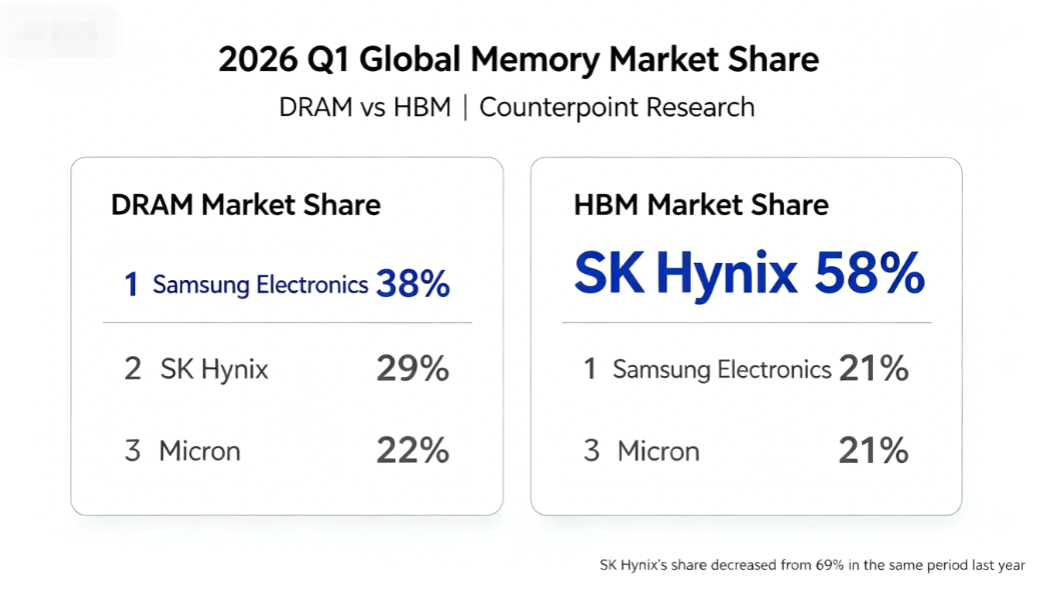
It places SK Hynix alongside Micron Technology, Inc.(MU.US), giving investors two pure-play AI memory leaders on the same exchange. According to Counterpoint Research, SK Hynix currently commands roughly 58% of the global HBM market, compared with Micron's 21%, with SAMSUNG ELECTRONICS CO(SSNLF.US) accounting for most of the remainder.
The listing effectively gives Wall Street another direct way to invest in the AI infrastructure buildout, where memory chips have become one of the industry's most supply-constrained components.
A Valuation Gap Could Narrow
Another major investment thesis centers on valuation.
SK Hynix currently trades at roughly 6-7x forward earnings, below Micron's 8-10x valuation range, also below the roughly 8x forward multiple implied by its global memory peers, leaving room for a valuation re-rating if the Nasdaq listing broadens its investor base. The Information also noted that SK Hynix trades at lower forward price-to-sales and price-to-book multiples despite its leadership in HBM.
Many investors believe this discount reflects market structure rather than fundamentals. Easier access for U.S. investors, stronger liquidity and broader institutional ownership could gradually narrow the valuation gap between the two AI memory leaders.
An additional catalyst could come from index inclusion.
According to UBS Group AG(UBS.US) Research, SK Hynix could attract approximately $3.5 billion in passive inflows if included in the MVIS US Listed Semiconductor 25 Index (tracked by SMH). Longer term, eventual inclusion in larger U.S. benchmarks such as the Nasdaq-100 could drive cumulative passive inflows of up to $15 billion.
Index Inclusion and Arbitrage Opportunities: Two Catalysts Awaiting Release
According to Bloomberg, a significant potential benefit of this listing is SK Hynix's eligibility for inclusion in US stock indices, potentially triggering systematic buying in passively managed ETFs.
For example, the Invesco QQQ Trust, which tracks the Nasdaq 100 index and manages $482 billion, will see substantial passive inflows once SK Hynix is included.
Meanwhile, the real opportunity begins after trading starts. The offering is expected to be priced at around $166 per ADS, equivalent to roughly KRW 255,000 per ordinary share—largely in line with SK Hynix's recent trading price on the Korea Exchange, meaning the IPO itself is not being offered at a meaningful premium.
If stronger U.S. institutional demand pushes the ADR above its Korean equivalent, arbitrage funds could buy the Seoul-listed shares while selling the higher-priced ADR, helping narrow price gaps and boost liquidity. Some investors are also betting that limited ADR conversion capacity—estimated by market participants at roughly 15%–20% of outstanding shares—could allow the U.S.-listed shares to maintain a persistent premium over time, similar to Taiwan Semiconductor Manufacturing Co., Ltd. Sponsored ADR(TSM.US).
Could the Listing Lift the Entire Memory Sector?
The listing arrives at a time when AI infrastructure spending continues to dominate semiconductor investment.
Cloud giants including Microsoft Corporation(MSFT.US), Alphabet Inc. Class C(GOOG.US), Amazon.com, Inc.(AMZN.US) and Meta Platforms(META.US) are still investing aggressively in AI data centers, while NVIDIA Corporation(NVDA.US)'s next-generation GPUs require increasing amounts of HBM memory.
If the ADR attracts strong institutional demand, investors may rotate into the broader AI memory supply chain rather than SK hynix(SKHY.US) alone.
Stocks to Watch
A successful Nasdaq debut could have implications well beyond SK Hynix itself. Investors often use high-profile semiconductor listings as a catalyst to rotate into related AI infrastructure names, particularly those exposed to HBM memory, advanced packaging and chip manufacturing equipment. If institutional demand for SK Hynix exceeds expectations, the positive sentiment could spill over into the broader AI semiconductor ecosystem, reinforcing the sector's leadership in the current market cycle.
| Company | Why It Matters |
|---|---|
| Micron Technology, Inc.(MU.US) | Direct U.S. memory peer and HBM supplier to Nvidia |
| SAMSUNG ELECTRONICS CO(SSNNF.US) | Expanding HBM production to regain market share |
| NVIDIA Corporation(NVDA.US) | Largest customer for advanced HBM chips |
| Advanced Micro Devices, Inc.(AMD.US) | AI accelerators require large HBM capacity |
| Broadcom Limited(AVGO.US) | AI networking and custom silicon |
| Marvell Technology(MRVL.US) | AI infrastructure and custom chips |
| Applied Materials, Inc.(AMAT.US) | Memory manufacturing equipment |
| Lam Research Corporation(LRCX.US) | Wafer fabrication equipment |
| KLA(KLAC.US) | Process control for semiconductor manufacturing |
| Amkor Technology, Inc.(AMKR.US) | Advanced semiconductor packaging |
Investors looking for diversified exposure may also watch semiconductor ETFs such as VanEck Vectors Semiconductor ETF(SMH.US) and PHLX Sox Semiconductor Sector Ishares(SOXX.US), both of which could benefit from renewed interest in AI infrastructure.
| ETF | Why Investors Should Watch |
|---|---|
| VanEck Vectors Semiconductor ETF(SMH.US) | Largest near-term passive inflow opportunity (~$3.5B, UBS estimate) |
| PHLX Sox Semiconductor Sector Ishares(SOXX.US) | Secondary semiconductor ETF |
| PowerShares QQQ Trust,Series 1(QQQ.US) | Biggest long-term catalyst if SK Hynix enters the Nasdaq-100 |
| Invesco NASDAQ 100 ETF(QQQM.US) | Tracks the same index as QQQ, adding incremental passive demand |
Or Is This the Top of the Cycle?
Despite the enthusiasm, not everyone is convinced.
Memory has historically been one of the semiconductor industry's most cyclical businesses, and some investors argue that major capital raises during boom periods have often preceded industry oversupply.
GAM Investment Management portfolio manager Jian Shi Cortesi has noted that memory stocks frequently peak before DRAM prices themselves reach their highs. Once pricing momentum begins to flatten, equity valuations can deteriorate quickly.
Others caution that the AI investment cycle ultimately depends on sustained spending from hyperscalers. If Microsoft, Alphabet, Amazon or Meta begin slowing data-center investment while new memory capacity comes online, pricing power across the industry could weaken much faster than expected.
Recent volatility in AI semiconductor shares has highlighted those concerns, reminding investors that even sector leaders remain highly cyclical.
Timeline: What Investors Should Watch
July 9 – Final ADS pricing expected
July 10 – SK Hynix begins trading on Nasdaq under ticker SK hynix(SKHY.US)
Following Weeks – Watch for institutional ownership trends, ADR liquidity and potential arbitrage between U.S. and Korean shares
Coming Months – Monitor eligibility for semiconductor indexes and future NASDAQ-100(NDX.US) inclusion, which could unlock additional passive ETF inflows
Q3 Earnings Season – Investors will focus on HBM demand, AI infrastructure spending and management guidance for 2027 capacity expansion
SK Hynix's Nasdaq debut marks more than a landmark listing—it represents a new chapter in how global investors access the AI memory trade.
If Wall Street embraces the company, the listing could narrow its valuation discount, drive billions in passive inflows and provide fresh momentum for the broader semiconductor sector. But investors should also remember that memory remains one of the market's most cyclical industries, where sentiment often peaks before fundamentals do.
Whether SK Hynix becomes the next AI market darling—or the latest signal that expectations have run too far ahead—may ultimately depend less on the IPO itself than on the durability of the global AI spending boom.