

NIKE (NKE) Moved Higher, But What Is Drawing Attention Now?
NIKE, Inc. Class B NKE | 0.00 |
Nike (NKE) is under pressure as its turnaround effort collides with weak digital demand, softer Greater China sales, and rising competition. Leadership changes and cautious sentiment now frame how investors read every new development.
Nike’s share price has bounced 2.47% over the past day and 1.33% over the past week, yet the 35.13% year to date share price decline and 44.69% fall in 1 year total shareholder return show momentum is still weak despite community projects like Crenshaw Rec and ongoing leadership changes.
If Nike’s reset has you rethinking where growth might come from next, this can be a good moment to size up 21 top founder-led companies
Nike still has a huge global footprint and strong brands, yet the stock has dropped to around a 12 year low. After that kind of reset, is this business simply cheap or fairly priced for its challenges?
Most Popular Narrative: 11.5% Overvalued
Narrative followers currently see Nike’s fair value at $36.83, which sits below the last close at $41.05 and frames the stock as pricing in more optimism than the model supports.
Nike runs with a solid operating margin above the ~10% mark, showing it still has some competitive advantage over competitors even with the maturity of its business and a highly competitive industry. Despite currently having a flat revenue growth, its projections point to a slightly below economy growth rate of ~3% over the next couple of years. The fact that the ROIC is almost double its cost of capital is good to see.
Read the complete narrative. Read the complete narrative.
The narrative leans heavily on how Nike converts its revenue into profit, the gap between return on capital and the discount rate, and what that means for future earnings power and valuation multiples. The detail is in how those inputs interplay over time, not just the headline fair value.
Result: Fair Value of $36.83 (OVERVALUED)
However, Nike’s narrative could be challenged if digital demand stays soft or if Greater China and wholesale partners reduce orders further, which would pressure margins and sentiment.
Another View On NIKE Using Our DCF Model
The user narrative suggests Nike is around 11.5% overvalued at $41.05, yet our DCF model presents a different perspective. Based on Simply Wall St estimates, Nike trades about 2.9% below an implied fair value of $42.26. This frames the stock as roughly in line with its future cash flow value rather than significantly overvalued. Which view do you find more convincing?
For readers who want to see how different cash flow paths translate into that fair value range, it can help to walk through the mechanics of the SWS DCF model in full detail. Look into how the SWS DCF model arrives at its fair value.
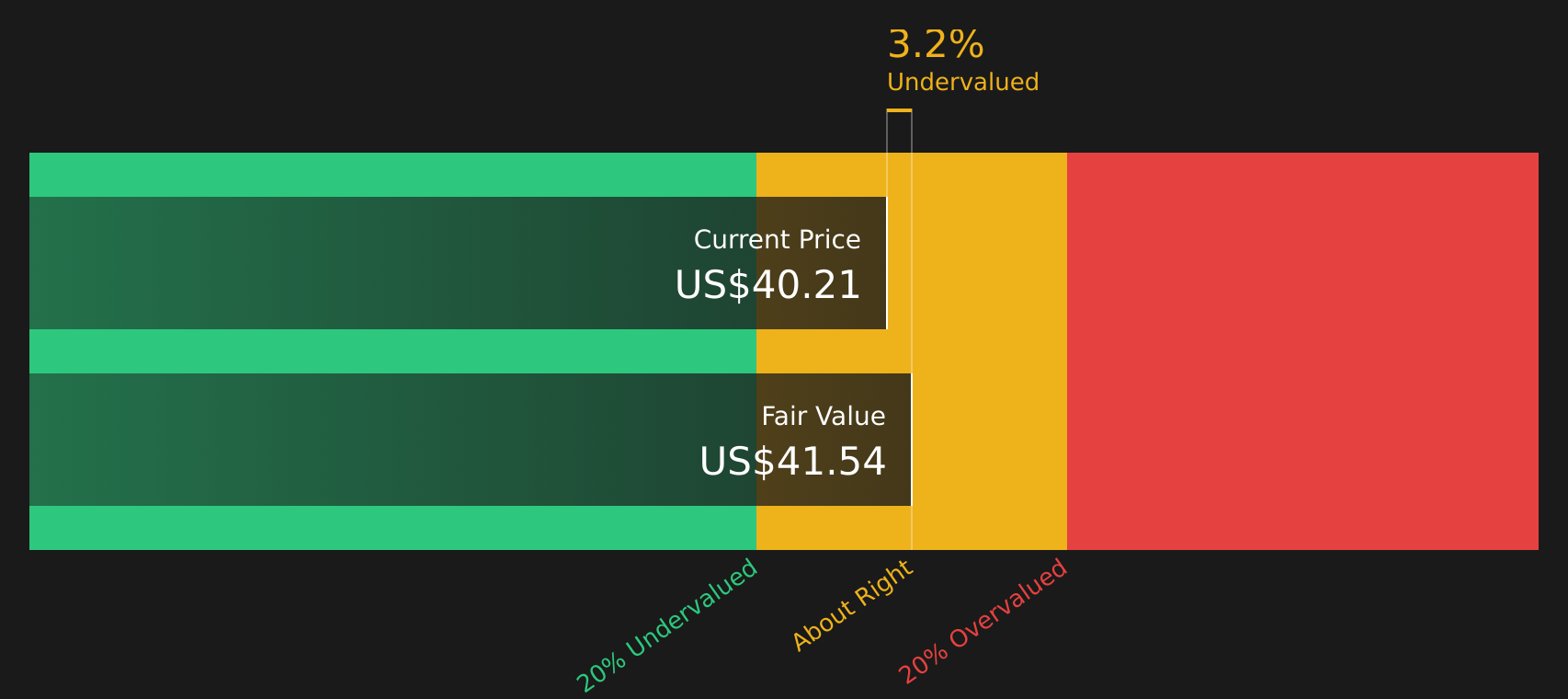
Simply Wall St performs a discounted cash flow (DCF) on every stock in the world every day (check out NIKE for example). We show the entire calculation in full. You can track the result in your watchlist or portfolio and be alerted when this changes, or use our stock screener to discover 52 high quality undervalued stocks. If you save a screener we even alert you when new companies match - so you never miss a potential opportunity.
Next Steps
With sentiment on Nike finely balanced between concern and optimism, it can help to move quickly and review both sides of the story for yourself. To weigh up what investors see as the main risks and rewards, take a closer look at the 2 key rewards and 1 important warning sign
Looking for more investment ideas beyond Nike?
If Nike’s situation has you reassessing where to commit fresh capital, broaden your watchlist now so you are not relying on a single turnaround story.
- Target resilient income by checking out companies screened as potential 12 dividend fortresses that might suit investors who prioritize regular cash returns.
- Hunt for potential value opportunities by reviewing the 52 high quality undervalued stocks that combine quality with pricing that may appeal to disciplined buyers.
- Focus on stability first by scanning 78 resilient stocks with low risk scores which could help if you want to limit downside while still staying invested.
This article by Simply Wall St is general in nature. We provide commentary based on historical data and analyst forecasts only using an unbiased methodology and our articles are not intended to be financial advice. It does not constitute a recommendation to buy or sell any stock, and does not take account of your objectives, or your financial situation. We aim to bring you long-term focused analysis driven by fundamental data. Note that our analysis may not factor in the latest price-sensitive company announcements or qualitative material. Simply Wall St has no position in any stocks mentioned.