

No Charts, No Indicators: How This Maverick Trader Made $42 Million in 15 Years
Tesla Motors, Inc. TSLA | 0.00 | |
Apple Inc. AAPL | 0.00 | |
Ultrapro QQQ Proshares TQQQ | 0.00 | |
Microsoft Corporation MSFT | 0.00 | |
SAUDI ARAMCO 2222.SA | 0.00 |
"One big trade in your lifetime is all you need to join the top 1% of investors. Land three, and you’ll be in the top 0.1%." — Chris Camillo

In an industry dominated by charts, spreadsheets, and technical analysis, Chris Camillo has carved out a distinctly different path. He doesn’t analyze financial statements, doesn’t rely on technical indicators, and doesn’t even check stock prices before executing a trade. For Camillo, once information reaches Wall Street, it’s already too late.
His strategy is unconventional. Camillo doesn’t dive deep into company financials or chase after “meme stocks.”
Instead, Camillo employs a self-coined investment strategy called “social arbitrage.” This method involves identifying opportunities early by observing trends on platforms like TikTok, Twitter, Facebook, and Instagram, as well as paying attention to everyday observations in the real world.
His results are extraordinary. According to trading expert and author of *Market Wizards*, Jack D. Schwager, Camillo achieved an annualized return of 77% between 2006 and 2020, compared to the S&P 500’s annualized growth rate of 7.6% over the same period.
Schwager, who audited Camillo’s trading records for his book *Unknown Market Wizards: The Best Traders You’ve Never Heard Of*, verified Camillo’s performance using monthly brokerage account statements dating back to August 2006. Starting with $84,000, Camillo’s account balance grew to over $21 million by May 2020, including cumulative net profits he had withdrawn. By May 2021, Schwager updated his audit, confirming that Camillo’s cumulative profits had doubled to $42 million.
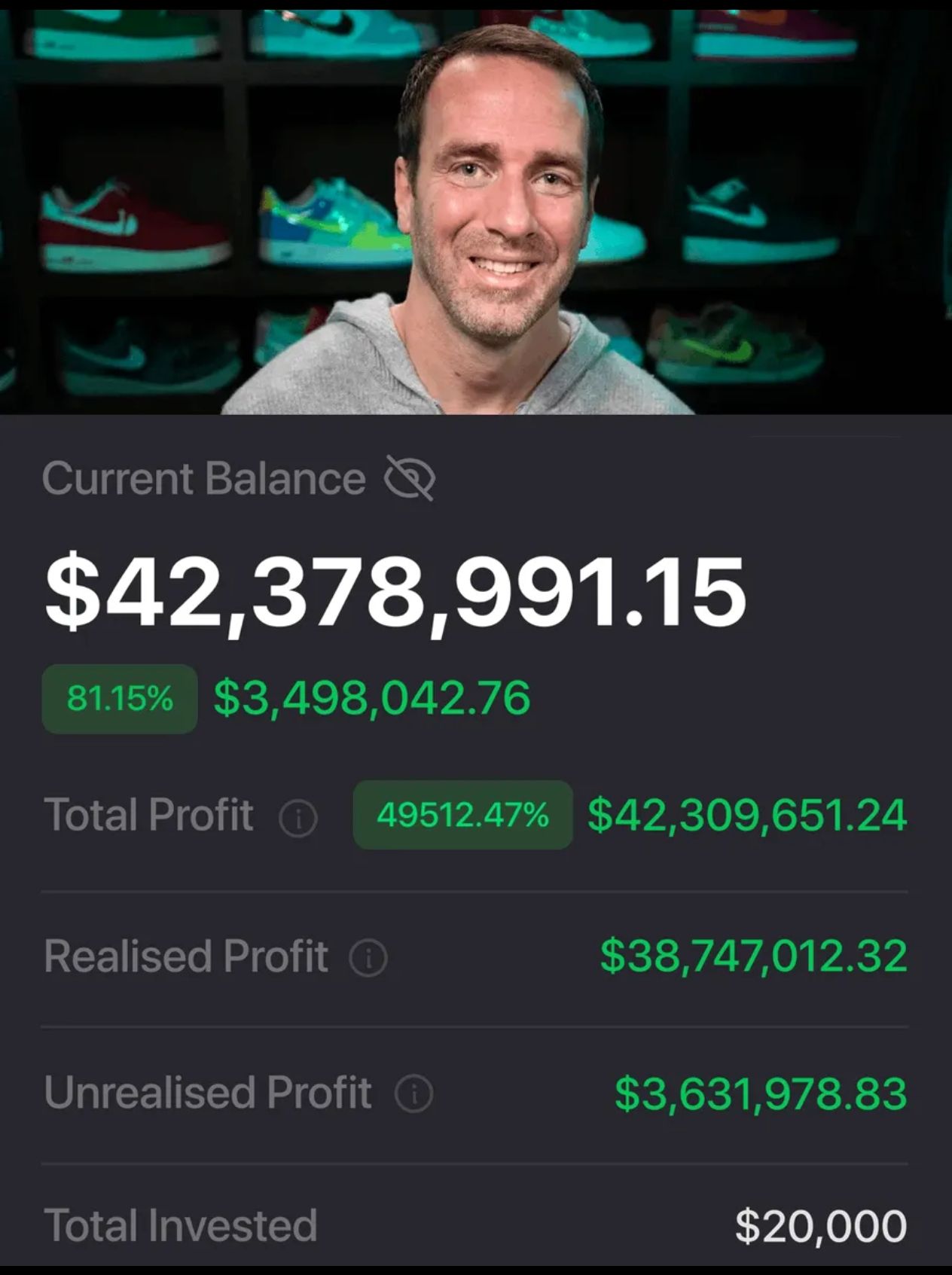
Business Insider also reviewed Camillo’s brokerage documents, including 1099 forms from 2014 to 2019, which showed approximately $5.6 million in gains over that period.
Chris Camillo's Professional Background
Biljana Adebambo, the Academic Director of the Master of Finance Program at the University of San Diego School of Business, reviewed Chris Camillo's brokerage account statements at the request of Business Insider and concurred with Jack Schwager's assessment.
In an email, she stated: "This is an outstanding performance, but beyond exceptional insight, it likely involves higher-risk strategies, such as options."
She added: "Options, due to leverage, increase the volatility of returns and can also elevate the frequency or severity of losses. In fact, since the portfolio's inception, its volatility has been nearly five times that of the S&P 500 ETF during the same period. Such a risk level may not be suitable for many investors."
Camillo's performance is rare because even professional fund managers find it challenging to beat the market. According to an analysis of the S&P SPIVA report, over 86% of active U.S. equity fund managers underperformed the S&P 500 over the 20 years leading up to 2020.
Camillo is not a Wall Street veteran. His career began in marketing and sales. In 2015, he co-founded TickerTags, a software that detects early trends from social media, which was later acquired by M Science, a subsidiary of the Wall Street investment bank Jefferies Financial Group.
He now focuses on teaching others how to engage in "social arbitrage." He told Business Insider that he believes the best way to address the wealth gap is to bring more people into the investor class. One approach is through his YouTube channel, Dumb Money Live, where he and two friends share observations and social investing techniques weekly. He also collaborates with a group of social arbitrage investors on the Dumb Money Discord channel.
Camillo shared with Business Insider key aspects of his strategy and the investment opportunities he is currently monitoring.
How Chris Camillo Identifies Opportunities
Chris Camillo's social arbitrage strategy doesn't chase every upward trend.
"I only focus on trends that I believe could be truly significant," he says. "Not small trends, and not necessarily cutting-edge ones, but those that impact the entire country, the world, or a large group."
Once Camillo identifies a potentially important trend, his next step is as simple as performing a Google search to find out which publicly traded companies offer the relevant product or service.
For example, during the spring 2020 pandemic outbreak, many malls, cinemas, restaurants, and gyms in the U.S. closed. Camillo noticed a surge in social media discussions and interest related to outdoor activities, such as cycling or boating.
"I realized, wow, this could be the biggest demand surge these companies have ever seen," Camillo said. "And indeed, that's what happened in the summer of 2020."
One stock he targeted was Dorel Industries, the parent company of major bicycle manufacturers like Schwinn and Cannondale. According to screenshots from his TD Ameritrade account reviewed by Business Insider, he bought the stock at $1.56 on April 24, 2020.
As the information he traded on became widely known, he gradually sold his shares in June when the price reached around $4.46. He stated that he exited the position entirely by November, when the stock had risen to $11.38, a 629% increase.
Camillo advises conducting thorough research to ensure there are no other significant factors affecting the company, such as underperforming business segments.
Timing: The Key to His Strategy
Camilo emphasizes that timing is crucial to his strategy. He capitalizes on what he calls "information asymmetry," which is the gap between when he identifies potential sales growth and when this information reaches Wall Street.
"Once information becomes widely known, it is already fully reflected in the stock price," Camilo explains. "The key is to be early. The whole game of being an efficient, observant retail investor is to see and act faster than others."
One of his favorite tools is Google Trends, which helps him identify what people are searching for at an early stage. Since Google Trends defaults to a 12-month chart, Camilo recommends extending it to a five-year chart to filter out annual trends and account for seasonal adjustments.
Camilo states that his exit strategy is usually not abrupt; he gradually sells his positions as more people become aware of the information.
"Typically, I don't completely exit a trade until I see the information fully reflected in the company's revenue and profits and before the company discloses it. So, I might exit over weeks or even months, selling 10% or 20% at a time until fully out."
Investing carries risks, and not every trade is a winner. Camilo recalls his largest loss in 2019, amounting to $750,000, when he invested in Restaurant Brands International, the owner of Burger King. He bet on the launch of two chicken sandwich products at Burger King. However, the company's coffee chain, Tim Hortons, experienced one of its worst quarters ever.
"This was due to an oversight in not understanding the poor performance of the third brand, Tim Hortons. The issue was that it was a Canadian company, lacking social data or consumer perception," Camilo says.
According to screenshots reviewed by Business Insider, he bought the stock in April and August 2019. The stock peaked at $78.45 in August and fell to $59 by March 2020.
He says the lesson learned was to recognize what he didn't know. He had high confidence in the product launches, but didn't realize his lack of insight into the third company.

In February this year, Camilo stated he had made a $60 million bet on Tesla, artificial intelligence, and robotics.
Camilo's 15 Social Arbitrage Insights
During his recent appearance on the "Words of Rizdom" show, Camilo elaborated on the mindset behind his "social arbitrage" strategy—how he seeks generational investment opportunities by reading TikTok comments, observing trend shifts, and tracking consumer behavior ahead of others.
Here are 10 powerful, lesser-known insights from the show that every investor should study:
1. “What I do doesn’t require financial knowledge.”
As the king of social arbitrage trading, Camilo claims you don't need to be a finance expert to make millions through trading and investing. Forget financial statements and PE analysis. His winning strategy? Discover the next big thing before the masses, whether in fashion or any other field.
2. “I buy a company’s stock when I discover information asymmetry—when I think I know disruptive information others don’t; I sell when it’s widely accepted on Wall Street.”
This is the core of social arbitrage: exploiting information asymmetry. Camilo buys into the “hard” information most investors don’t know yet; when the news spreads across Wall Street and stock prices soar, he cashes out. Want to beat Wall Street? Research is key. Camilo was initially inspired by Peter Lynch’s "One Up on Wall Street."
3. “If you’re just an ordinary person, you actually have a natural edge over Wall Street—you just haven’t realized it yet.”
Camilo believes ordinary people are closer to consumer trends, holding a natural advantage. Wall Street executives don’t scroll TikTok or watch YouTube influencers, but you do! For example, if you notice a product going viral among friends, it might be the right time to buy shares in the related company.
4. “My investment style completely ignores fundamentals or technical analysis. I don’t study financial reports or care about the quality of company management.”
He abandons traditional investment methods, focusing instead on spotting consumer trends before Wall Street.
5. “In a year, I might find only one or two truly worthwhile investment opportunities.”
Camilo practices a “few but fine” investment philosophy. He emphasizes patience and precision—waiting for that one or two perfect opportunities.
6. “Like big wave surfers are bound by nature and ready to travel the world for the next big wave, information arbitrage investors must be patient, prepared, and accept the timing, location, and manner in which opportunities arise.”
Investing is like surfing: be patient, prepared, and adaptable. Social arbitrage investing is similar; golden opportunities don’t appear at your convenience, so you must seize them decisively like a surfer.
7. “As an information arbitrage investor, every observation in the real world is a potential strike. Every at-bat could uncover wealth-bringing information asymmetry.”
Every observation could be a goldmine. By keenly observing trends, events, and daily behaviors, you can uncover information overlooked or undervalued by the market.
8. “Catching one great deal every two to three years is enough to be in the top 0.1% of investors.”
Success isn’t about frequent trades, but about few, well-timed, perfect trades. Camilo typically bets 5%-30% of his portfolio on big opportunities, leaving no room for error.
9. “To be a great information arbitrage investor, you must change how you view the world and have the patience to act when opportunities arise.”
This isn’t a game for the faint-hearted; it requires keen observation and patience to strike at the right moment.
10. “Sometimes investing is just about catching the obvious early. Don’t overthink it.”
Don’t miss opportunities due to over-analysis; spotting the “obvious” hot products early is key to winning.
These 10 revolutionary insights teach you how to “swim upstream” to earn wealth. Each piece of advice is a goldmine, offering strategic insights for enormous returns. By embracing this unconventional mindset, immersing yourself in the latest trends, and staying ahead of the market, you can equip yourself to surpass most others.