

NVDA +4.7%, Yet CRWD +10.5% and CRM +13%: What Nvidia’s Earnings Really Mean—and What to Watch Next
NVIDIA Corporation NVDA | 0.00 | |
CrowdStrike CRWD | 0.00 | |
Salesforce.com, inc. CRM | 0.00 | |
Okta OKTA | 0.00 | |
Micron Technology, Inc. MU | 0.00 |
NVIDIA Corporation(NVDA.US), CrowdStrike(CRWD.US) and Salesforce.com, inc.(CRM.US) all reported earnings after the U.S. market closed on August 26. They operate in very different businesses, but together their results offer a useful snapshot of where the AI investment cycle is producing financial results.
The important point is not that “three AI stocks beat earnings.” It is that AI-related spending is showing up across three different layers: computing infrastructure, cybersecurity and enterprise software. The market is also judging each layer by a different standard.
⏱️ In One Minute: What Happened and What to Watch Next
Nvidia says AI infrastructure demand is still accelerating. CrowdStrike’s record new recurring business shows cybersecurity spending remains strong as AI creates more systems and identities to protect. Salesforce is showing clearer signs that AI-related products are becoming measurable recurring revenue. But the next test is different for each company: NVDA needs to protect margins, CRWD needs to sustain ARR acceleration, and CRM needs to turn AI momentum into faster organic growth.
Stocks & ETFs to Watch
| Ticker | Aug. 26 After-bell Stock Moves | Exposure | Why It Matters | What to Watch |
|---|---|---|---|---|
| +4.7% | Core AI Infrastructure | Strongest direct signal on AI compute demand | Gross margin, Rubin ramp, FY2028 growth | |
| +10.5% | AI Cybersecurity | Record net-new ARR shows accelerating security demand | Net-new ARR, Falcon Flex | |
| +13% | Enterprise AI | AI/data products are becoming measurable recurring revenue | cRPO, organic growth, Agentforce monetization | |
| +20.8% | Security Cross-Check | AI agents create new identity and access-control needs | cRPO, AI-related customer adoption | |
Micron Technology, Inc.(MU.US) | +3.8% | AI Value Chain | Rising memory costs show how tight AI memory supply remains | HBM/DRAM pricing and supply |
| VanEck Vectors Semiconductor ETF(SMH.US) | +2.6% | Semiconductor ETF | Broader exposure to AI hardware and semiconductor demand | Whether strength extends beyond NVDA |
| First Trust NASDAQ Cybersecurity ETF(CIBR.US) | +3.8% | Cybersecurity ETF | Broader way to track security spending | Whether CRWD/OKTA strength spreads across the sector |
| Leveraged ETFs are highly complex financial instruments designed strictly for short-term trading, where daily compounding and volatility decay can lead to rapid, magnified, and total loss of capital over longer periods. | ||||
Broader AI Ripple: More Stocks Moving After the Earnings
The reaction extended well beyond Nvidia itself. AI-linked stocks across memory, neocloud infrastructure, optical networking and semiconductor equipment moved higher after the results, suggesting investors were treating Nvidia's outlook as a broader read-through on the physical AI buildout rather than simply an NVDA-specific earnings beat.
| AI Layer | Ticker | Initial Post-Earnings Reaction | Why It Matters |
|---|---|---|---|
| AI Cloud / Neocloud | NEBIUS(NBIS.US) | +6.3% after hours | Nebius is expanding GPU-based AI cloud capacity; Nvidia specifically cited rising neocloud capacity as a source of demand. |
| CoreWeave(CRWV.US) | +4.8% after hours | CoreWeave is one of the clearest listed proxies for Nvidia GPU deployment by specialized AI cloud providers. | |
| Applied Digital(APLD.US) | +3.3% after hours | Applied Digital develops data-center infrastructure increasingly geared toward AI/HPC workloads. | |
| IREN Limited(IREN.US) | +3.2% after hours | IREN is expanding from digital-asset infrastructure into GPU-based AI cloud and data-center capacity. | |
| Core Scientific(CORZ.US) | +3.2% after hours | Core Scientific provides large-scale digital infrastructure and has become increasingly exposed to AI/HPC data-center demand. | |
| Memory & Storage | SK hynix Inc. Sponsored ADR(SKHY.US) | +4.5% after hours | SK Hynix is a major HBM supplier; constrained memory availability is becoming increasingly important to AI accelerator supply. |
| Sandisk Corporation(SNDK.US) | +3.7% after hours | SanDisk provides NAND and flash-storage exposure as AI infrastructure drives broader storage demand. | |
| Micron Technology, Inc.(MU.US) | +3.7% after hours | Micron is directly exposed to HBM and DRAM demand, making it one of the clearest beneficiaries of tighter AI-memory supply. | |
| Seagate Technology Holdings PLC(STX.US) | +3.2% after hours | Seagate provides mass-storage infrastructure used in increasingly data-intensive AI environments. | |
| Western Digital Corporation(WDC.US) | +3.1% after hours | Western Digital provides another storage read-through as AI workloads increase data-generation and storage requirements. | |
| Networking & Optical Connectivity | Applied Optoelectronics, Inc.(AAOI.US) | +4.3% after hours | Applied Optoelectronics supplies high-speed optical products used in data-center connectivity. |
| Marvell Technology(MRVL.US) | +4.1% after hours | Marvell provides data-center networking, custom silicon and optical-connectivity exposure; its own earnings are the next major sector test. | |
| Credo Technology(CRDO.US) | +3.8% after hours | Credo supplies high-speed connectivity solutions used to move data inside increasingly large AI clusters. | |
| Coherent Corp.(COHR.US) | +3.4% after hours | Coherent is exposed to optical transceivers and photonics required to connect AI data-center infrastructure. | |
| Astera Labs(ALAB.US) | +3.3% after hours | Astera Labs supplies connectivity chips linking GPUs, CPUs and memory inside AI systems. | |
| Semiconductors & Equipment | Arm Holdings(ARM.US) | +4.2% after hours | Arm's architecture is increasingly used across CPUs and custom silicon surrounding AI accelerators. |
| Lam Research Corporation(LRCX.US) | +2.7% after hours | Lam Research supplies chipmaking equipment; sustained AI semiconductor demand ultimately supports advanced-node and memory capacity investment. | |
| KLA(KLAC.US) | +2.4% after hours | KLA provides process-control equipment required as advanced semiconductor manufacturing expands. |
Initial moves refer to post-market trading following the August 26 earnings releases; Off-hours prices can change materially before the regular-session open.
Taken together, these results suggest that the AI trade is becoming broader. Nvidia remains the infrastructure engine, while cybersecurity and enterprise software are beginning to show their own financial benefits. But investors should not treat all three signals as equivalent—the next test is different at each layer.
Nvidia: Demand Is No Longer the Main Question
NVIDIA Corporation(NVDA.US)'s fiscal Q2 revenue reached $96.22 billion, up 106% year over year, while Data Center revenue climbed 117% to $89 billion. The company expects roughly $108 billion of revenue in Q3, even without assuming China Data Center compute revenue.
Those numbers were strong, but they were not the biggest new information.
This is the number that matters most: Nvidia expects fiscal 2028 revenue to grow about 70%. Before the earnings call, analysts were expecting growth much closer to 45%. Management also indicated that growth could be even stronger if more supply were available.
That changes the debate around Nvidia.
The immediate question is becoming less:
“Is AI demand slowing?”
and more:
“Can NVIDIA Corporation(NVDA.US) secure enough components and systems to satisfy that demand without sacrificing too much profitability?”
That matters because costs are moving in the opposite direction. Q3 gross margin is expected near 74%, while management said margins could bottom around 71%–72% in Q4, partly because memory and other component costs are rising.
The transmission mechanism is straightforward:
More AI demand → more Nvidia systems → more HBM/DRAM demand → tighter memory supply → higher input costs → pressure on Nvidia's gross margin.
For investors, this also makes Micron Technology (MU) an important second-order read-through. Rising memory costs are a headwind for Nvidia's margins, but tight supply and stronger pricing can be supportive for memory suppliers.
The next NVIDIA Corporation(NVDA.US) test is therefore not simply another revenue beat. Investors may want to watch whether the Vera Rubin ramp stays on schedule and whether the expected Q4 margin trough really becomes a floor rather than the start of a deeper decline.
CrowdStrike: The Cleanest Recurring-Revenue Acceleration
CrowdStrike(CRWD.US)'s Q2 revenue rose 26% to $1.47 billion, while annual recurring revenue, or ARR, reached $5.84 billion.
But again, one number matters more than the headline revenue figure.
Net-new ARR reached a record $333 million, up 51% year over year. Falcon Flex customer ARR also exceeded $2.29 billion, up 101%, and CrowdStrike raised its full-year net-new ARR growth outlook to 34% at the midpoint.
For newer investors, ARR measures the recurring subscription revenue a software company has built up. Net-new ARR tells us how much additional recurring business it added during the quarter.
That makes CrowdStrike arguably the cleanest beat-and-raise of the three reports: new recurring business is not merely growing—it accelerated.
AI adds another potential growth vector. More AI agents, cloud workloads and automated systems mean more machines, identities, data and access points that companies need to protect. But investors should be careful not to conclude that AI alone caused CrowdStrike's growth.
There is, however, an interesting cross-check.
Okta(OKTA.US), which reported the same night, said revenue rose 11% to $805 million, while subscription backlog, or RPO, increased 17% and cRPO rose 14%. CEO Todd McKinnon specifically highlighted the need to give AI agents trusted identities and clear controls over what they are allowed to access and do.
That does not mean AI agents already explain Okta's overall growth.
But it strengthens a broader industry thesis:
More AI agents → more machine identities and permissions → larger security surface → more need for endpoint, identity and access-control security.
In other words, CrowdStrike(CRWD.US)'s results may not be an isolated security signal. Okta is showing a similar opportunity from a different part of the cybersecurity stack.
For CrowdStrike, the next confirmation should come from net-new ARR and Falcon Flex, rather than simply more management commentary about AI.
Salesforce: Can AI Make a Mature Software Company Grow Faster?
Salesforce.com, inc.(CRM.US)'s quarter produced a different kind of signal.
Revenue increased 11% to about $11.35 billion, while current remaining performance obligations, or cRPO, reached $33.5 billion and grew 14%. cRPO is essentially contracted revenue expected to be recognized over the coming 12 months, making it a useful forward indicator for a subscription software company.
More importantly for the AI thesis, Agentforce and Data 360 ARR reached nearly $3.9 billion, up more than 210% year over year, while Agentforce ARR alone exceeded $1.5 billion. Management also continues to expect organic revenue growth to reaccelerate in the second half.
This is important because Salesforce.com, inc.(CRM.US) faces a very different investor question from NVIDIA Corporation(NVDA.US).
The debate is not whether companies want to experiment with AI.
It is:
Can those AI products become large enough to lift Salesforce's overall growth rate?
The latest quarter moves that argument in a positive direction, but it does not settle it.
Salesforce.com, inc.(CRM.US) also expanded its partnership with Anthropic around “Claudeforce,” integrating Claude more deeply with Salesforce's enterprise data and workflows. Strategically, the interesting idea is that large language models can provide intelligence while Salesforce provides the customer data, permissions and workflows required to turn that intelligence into business actions.
Investors should also avoid overreading Salesforce's headline $5.90 adjusted EPS. Reuters reported that strategic-investment gains contributed about $2.53 per share, meaning the headline EPS figure was not purely the result of operating improvement.
For that reason, cRPO, bookings, organic revenue growth and Agentforce monetization are more useful indicators than the headline EPS number.
Why Did CRWD and CRM React More Than Nvidia?
One mistake would be to interpret the stronger initial moves in CrowdStrike(CRWD.US) and Salesforce.com, inc.(CRM.US) as evidence that investors are abandoning Nvidia for software.
That is not what these earnings showed.
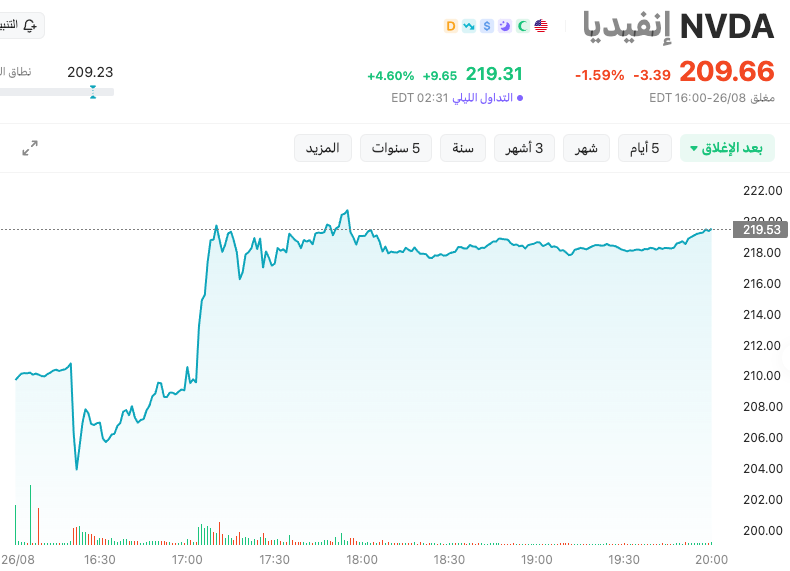
NVIDIA Corporation(NVDA.US) entered the quarter with an extraordinarily high expectations bar. Strong results were already widely expected, and investors initially focused on weaker margin guidance before the longer-term 70% growth outlook changed the reaction. Nvidia shares subsequently moved nearly 5% higher after hours.
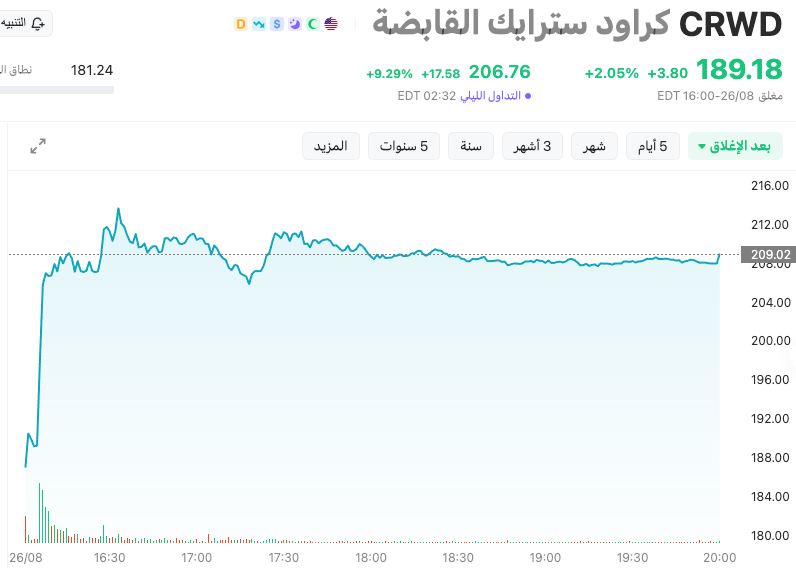
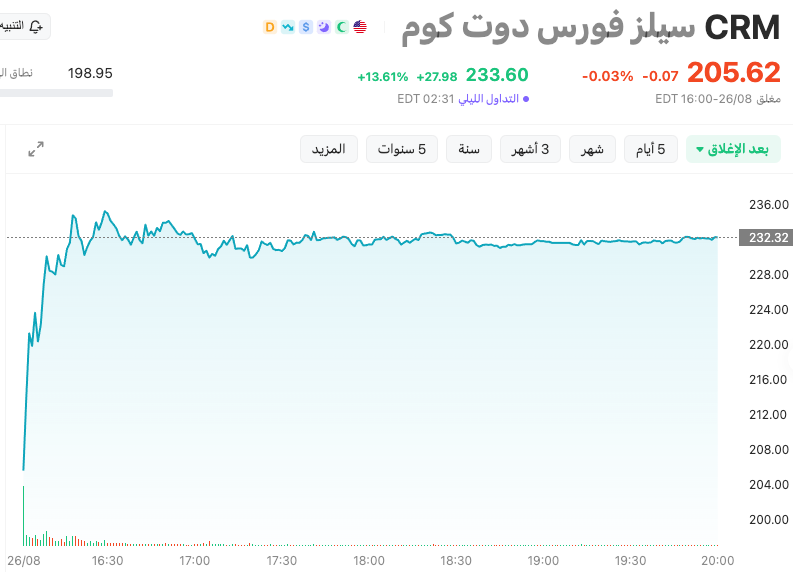
CrowdStrike(CRWD.US), by contrast, produced unexpectedly strong acceleration in net-new ARR and raised its outlook, helping shares rise more than 10% after hours. Salesforce delivered a larger-than-expected improvement in the narrative around AI monetization and organic growth, and its shares rose about 14%.
So the distinction is useful:
NVIDIA Corporation(NVDA.US): strongest fundamental signal on AI infrastructure demand.
CrowdStrike(CRWD.US): cleanest recurring-revenue acceleration.
Salesforce.com, inc.(CRM.US): biggest change in what investors may expect from AI-driven software growth.
The size of the stock move reflects expectations versus reality, not simply which company has the strongest AI business.
What Should Investors Watch Next?
In the near term, NVIDIA Corporation(NVDA.US)'s gross-margin floor and Rubin execution are the clearest tests. If growth stays near management's ambitious outlook while margins stabilize after Q4, the infrastructure thesis remains much stronger than a simple one-quarter beat would suggest.
For CrowdStrike(CRWD.US), watch net-new ARR and Falcon Flex adoption. Continued acceleration would provide stronger evidence that cybersecurity spending remains resilient as companies deploy more AI-enabled systems.
For Salesforce.com, inc.(CRM.US), the key test is organic revenue reacceleration. Rapid Agentforce growth becomes much more meaningful if it eventually lifts cRPO, bookings and overall Salesforce growth—not just the AI product metrics themselves.
And across the broader AI ecosystem, memory remains an important confirmation signal. If Nvidia continues to encounter memory-related cost pressure while suppliers such as Micron Technology, Inc.(MU.US) see strong pricing and demand, that would reinforce the view that supply—not end demand—is becoming one of the main constraints on AI infrastructure growth.
The wider takeaway from this earnings night is therefore not that the market has moved on from Nvidia.
It is that the AI investment cycle now has more places to prove itself:
NVIDIA Corporation(NVDA.US) must prove the infrastructure boom can scale profitably.
CrowdStrike(CRWD.US) and Okta(OKTA.US) must show that AI creates durable security demand.
Salesforce.com, inc.(CRM.US) must prove that enterprise AI can materially lift software growth.
If those layers continue to confirm one another, the AI trade could become a broader earnings cycle rather than a story concentrated mainly in GPU spending.
Disclaimer: This article is for informational purposes only and does not constitute investment advice or a recommendation to buy or sell any securities.