

Nvidia (NVDA) Stock Weighs AI Growth Story Against Mixed Valuation Signals
NVIDIA Corporation NVDA | 0.00 |
With NVIDIA such a focal point for growth stories, many investors are asking a simple question: does the current share price still make sense if you care about value, not just headlines?
The stock last closed at US$208.65, with returns that include 10.5% year to date, 44.9% over 1 year and a very large gain over 5 years. This keeps expectations and perceived risk firmly in the spotlight.
Recent coverage around NVIDIA has focused on its role in semiconductors and AI related demand, which continues to shape how investors think about the stock. This backdrop helps explain why shorter term moves, such as a 1.8% decline over 7 days and a 3.1% decline over 30 days, can attract extra attention even when longer term returns remain strong.
On Simply Wall St's checklist, NVIDIA currently has a valuation score of 3 out of 6. The rest of this article will break down what that means across different valuation methods, and then finish with a broader way to think about what "fair value" really looks like for this stock.
Approach 1: NVIDIA Discounted Cash Flow (DCF) Analysis
A Discounted Cash Flow model estimates what NVIDIA might be worth today by projecting future free cash flows and then discounting them back to a single present value figure.
For NVIDIA, the model used is a 2 Stage Free Cash Flow to Equity approach. The latest twelve month free cash flow is reported at $119.4b. Analyst and extrapolated projections used by Simply Wall St reach a forecast free cash flow of $540.8b in 2035, with interim estimates such as $96.0b in 2026 and $434.9b in 2031. All figures here are in $ and refer to free cash flow available to equity holders.
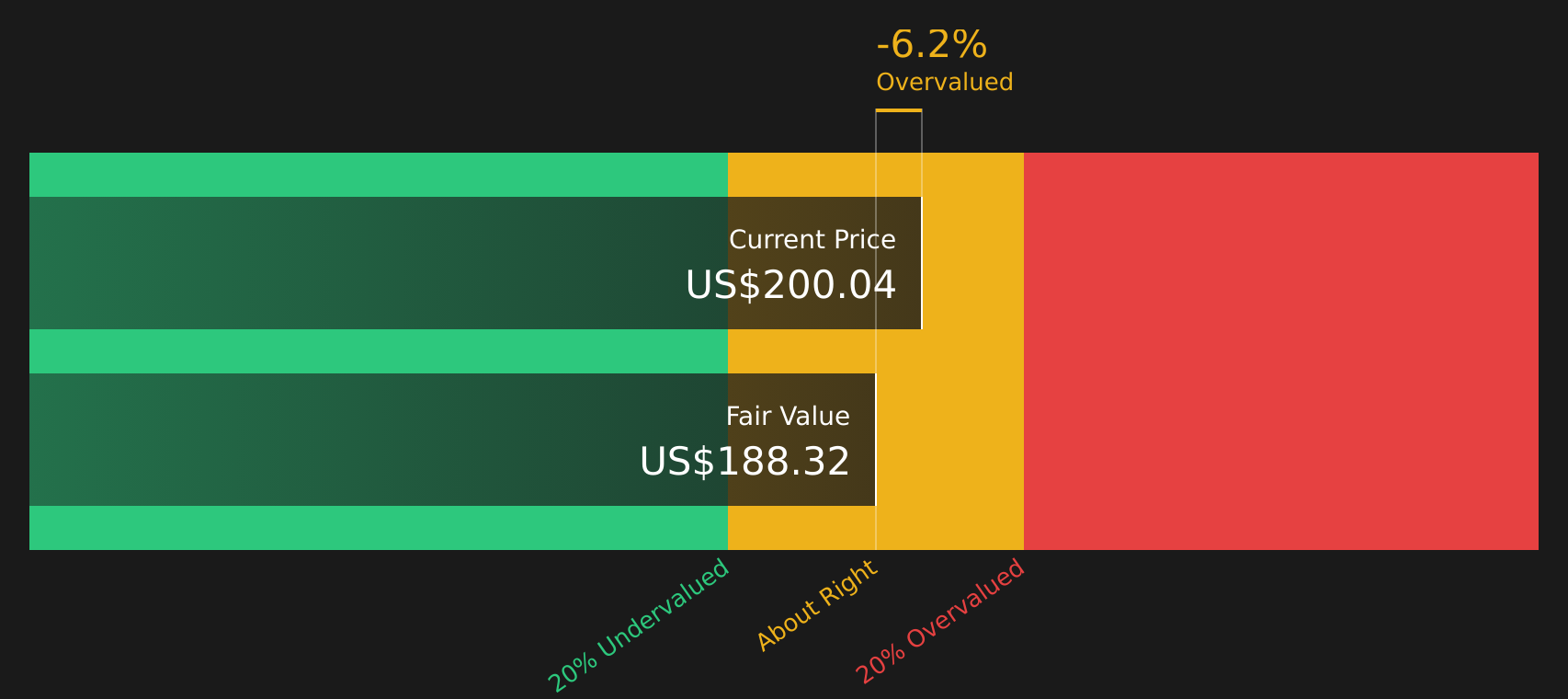
When these projected cash flows are discounted back and summed, the model arrives at an estimated intrinsic value of $187.93 per share. Compared to the recent share price of $208.65, this implies the stock is around 11.0% above that DCF estimate, so on this metric NVIDIA screens as overvalued rather than cheap.
Result: OVERVALUED
Our Discounted Cash Flow (DCF) analysis suggests NVIDIA may be overvalued by 11.0%. Discover 44 high quality undervalued stocks or create your own screener to find better value opportunities.
Approach 2: NVIDIA Price vs Earnings (P/E)
For a profitable company like NVIDIA, the P/E ratio is a useful shorthand for how much you are paying for each dollar of current earnings. It is simple to track, widely used and directly linked to the bottom line that ultimately supports shareholder returns.
What counts as a “normal” or “fair” P/E depends on how fast earnings are expected to grow and how risky those earnings are perceived to be. Higher growth or lower perceived risk can support a higher multiple, while slower growth or higher risk usually points to a lower one.
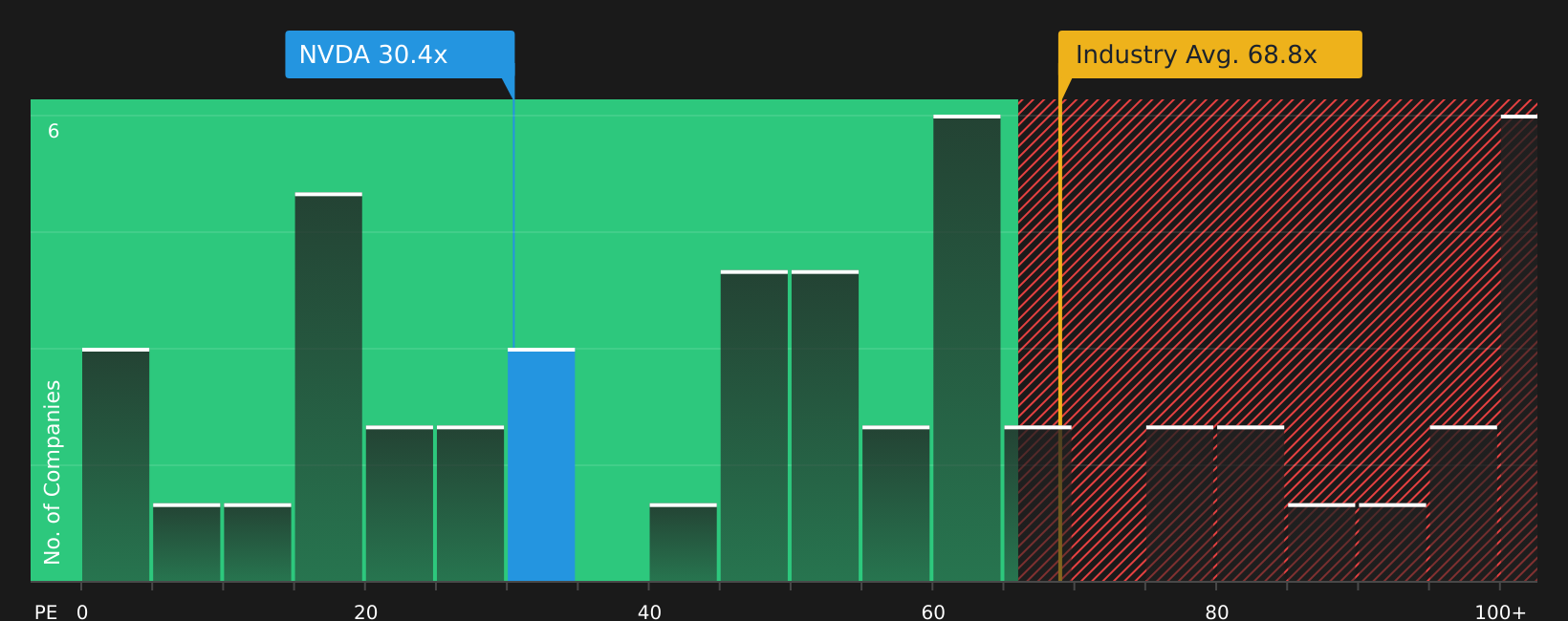
NVIDIA currently trades on a P/E of 31.66x. This sits below the Semiconductor industry average P/E of 75.81x, and also below a peer group average of 102.32x. Simply Wall St’s Fair Ratio metric, which estimates a suitable P/E after considering factors such as earnings growth, profit margins, industry, market cap and company specific risks, sits at 64.26x for NVIDIA. This tailored approach can be more informative than a simple comparison with industry or peers because it links the multiple more closely to the company’s own characteristics.
Comparing the current P/E of 31.66x with the Fair Ratio of 64.26x, NVIDIA screens as undervalued on this measure.
Result: UNDERVALUED
P/E ratios tell one story, but what if the real opportunity lies elsewhere? Start investing in legacies, not executives. Discover our 20 top founder-led companies.
Upgrade Your Decision Making: Choose your NVIDIA Narrative
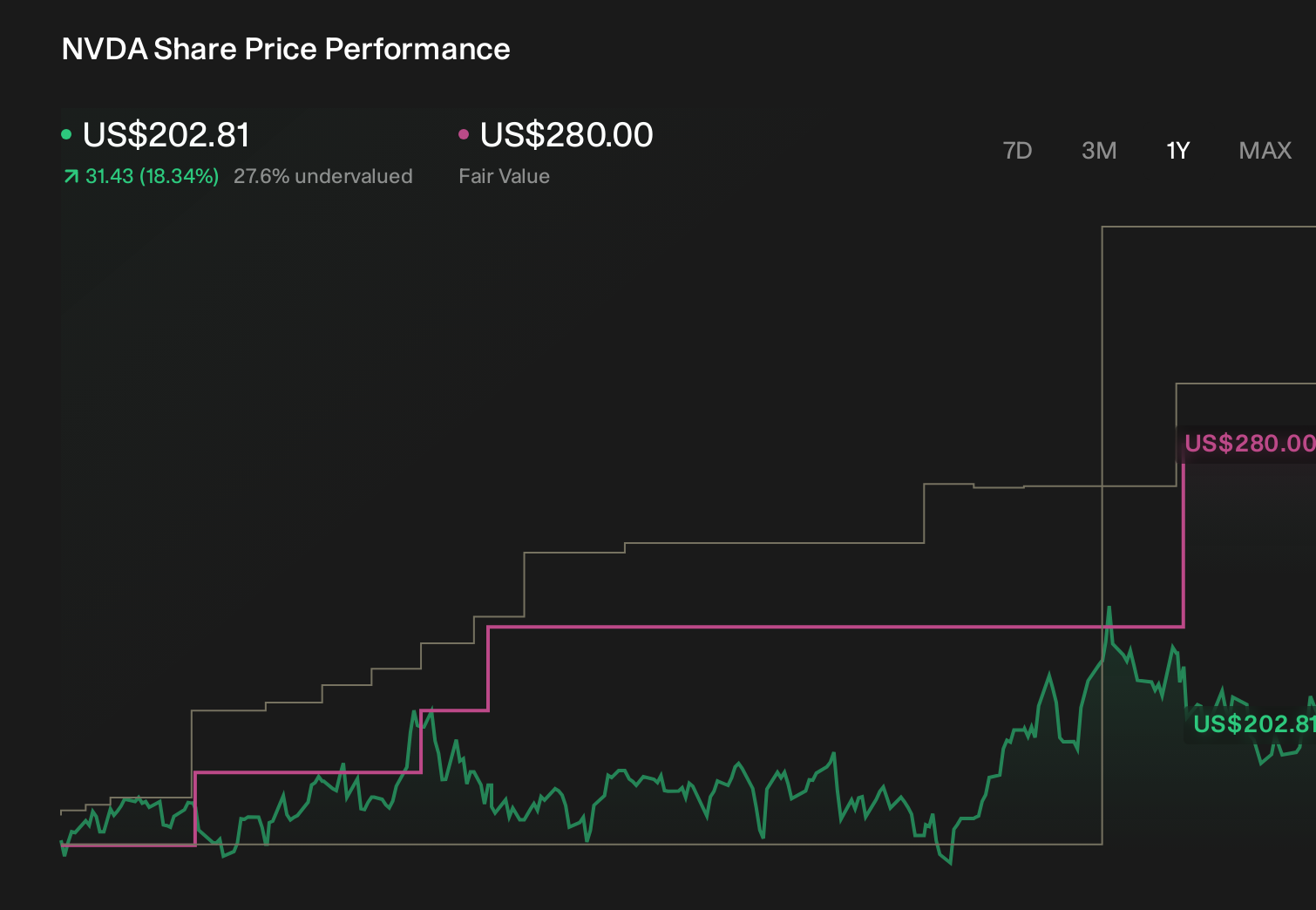
Earlier we mentioned that there is an even better way to think about valuation, so this is where Narratives come in, giving you a simple way to connect your view of NVIDIA’s story with the numbers behind it, including fair value, revenue, earnings and margin assumptions. A Narrative on Simply Wall St is your structured story about a company that ties three things together: what you think the business is really about, how that translates into a financial forecast, and the fair value that falls out of those assumptions. Instead of passively accepting a single DCF or P/E output, you can choose or create a Narrative on the Community page, compare its fair value with today’s share price, and use that gap to help decide whether NVIDIA looks more like a buy, a hold or a sell to you. Because Narratives are linked to live data, they update automatically when new information arrives, such as earnings, AI infrastructure orders or fresh regulatory news. For NVIDIA, one investor might back a more cautious Narrative with a fair value around US$167, while another follows a growth focused Narrative closer to US$305 or above. Seeing those side by side makes it clearer which story you believe and what that implies for your own decision making.
For NVIDIA, we will make it really easy for you with previews of two leading NVIDIA Narratives:
Together they bracket a wide range of views on what the stock could be worth, so you can see how different assumptions feed through to fair value, growth and risk.
Fair value: US$339.90
Undervalued by around 38.6% versus the latest close of US$208.65, based on this narrative's fair value.
Revenue growth used in this narrative: 30%
- NVIDIA reaches US$400b in annual revenue within 5 years, with around 90% of that tied to data center customers and large scale AI demand.
- The case assumes NVIDIA keeps a strong position in GPU design and the AI software stack, while partners such as TSMC and ASML keep delivering products that encourage regular hardware refresh cycles.
- Key risks include tougher competition in GPUs and AI platforms, the potential for cheaper or open source alternatives to CUDA, limits on data center power growth and shifting regulation around AI, semiconductors and energy.
Fair value: US$104.00
Overvalued by around 100.6% versus the latest close of US$208.65, based on this narrative's fair value.
Revenue growth used in this narrative: 13%
- This view sees NVIDIA as a key beneficiary of the initial AI training boom, with strong demand and pricing power already reflected in how highly the stock is priced.
- The narrative highlights the risk that GPU demand for training could level off once big customers have built out capacity, while long term inference workloads may shift toward custom chips and other alternatives.
- On this logic, current expectations around NVIDIA are described as very demanding, and the stock could reset toward more moderate multiples if growth normalizes and competition in AI hardware and infrastructure increases.
These two NVIDIA Narratives sit within a wider set of 26 community views, with 16 leaning toward NVIDIA being undervalued and 10 leaning toward it being overvalued. If you want to see how your own view compares, and how changes in growth, margins or discount rates affect fair value, the full set of community narratives is a useful next step.
To see how these results tie into long-term growth, risks, and valuation, check out the full range of community narratives for NVIDIA on Simply Wall St. Add the company to your watchlist or portfolio so you'll be alerted when the story evolves.
Do you think there's more to the story for NVIDIA? Head over to our Community to see what others are saying!
This article by Simply Wall St is general in nature. We provide commentary based on historical data and analyst forecasts only using an unbiased methodology and our articles are not intended to be financial advice. It does not constitute a recommendation to buy or sell any stock, and does not take account of your objectives, or your financial situation. We aim to bring you long-term focused analysis driven by fundamental data. Note that our analysis may not factor in the latest price-sensitive company announcements or qualitative material. Simply Wall St has no position in any stocks mentioned.