

Research Digest | AI Frenzy Sparks Major Price Target Increases—3 Stocks Set for Big Gains
Micron Technology, Inc. MU | 0.00 | |
Sandisk Corporation SNDK | 0.00 | |
Applied Materials, Inc. AMAT | 0.00 |
Subscribe to The Value Anchor Topic / The Trend Catcher Topic —unlock the full historical archive and never miss a weekly pick again.
AI memory and equipment stocks are on fire. Micron, SanDisk, and Applied Materials all have aggressive price target upgrades from top Wall Street banks, making them key names to watch.
Top 3 US Stock Picks
| Stock | Key Catalyst | Wall Street Views |
|---|---|---|
| Micron Technology, Inc.(MU.US) | AI memory supercycle; 16 long-term contracts (SCAs) covering 2026–2030 | Cantor: PT $2,000; Phillip Securities: PT $1,870 |
| Sandisk Corporation(SNDK.US) | New LTAs reshape business model; stress test shows much higher earnings floor | Bernstein: PT $3,000 (from $1,700), Outperform |
| Applied Materials, Inc.(AMAT.US) | AI expansion from logic to packaging; WFE supercycle | Cantor: PT $850, Overweight |
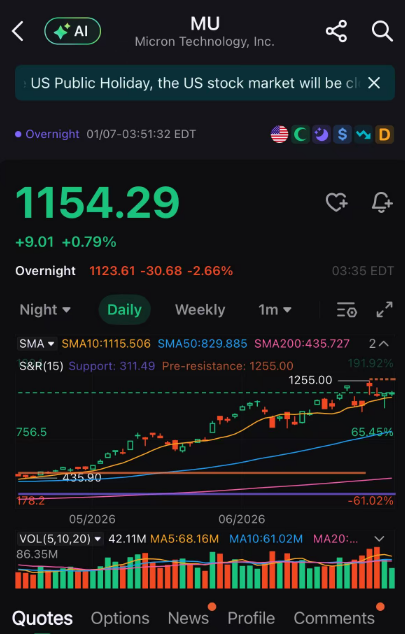
1. Micron Technology, Inc.(MU.US) – Long-term contracts lock in revenue; valuation remains cheap
Micron is a prime example of the structural re-rating taking place in memory. Bernstein notes that while both Micron and SanDisk are rolling out new LTAs, their structures differ. Micron’s contracts are longer (mostly 5 years), backed by more tangible cash commitments ($22B in deposits and letters of credit), but have a lower price floor (~50% below current pricing). Even so, Micron’s worst-case gross margins would still be well above the previous peak of 61%. Cantor argues that these Strategic Customer Agreements will fundamentally extend the memory profit cycle by locking in future supply, raising its price target from $1,500 to $2,000.
2. Sandisk Corporation(SNDK.US) – New LTAs make earnings resilient; Bernstein just raised target to $3,000
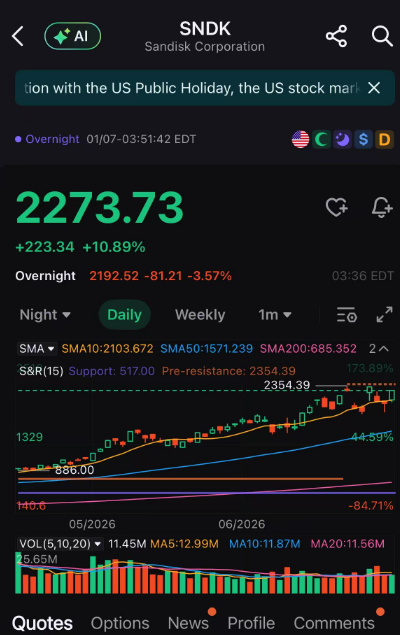
This is the most symbolic memory re-rating case of late. Bernstein lifted SanDisk’s target from $1,700 to $3,000, citing that new LTAs are changing how earnings fluctuate. Unlike old one-sided supply agreements, these new LTAs have three structural changes: fixed or banded pricing, upfront financial guarantees from customers, and longer terms of 3–5 years.
Bernstein highlights a key, often-missed point: the protection from financial guarantees increases over time. As the contract is fulfilled, remaining obligations shrink while the guarantee stays the same, making its relative coverage progressively larger. A stress test proves this: with 60% of shipments under LTAs, even if NAND prices crash 72% peak-to-trough to $0.11/GB, SanDisk’s FY30 EPS would still be $214—versus just $81 without LTAs. In a more extreme case ($0.06/GB ASP), 60–80% LTA coverage still keeps FY30 gross margins above 80%.
Earnings estimates: FY27 and FY28 EPS raised to $243 and $272, supporting a $3,000 target (11x FY28 PE or 14x through-cycle PE).
3. Applied Materials, Inc.(AMAT.US) – The broadest beneficiary of the AI equipment upcycle
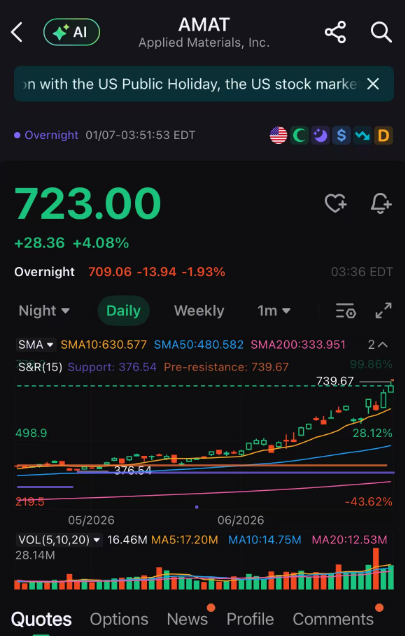
As memory makers lock in revenue via LTAs, the natural next step is to boost capex to meet demand. AMAT sits at the center of this capex cycle. Cantor points to a WFE supercycle, with AMAT’s advanced packaging revenue growth outlook upgraded from 20% to 50%, driven by logic, DRAM/HBM, and packaging all growing simultaneously. Citi’s bull case sees WFE reaching ~$250B by 2028, expanding AMAT’s addressable market further.
Bottom Line:
All three picks share one common driver—AI-powered memory and semiconductor equipment are shifting from "cyclical commodities" to "contract-protected capacity bottlenecks." SanDisk and Micron represent a structural improvement in earnings visibility, while AMAT captures the direct benefit of accelerating capex. With top-tier banks still raising targets and estimates, the market has yet to fully price in the long-term impact of this "New Memory Paradigm."
Disclaimer: The content is provided as general information only and should not be taken as investment advice. All the contents shall not be taken as a recommendation to buy or sell any security or financial instruments. Any action you take resulting from information, analysis, or commentary on this article is your responsibility. Please consult your investment advisor before making any investments.