

SanDisk Surges Over 70% From Lows; SOXX Re-Enters Technical Bull Market — Chase the Rally or Take Profits?
PHLX Sox Semiconductor Sector Ishares SOXX | 0.00 | |
Western Digital Corporation WDC | 0.00 | |
Sandisk Corporation SNDK | 0.00 | |
NVIDIA Corporation NVDA | 0.00 | |
Micron Technology, Inc. MU | 0.00 |
🔔 Subscribe to The Trend Catcher / The Value Anchor — unlock the full historical archive and never miss a weekly pick again.
Following a sharp correction in July, the AI hardware sector has staged a violent comeback. Driven by a massive rally in memory stocks, the PHLX Sox Semiconductor Sector Ishares(SOXX.US) has rebounded over 20% from its recent lows, re-entering a technical bull market. Notably, Sandisk Corporation(SNDK.US) led the charge, skyrocketing over 70% from its bottom.
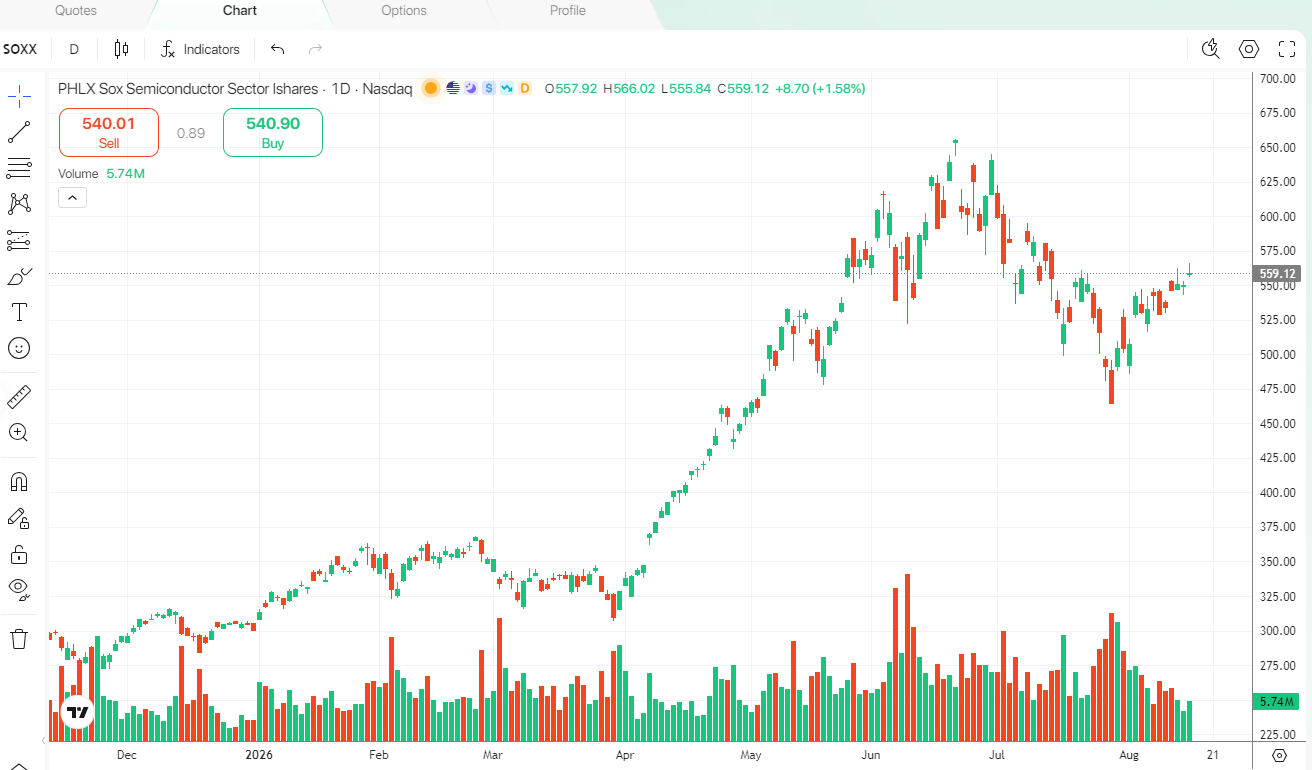
According to market data, the recent semiconductor bear market lasted a mere 21 days—the shortest since March 2020. Alongside the SOXX, South Korea's Kospi Index has also bounced more than 20%.
The "Memory Supercycle" Remains Intact
The August rebound was fueled by a confluence of positive catalysts, including strong Q2 developments from AI model leaders like OpenAI and Anthropic, rumors of a massive $100 billion backing involving NVIDIA Corporation(NVDA.US), and Sandisk Corporation(SNDK.US) upgrading its long-term financial guidance.
Fundamentally, the global "memory supercycle" has not been derailed by recent price volatility. Elon Musk recently identified memory capacity as the core bottleneck for the autonomous AI era, expressing long-term optimism for the growth potential of three industry leaders: Micron Technology, Inc.(MU.US), Sandisk Corporation(SNDK.US), and SK hynix Inc. Sponsored ADR(SKHY.US).
Industry projections strongly support this bullish outlook. The Chairman of SK Hynix recently warned of a severe "memory shortage" by 2027. Furthermore, Goldman Sachs estimates that global monthly AI token consumption will hit 120 quadrillion by 2030—24 times the projected volume for early 2026—pointing to near-limitless demand for memory chips.
Caution Ahead of Nvidia Earnings: Time to Hedge?
Despite the explosive rally in the memory sector, broader U.S. equity indices are currently trading sideways at high levels, pressured by rising Treasury yields and geopolitical risks.
Bank of America analysts are urging investors to remain cautious about blindly chasing momentum in the memory sector. While BofA agrees that the current AI-driven supercycle differs from the industry's historical boom-and-bust patterns, the inherent high volatility of memory stocks warrants a tactical approach.
For investors concerned that the short-term momentum may be overextended, analysts suggest utilizing options strategies ahead of Nvidia’s highly anticipated Q2 earnings report next week. These strategies can help de-risk, lower overall positioning, and lock in short-term profits on memory ETFs (like Roundhill Memory ETF(DRAM.US)) and individual stocks like Sandisk Corporation(SNDK.US) and SK hynix Inc. Sponsored ADR(SKHY.US).
Experts recommend two primary options strategies:
1. Covered Calls (To Lock in Profits):
- Objective: To lock in profits at current highs, lower holding costs, and generate premium income by capitalizing on high Implied Volatility (IV). This is ideal for investors who remain moderately bullish but do not want to add exposure at peak prices, effectively enhancing overall yields.
2. Long Puts (Protective Hedging):
- Objective: A low-cost, defined-risk strategy to protect existing gains. Purchasing put options acts as an insurance policy, allowing investors to hedge against a potential short-term pullback if the sector's rapid ascent proves to be overextended.
Options Risk Warning: Options trading involves significant risk and is not suitable for all investors. Investors should fully understand the risks before executing any options strategies.