

Semis Surge 50% in 25 Days — Echo of the Dot-Com Peak or Justified AI Supercycle?
PHLX Semiconductor SOX | 0.00 | |
NASDAQ IXIC | 0.00 | |
NVIDIA Corporation NVDA | 0.00 | |
Intel Corporation INTC | 0.00 | |
Credo Technology CRDO | 0.00 |
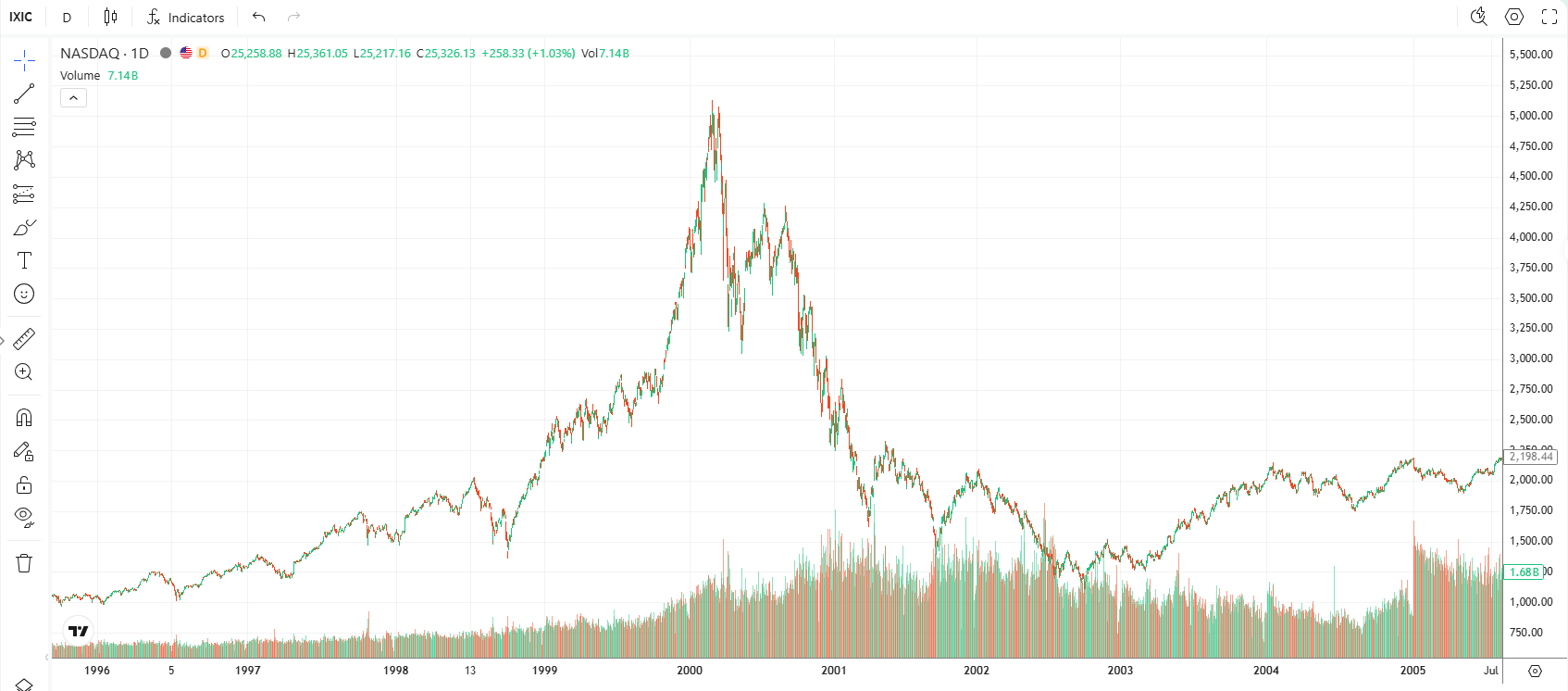
U.S. semiconductor stocks are in the middle of an extraordinary rally, one that is now drawing uncomfortable comparisons to the final stretch of the dot-com bubble. The PHLX Semiconductor(SOX.US) has surged more than 50% over a rolling 25-day period — its strongest short-term performance since March 9, 2000, just one day before the NASDAQ(IXIC.US) peaked during the internet bubble.
That historical parallel is difficult to ignore. After reaching its peak in March 2000, the Nasdaq went on to lose roughly 80% of its value over the next three years, requiring more than a decade to fully recover.
A Broadening Rally, Not Just an Nvidia Story
What began as a narrow, AI-driven rally led by NVIDIA Corporation(NVDA.US) has now expanded into a full-sector surge.
Over the past 25 trading days, every constituent of the PHLX Semiconductor(SOX.US) index has gained at least 14%. Several names have delivered outsized returns, including Intel Corporation(INTC.US), Credo Technology(CRDO.US), and Astera Labs(ALAB.US) — each posting gains of more than 100%.
Even laggards like QUALCOMM Incorporated(QCOM.US) have joined the rally, signaling a shift from a single-stock momentum trade to a broader re-rating of the semiconductor ecosystem.
This breadth is a key difference from earlier phases of the AI trade, where performance was heavily concentrated in a handful of mega-cap names.
Fundamentals: AI Demand Is Real — and Expanding
Unlike the late-1990s tech bubble, today’s rally is underpinned by tangible demand drivers.
The global buildout of AI infrastructure — from hyperscale data centers to edge computing — is creating sustained demand across the semiconductor value chain. While high-end GPUs remain central, the impact has spread to memory, networking chips, and custom silicon.
Supply constraints in critical components have further amplified pricing power, prompting Wall Street analysts to revise earnings forecasts higher across a wide range of chipmakers. Strong quarterly results in recent months have reinforced confidence that this is not purely speculative momentum.
Warning Signals: Extreme Momentum and Rising Skepticism
Still, the pace of the rally has raised red flags among seasoned market observers.
Former JPMorgan Chase & Co.(JPM.US) strategist Marko Kolanovic has warned that AI-related equities appear “overextended,” echoing concerns that rapid price appreciation may be detaching from near-term fundamentals.
At the same time, investor Michael Burry — known for his prescient bets against the housing market before the 2008 financial crisis — has reportedly increased bearish exposure. He recently disclosed additional put option positions on the PHLX Sox Semiconductor Sector Ishares(SOXX.US), with expirations extending to January 2027, signaling a longer-term cautionary stance.
Such positioning does not necessarily imply an imminent downturn, but it highlights growing divergence in market expectations.
Then vs. Now: Bubble Setup or Structural Shift?
The comparison to 2000 hinges on whether current conditions reflect speculative excess or a structural technology transition.
In 2000, valuations were driven largely by future expectations with limited earnings support. Today, semiconductor companies are delivering strong revenue growth, margin expansion, and clear demand visibility tied to AI adoption.
However, one similarity remains: velocity. Rapid, near-parabolic gains over short periods have historically increased the probability of volatility spikes, even within longer-term bull markets.
What to Watch Next
Key variables that could determine the trajectory of the sector include:
- Sustainability of AI-related capital expenditures from hyperscalers
- Supply-demand dynamics in memory and advanced packaging
- Earnings revisions versus already elevated expectations
- Broader macro conditions, including interest rates and liquidity
The semiconductor rally reflects both a powerful structural tailwind from AI and an unusually intense burst of short-term momentum. While historical parallels to the dot-com peak provide a useful reference point, the current cycle is supported by stronger fundamentals.
At the same time, the speed and breadth of recent gains suggest that volatility risk is rising, leaving the market at a point where both continuation and correction scenarios remain plausible.