

SpaceX Rallies More Than 6% Amid a $100B Supply Test—Is Smart Money Calling a Bottom?
SpaceX SPCX | 0.00 | |
S&P 500 index SPX | 0.00 | |
Leverage Shares 2X Long SPCX Daily ETF SPCH | 0.00 | |
Leverage Shares 2X Short SPCX Daily ETF SSPC | 0.00 | |
Defiance Daily Target 2X Short SpaceX ETF SPCQ | 0.00 |
SpaceX shares remain below their $135 IPO price, but professional options traders, Wall Street analysts and bargain hunters are beginning to position for a tactical rebound. The evidence is increasingly constructive—although a confirmed uptrend still requires several important conditions.
SpaceX(SPCX.US) has just passed its first major post-IPO stress test.
When 911.5 million restricted shares became tradable, the company’s free float increased to approximately 1.55 billion shares. The potential supply shock was worth nearly $100 billion and had been widely expected to trigger another round of heavy selling.
Instead, SpaceX rose 6.14% on the lockup-expiration day to $114.92, with approximately 255 million shares changing hands.
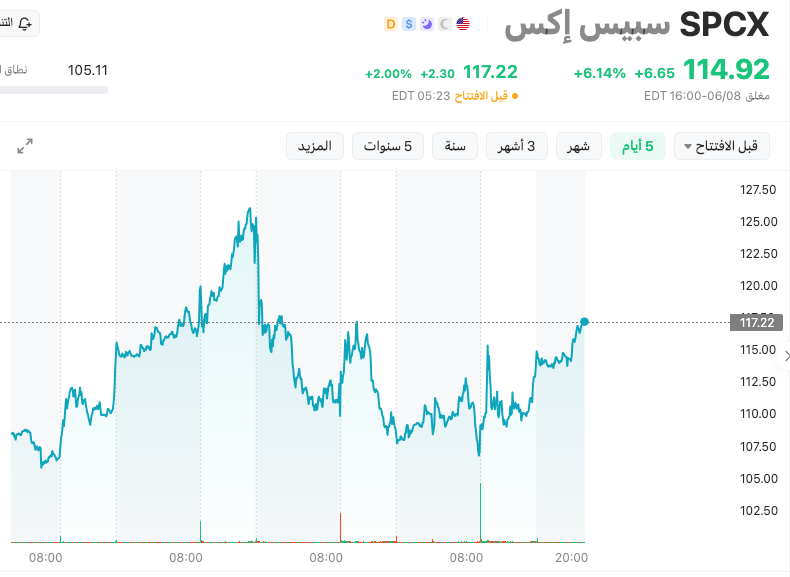
That reaction suggests Wednesday’s 13.6% post-earnings decline had already priced in much of the pressure from the share unlock, aggressive capital spending and profit-taking. New sell orders were absorbed by bargain hunters and short covering, revealing meaningful buying support around $105–$110.
For investors, this is an important change in the risk-reward profile—but not yet proof that a durable bull market has begun.
Smart Money Is Selling Downside Fear
The clearest shift is happening in the options market.
Earlier trading had been dominated by demand for out-of-the-money calls, a pattern that had often acted as a contrarian signal. On Thursday, however, the most popular directional trade narrowly shifted toward put selling.
According to SpotGamma, approximately $600 million in SpaceX(SPCX.US) options premiums traded by midday. Put options accounted for $316 million, with an estimated $166 million likely associated with put-writing activity.
Selling puts remains a bullish strategy, but its message differs from simply buying speculative calls. It reflects confidence that the stock can stabilize above lower strike prices—even if an immediate surge is not guaranteed.
Two large institutional-style risk reversals made that message especially clear.
Shortly after the opening bell, one professional trader appeared to:
- Sell $12 million of June 2027 $90 puts
- Buy $4.3 million of June 2027 $220 calls
- Collect approximately $7.7 million in net premium
The position effectively wagers that SpaceX(SPCX.US) will not fall another 20% over the next ten months, while preserving exposure to a potential doubling of the share price.
Later in the session, another trader used the same structure:
- Sell $3.5 million of January 2028 $75 puts
- Buy the same number of January 2028 $185 calls
- Pay a net debit because the calls cost about $5 million
These are not simple high-strike call bets. By selling downside protection to finance upside exposure, the traders are positioning around an entire probability distribution: limited expected downside, combined with substantial upside optionality.
That approach is more characteristic of well-capitalized hedge funds than retail investors chasing a short-term rally.
The Chart Supports a Tactical Bottom
Technical conditions are also becoming more constructive.
SpaceX(SPCX.US) reached a new low on Monday, one day before its earnings release, but has otherwise traded largely around $110 since July 23. The pace of the decline has slowed, while the 14-day Relative Strength Index bottomed near the end of last month.
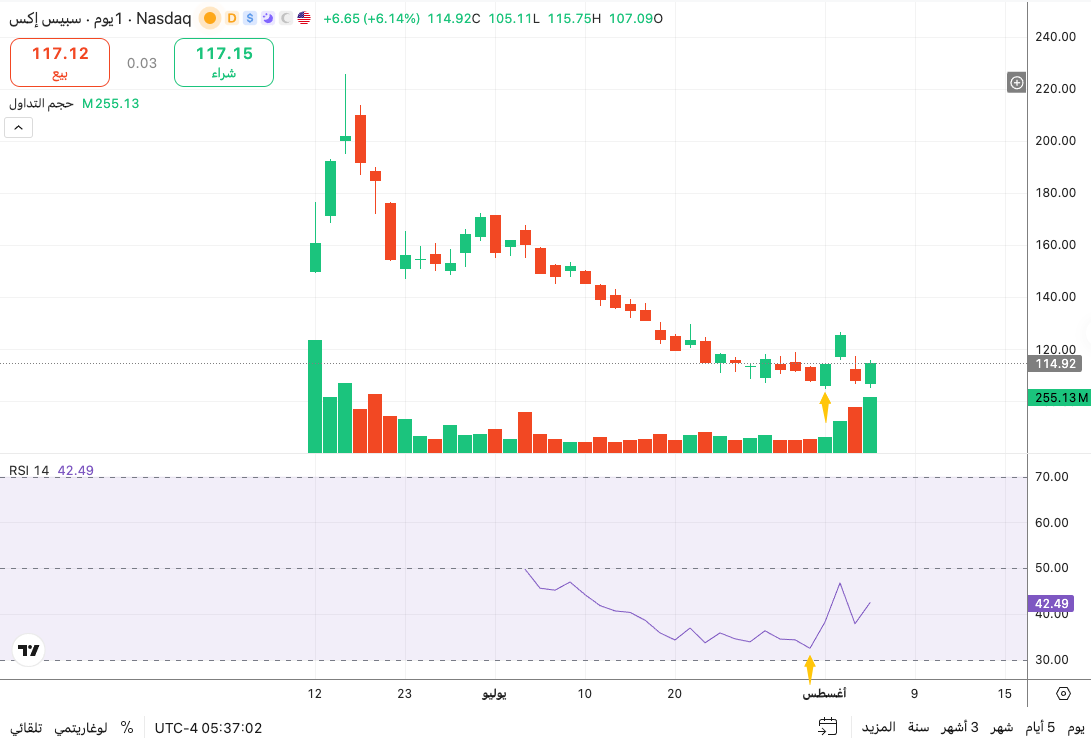
Implied volatility has also fallen to its lowest level since June 30.
Taken together, the stabilization in price, bottoming RSI and declining volatility suggest professional traders may be shifting from chasing extreme upside scenarios to selling downside panic and building asymmetric long exposure.
Most importantly, the stock advanced on the lockup-expiration day itself. That failure of a widely anticipated “sell-the-news” event is evidence of strong marginal demand near $105–$110.
It does not, however, eliminate long-term supply risk. More large shareholder lockups remain ahead, and the stock is still below its $135 IPO price.
Strong Growth, but an Expensive AI Buildout
Fundamental results help explain why Wall Street remains constructive despite the near-term pressure.
SpaceX(SPCX.US) reported second-quarter revenue of $7.814 billion, up 92% year over year. Adjusted EBITDA increased 191% to $3.538 billion.
AI-related revenue rose 247% to $2.561 billion, while AI computing capacity expanded from 0.4 gigawatts to 1.4 gigawatts. The company also signed $14.1 billion of cloud-service contracts.
The concern is the cost of achieving that growth.
Quarterly capital expenditures reached $18.369 billion, including $15.828 billion allocated to AI—far exceeding AI-related revenue during the period. SpaceX(SPCX.US) still recorded a net loss of $541 million.
This creates the central investment tension: the long-term value of Starlink, AI cloud capacity and vertical integration may be rising, but near-term free cash flow and funding requirements remain significant constraints.
Wall Street’s latest targets reflect that balance:
- JPMorgan: raised its target from $225 to $240
- Goldman Sachs: raised its target to $220
- Morgan Stanley: maintained its $300 target
These targets indicate greater confidence in SpaceX(SPCX.US)’s long-term terminal value. They do not mean analysts are dismissing the risks associated with capital intensity, future financing or additional share unlocks.
Musk’s Vision Still Requires Execution
Elon Musk’s track record remains an essential part of the investment case.
He turned high-frequency commercial rocket launches into a viable business, helped move electric vehicles into the mainstream through Tesla and deployed Starlink as space-based internet infrastructure.
His latest plan is even more ambitious.
In Austin, Musk outlined what he called the “most epic” semiconductor manufacturing initiative, supporting a broader vision that combines widespread AI adoption, autonomous driving, humanoid robots and AI-powered data centers in space.
Investors are not only evaluating whether these markets are large enough. They must also decide whether SpaceX(SPCX.US) can finance and execute this vision without allowing capital expenditures to overwhelm revenue growth and free cash flow.
A Favorable Market—and a Potential Gamma Loop
SpaceX’s rebound is occurring as risk appetite recovers across the broader U.S. equity market.
S&P 500 index(SPX.US) call-option volume exceeded 4 million contracts in a single day, setting a record and suggesting that fear of missing out is outweighing concerns about another pullback.
After crowded technology trades underwent sharp deleveraging, Goldman Sachs’ trading desk recorded the largest weekly net purchase of U.S. equities since November 2020. Much of that buying came from short covering.
This environment is particularly supportive for a heavily shorted, options-sensitive stock such as SpaceX(SPCX.US).
Call buying can also create a reflexive hedging cycle. When market makers sell calls, they generally purchase shares to offset their negative delta exposure. If the stock rises and call deltas increase, those dealers may need to buy still more shares.
The resulting cycle—call buying, dealer hedging, a rising share price and additional hedging—is commonly known as a gamma squeeze.
That mechanism can accelerate a rally, but it is not equivalent to stable long-term institutional accumulation. If market risk appetite weakens, AI spending faces renewed skepticism or future unlocks release more supply than expected, the same liquidity-driven momentum could reverse quickly.
What Investors Should Watch Next
The evidence now supports a tactical bottom-building thesis, not a fully confirmed medium-term uptrend.
Four developments would provide stronger confirmation:
- The $105–$110 support zone holds consistently.
This would reinforce the view that buyers are prepared to absorb additional supply. - SpaceX(SPCX.US) recovers above its $135 IPO price on strong volume.
Reclaiming that level would be a more convincing signal of trend reversal. - Future lockup expirations do not produce new lows.
The first supply test was encouraging, but several larger tests may still lie ahead. - AI contract revenue begins catching up with capital expenditures.
Improving free cash flow would turn the long-term growth narrative into a more sustainable financial case.
For now, put selling and risk-reversal trades suggest professional investors believe downside risk has become more manageable while upside optionality remains attractive.
That is a meaningful improvement—but it is a bet on an emerging floor, not a declaration that SpaceX(SPCX.US)’s next major uptrend has already arrived.