

Stocks to Watch | $1 Trillion AI Boom: Goldman Says the Spending Cycle Isn't Over — Here's Where the Money May Flow
Goldman Sachs Group, Inc. GS | 0.00 | |
Microsoft Corporation MSFT | 0.00 | |
Amazon.com, Inc. AMZN | 0.00 | |
Alphabet Inc. Class A GOOGL | 0.00 | |
Meta Platforms META | 0.00 |
The second-quarter earnings season may have marked a turning point for the AI investment cycle.
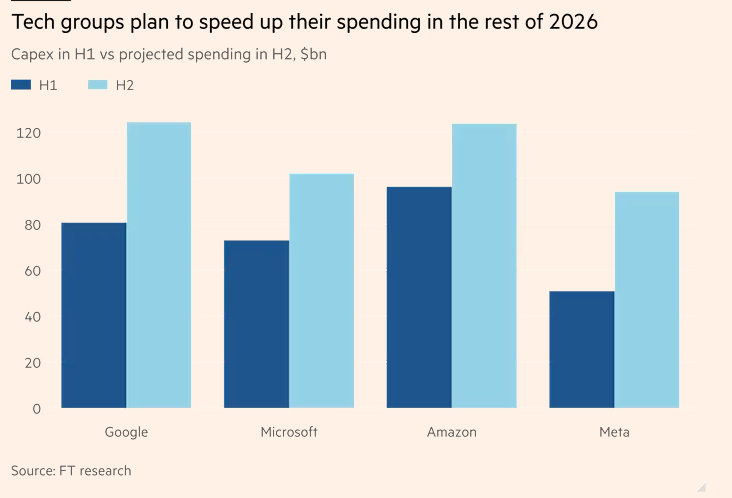
For nearly two years, investors rewarded companies that spent the most on AI infrastructure. Every increase in cloud capital expenditure (capex) lifted semiconductor manufacturers, memory suppliers, networking companies, optical component makers, and data-center infrastructure providers.
This earnings season, however, the market asked a different question:
"Who is actually earning attractive returns on those investments?"
The answer is reshaping leadership across the AI ecosystem.
Meanwhile, Goldman Sachs estimates that global AI investment could exceed $1 trillion in 2026, suggesting the investment cycle itself remains intact—even as market leadership rotates from infrastructure suppliers toward companies capable of monetizing AI at scale.
Subscribe to The Value Anchor Topic / The Trend Catcher Topic —unlock the full historical archive and never miss a weekly pick again.
AI Investment Isn't Slowing—It's Getting Bigger
Headline estimates often cite roughly $800 billion of hyperscaler capex as the benchmark for AI investment.
Goldman Sachs Group, Inc.(GS.US) argues that figure significantly understates the true size of the AI economy.
After incorporating private companies, non-U.S. investment, and adjusting for non-AI spending, Goldman estimates:
- Global AI investment could reach approximately $1.02 trillion in 2026
- U.S. AI investment could total roughly $581 billion
Multiple independent methodologies—including corporate earnings revisions and national investment data—produce estimates near the same level.
The implication is important.
Rather than signaling the end of the AI investment cycle, the data suggests AI spending may remain elevated for years. The key change is where investors expect the returns to accrue.
Q2 Earnings Changed the Narrative
This quarter produced three major signals.
1. Cloud Providers Are Finally Monetizing AI
For the first time, the largest cloud platforms demonstrated that AI infrastructure is translating into accelerating revenue growth.
Major cloud businesses reported strong expansion:
Microsoft Corporation(MSFT.US) — Azure revenue growth accelerated
Amazon.com, Inc.(AMZN.US) — AWS delivered its fastest growth in several quarters
Alphabet Inc. Class A(GOOGL.US) — Google Cloud continued rapid expansion
More importantly, management commentary suggested demand is no longer concentrated among frontier AI labs.
Enterprise customers—including financial institutions, manufacturers, healthcare companies, and governments—are increasingly adopting AI workloads.
Longer-duration customer commitments also imply higher visibility into future cloud revenue.
This helps address one of Wall Street's biggest concerns over the past two years: whether AI infrastructure spending was simply circulating between hyperscalers and AI startups without creating durable end demand.
2. Infrastructure Stocks Are Being Repriced
Ironically, several hardware suppliers delivered record earnings while suffering sharp stock declines.
Investors appear less focused on current profits than on future growth rates.
As cloud capex growth matures, valuation models naturally shift.
Markets begin transitioning from asking:
"How much more hardware can be sold?"
to
"How much faster can growth continue?"
This distinction matters.
Even if cloud spending continues rising in absolute dollars, a moderation in growth rates can lead to multiple compression across infrastructure suppliers.
This dynamic has affected several AI hardware segments, including memory, storage, networking, and other capex-sensitive suppliers.
3. AI Models Are Becoming Commodities
Competition in foundation models continues to intensify.
Rapid price reductions across the industry suggest inference costs may continue falling as open-source alternatives improve.
If model pricing becomes increasingly competitive, more economic value could migrate toward companies that own:
- cloud infrastructure
- customer relationships
- enterprise software ecosystems
- AI deployment platforms
Rather than the models themselves.
The AI Profit Pool Is Moving Up the Stack
The AI industry may be entering a new phase.
During the infrastructure build-out, semiconductor companies captured much of the economic upside.
As enterprise adoption accelerates, investors increasingly focus on recurring software and cloud revenue.
Cloud providers effectively become the landlords of AI infrastructure.
Instead of simply purchasing GPUs, they rent computing capacity to millions of enterprise customers while layering higher-margin software services on top.
Examples include:
Microsoft Corporation(MSFT.US) integrating Azure, AI Foundry, GitHub Copilot, and Microsoft 365.
Amazon.com, Inc.(AMZN.US) expanding AWS AI services while benefiting from long-term enterprise cloud contracts.
Alphabet Inc. Class A(GOOGL.US) combining cloud infrastructure with Gemini AI across Workspace, Search, and enterprise applications.
Meta Platforms(META.US) exploring broader commercialization of its AI infrastructure beyond internal workloads.
This diversification may improve returns on invested capital over time.
What Does This Mean for AI Stocks?
The AI investment story appears to be evolving—not disappearing.
Different segments of the AI ecosystem may now face very different investment environments.
| Category | Representative Stocks | Outlook |
|---|---|---|
| Cloud Platforms | Microsoft Corporation(MSFT.US), Amazon.com, Inc.(AMZN.US), Alphabet Inc. Class A(GOOGL.US), Meta Platforms(META.US) | Potential relative beneficiaries as AI monetization improves |
| AI Accelerators | NVIDIA Corporation(NVDA.US), Advanced Micro Devices, Inc.(AMD.US), Broadcom Limited(AVGO.US) | Long-term demand remains supported, but valuation sensitivity increases |
| Networking & Optical | Arista Networks Inc(ANET.US), Ciena Corporation(CIEN.US), Lumentum Holdings, Inc.(LITE.US), Coherent Corp.(COHR.US) | Structural demand remains, though multiples may increasingly depend on technology upgrades rather than capex growth alone |
| Memory & Storage | Micron Technology, Inc.(MU.US), Western Digital Corporation(WDC.US) | Earnings may remain strong, but stock performance could become more cyclical as growth normalizes |
| AI Software & Enterprise Platforms | Salesforce.com, inc.(CRM.US), ServiceNow, Inc.(NOW.US), Oracle Corporation(ORCL.US), Palantir(PLTR.US) | Enterprise adoption could become an increasingly important growth driver |
The distinction between AI beneficiaries and AI compounders may become increasingly important.
Companies capable of generating recurring cash flow from AI services may command stronger valuation support than businesses relying primarily on hardware shipment cycles.
Three Metrics Investors Should Watch Next
Following Q2 earnings, simply tracking announced capex is no longer sufficient.
Instead, investors may consider monitoring three indicators:
1. Cloud Revenue Growth
Continued acceleration in Azure, AWS, and Google Cloud would indicate AI investment is translating into sustainable enterprise demand.
Relevant names:
Microsoft Corporation(MSFT.US), Amazon.com, Inc.(AMZN.US), Alphabet Inc. Class A(GOOGL.US)
2. AI Infrastructure Utilization
Higher utilization rates suggest cloud providers are generating stronger returns on existing AI infrastructure, supporting future investment decisions.
Relevant ecosystem:
NVIDIA Corporation(NVDA.US), Broadcom Limited(AVGO.US), Arista Networks Inc(ANET.US), VERTIV HOLDINGS LLC(VRT.US)
3. Enterprise AI Adoption
Growing adoption outside frontier AI labs may represent the next phase of AI commercialization.
Software vendors with large installed customer bases could benefit if AI becomes embedded into everyday enterprise workflows.
Relevant names:
Microsoft Corporation(MSFT.US), Salesforce.com, inc.(CRM.US), Oracle Corporation(ORCL.US), ServiceNow, Inc.(NOW.US), Adobe Systems Incorporated(ADBE.US)
Investment Strategy: Follow the Cash Flow, Not Just the CapEx
Goldman Sachs' trillion-dollar AI investment estimate suggests the infrastructure build-out is far from over.
However, the market's focus appears to be shifting.
Instead of rewarding every additional dollar of AI spending equally, investors increasingly differentiate between companies that consume capital and those that convert capital into durable earnings growth.
If this trend continues, AI investing may become less about identifying the biggest spenders and more about identifying the companies demonstrating sustainable monetization, recurring customer demand, and attractive returns on invested capital.
The AI cycle may not be ending—it may simply be entering a more selective phase.
Disclaimer: This article is for informational purposes only and does not constitute investment advice. Investors should conduct their own research and carefully assess the risks before making investment decisions.