

Stocks to Watch | A $1 Trillion Valuation, 283% Revenue Growth—and No Room for Error: Micron Faces Its Biggest Earnings Test Yet
Micron Technology, Inc. MU | 0.00 | |
Arm Holdings ARM | 0.00 | |
QUALCOMM Incorporated QCOM | 0.00 | |
Sandisk Corporation SNDK | 0.00 | |
Marvell Technology MRVL | 0.00 |
Memory Stocks Rebound Ahead of Micron's Earnings
Investors are positioning for Wednesday's report with renewed optimism across the semiconductor sector. In premarket trading, Micron Technology, Inc.(MU.US) rose more than 3%, alongside gains of over 3% in Arm Holdings(ARM.US) and QUALCOMM Incorporated(QCOM.US). Sandisk Corporation(SNDK.US), Marvell Technology(MRVL.US) Technology and Intel Corporation(INTC.US) advanced more than 2%, reflecting expectations that Micron's results could provide another positive read-through on AI infrastructure spending and memory demand.
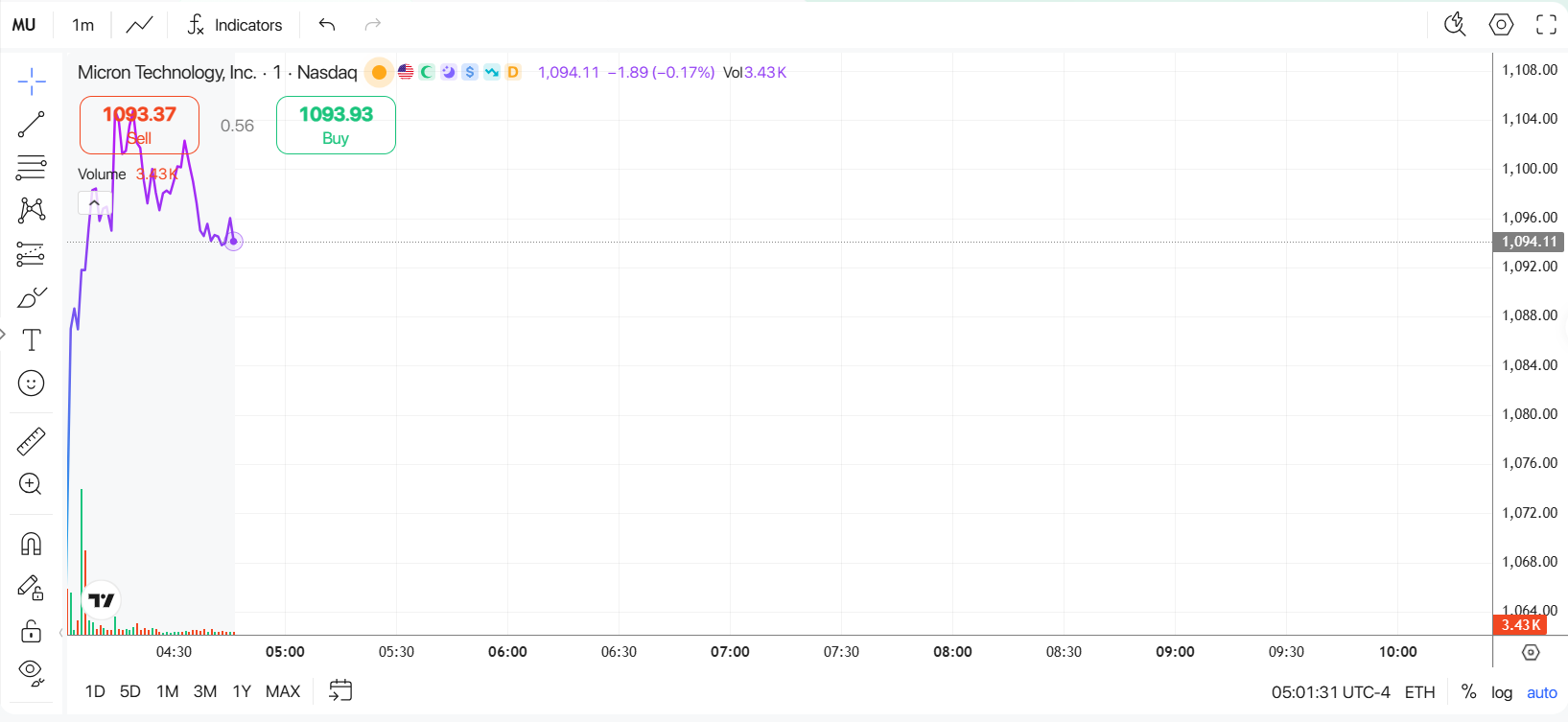
Wall Street expects Micron Technology, Inc.(MU.US) revenue between $34.5 billion and $35.6 billion, depending on the estimate source, implying roughly 280% year-over-year growth. The Bigger Question Is Whether AI Memory Demand Can Justify a $1 Trillion Valuation.
Micron Technology enters Wednesday’s earnings report as one of the biggest beneficiaries of the artificial-intelligence spending boom.
The memory-chip maker has become a proxy for investor confidence in the AI infrastructure buildout, with shares rising more than 300% year-to-date and the company’s market capitalization surpassing $1 trillion.
Yet after one of the strongest rallies in semiconductor history, simply beating quarterly estimates may no longer be enough.
The key question facing investors is whether Micron can convince the market that the current memory upcycle—and the extraordinary profitability that comes with it—can persist well into 2027 and beyond.
Expectations Are Already Exceptionally High
Wall Street expects Micron Technology, Inc.(MU.US) to report fiscal third-quarter revenue of approximately $35.6 billion, up nearly 283% from a year earlier.
FactSet consensus estimates call for fiscal Q3 EPS of $20.42, while buy-side expectations have moved significantly higher, with Bank of America's trading desk citing a whisper number of $22.17, and gross margins of roughly 81.6%, which would mark another company record.
Notably, several major firms are already forecasting results above consensus:
| Firm | EPS Forecast | Price Target |
|---|---|---|
| Goldman Sachs Group, Inc.(GS.US) | $22.07 | $900 |
| Bank of America | $22.17 | - |
| Wedbush | $22.84 | $1,300 |
| Morgan Stanley(MS.US) | $21.31 | $1,050 Base Case |
| Needham | $20.97 | $1,550 |
| Bernstein U.S. Research Fund(BERN.US) | - | $1,300 |
The fact that investors are expecting a beat before earnings are released illustrates the challenge Micron faces.
As one portfolio manager recently noted, “The hurdle rate keeps moving higher.”
Five Questions That Matter More Than Earnings
1. Can Gross Margins Stay Above 80%?
The most important debate on Wall Street is no longer revenue growth.
It is profitability.
Micron’s margins have expanded dramatically as DRAM and NAND prices surged amid supply shortages. Investors now want to know whether operating margins can remain in the 70%-75% range over the next several years.
If management suggests margins have peaked, the stock could face pressure even if quarterly earnings exceed expectations.
Conversely, evidence that pricing remains firm into fiscal 2027 would strengthen the bull case that the memory industry has entered a structurally different era.
2. What Does Management Say About HBM4?
High-bandwidth memory (HBM) has become the critical component powering AI accelerators from companies such as NVIDIA.
Micron has already begun shipping HBM4 products for next-generation AI systems, and investors want clarity on two issues:
- How much HBM contributes to revenue today
- Whether 2027 supply has already been committed to customers
Any indication that future HBM production is largely sold out would reinforce the narrative that AI memory demand remains supply-constrained.
3. Are Long-Term Customer Agreements Expanding?
Several analysts expect Micron to provide additional commentary on long-term supply agreements with hyperscalers and AI infrastructure providers.
These contracts matter because they improve visibility into future demand and reduce concerns about a cyclical downturn.
Needham believes such agreements could justify a higher valuation multiple for memory companies than investors have historically assigned.
4. Is AI Demand Broadening Beyond HBM?
While HBM receives most of the attention, Micron executives have previously highlighted unusually strong profitability in traditional DRAM products.
This could be an underappreciated story.
If enterprise servers, AI PCs, and premium smartphones continue increasing memory content per device, demand growth may extend beyond a single AI-related product category.
5. Can Supply Catch Up?
Perhaps the most important long-term question is whether supply growth eventually undermines pricing power.
Current industry commentary suggests new DRAM and NAND capacity will not arrive in meaningful volume until fiscal 2028.
That timeline is a central pillar of the bullish thesis.
If Micron confirms that supply constraints remain severe through 2027, investors may become more comfortable assigning higher earnings multiples.
Scenario Analysis: What Happens After Earnings?
Bull Case
A bullish outcome would likely require:
- Revenue and EPS above elevated whisper estimates
- Gross margins above 80%
- Strong Q4 guidance
- Positive commentary on HBM4 demand
- Confirmation that memory supply remains tight through 2027
In this scenario, investors could interpret the report as evidence that the AI infrastructure cycle remains in its early stages.
Base Case
Micron beats consensus but largely meets already elevated expectations.
Margins remain strong, but management offers limited new information on future contracts or HBM allocation.
Given the stock's massive run, a modest pullback would not be surprising under this scenario.
Bear Case
The biggest risk is not a miss on Q3 results.
It is cautious forward guidance.
Any indication that:
- Memory pricing is beginning to normalize,
- Margins have peaked,
- Demand visibility is weakening,
- Or AI customers are becoming more selective in spending,
could trigger a significant correction.
Options markets currently imply a post-earnings move of roughly 12%-13%, highlighting how much uncertainty remains despite widespread optimism.
Why Micron Matters Beyond Memory Stocks
Micron's report could have implications far beyond its own shares.
Because memory sits at the center of the AI hardware stack, the earnings release is widely viewed as a read-through for broader AI infrastructure spending.
Potential Beneficiaries of Strong Results
| Segment | Stocks Likely to Benefit |
|---|---|
| AI GPUs | NVIDIA Corporation(NVDA.US), Advanced Micro Devices, Inc.(AMD.US) |
| Memory | SK HYNIX INC(HXSCF.US), SAMSUNG ELECTRONICS CO(SSNLF.US) |
| Networking | Broadcom Limited(AVGO.US), Marvell Technology(MRVL.US) |
| Servers | Dell Technologies, Inc. Class C(DELL.US), SUPER MICRO COMPUTER INC DEP SHS REPSTG 1/20TH PFD CONV SER A WI(SMCIV.US) |
| Data Center Infrastructure | VERTIV HOLDINGS LLC(VRT.US), Arista Networks Inc(ANET.US) |
Few companies have enough investor attention to support an entire ecosystem of long, short, and income-focused ETFs. Ahead of what could be one of the most important earnings reports of the AI cycle, Micron is firmly in that category.
Here are the ETFs currently offering targeted exposure to the stock:
| ETF Name | Ticker | Strategy | Leverage |
|---|---|---|---|
| Direxion Daily MU Bull 2X ETF(MUU.US) | MUU | Long Micron | 2x |
| GraniteShares 2x Long MU Daily ETF(MULL.US) | MULL | Long Micron | 2x |
| Direxion Daily MU Bear 1X ETF(MUD.US) | MUD | Short Micron | -1x |
| Defiance Daily Target 2X Short MU ETF(MUZ.US) | MUZ | Short Micron | -2x |
| GraniteShares YieldBOOST MU ETF(MUYY.US) | MUYY | Covered Call Income Strategy on Micron | Non-Leveraged |
A strong report would suggest that AI spending remains robust across the ecosystem.
A disappointing report, however, could raise questions about whether investor enthusiasm for the broader AI trade has run ahead of fundamentals.
Micron's earnings are no longer simply about memory chips.
They have become a referendum on the durability of the AI infrastructure boom.
With revenue expected to rise nearly 283%, gross margins projected above 80%, and shares already reflecting enormous optimism, investors are looking beyond the headline numbers.
The real test is whether management can provide enough evidence that supply shortages, AI demand growth, and pricing power will persist into 2027.
If it can, Micron may reinforce the market's conviction in the AI trade.
If it cannot, one of the year's biggest winners could discover that expectations have become its toughest competitor.