

Stocks to Watch | Cisco Earnings Blowout - Surges Nearly 17%: AI Orders Jump 80%, What's the Next Infrastructure Winner Investors Eye?
Cisco Systems, Inc. CSCO | 0.00 | |
NVIDIA Corporation NVDA | 0.00 | |
Broadcom Limited AVGO | 0.00 | |
Arista Networks, Inc. ANET | 0.00 | |
Hewlett Packard Enterprise Co. HPE | 0.00 |
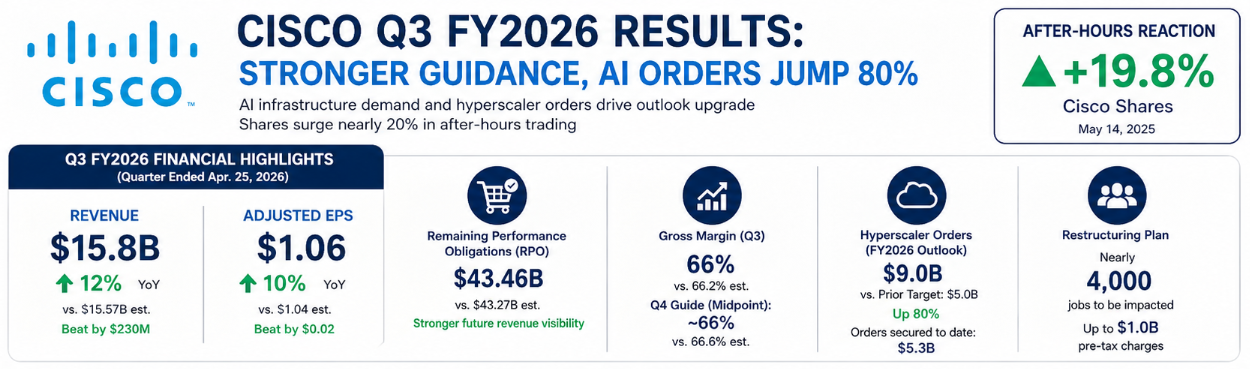
Cisco Systems shares surged nearly 17% in pre-market trading after the company delivered stronger-than-expected earnings, sharply raised guidance, and significantly increased its AI-related order outlook — reinforcing Wall Street’s growing belief that AI infrastructure spending is expanding far beyond GPUs.
The networking giant posted fiscal Q3 revenue of $15.8 billion, up 12% year-over-year and above consensus estimates of $15.57 billion. Adjusted EPS came in at $1.06, also topping expectations.
But the real catalyst was guidance.
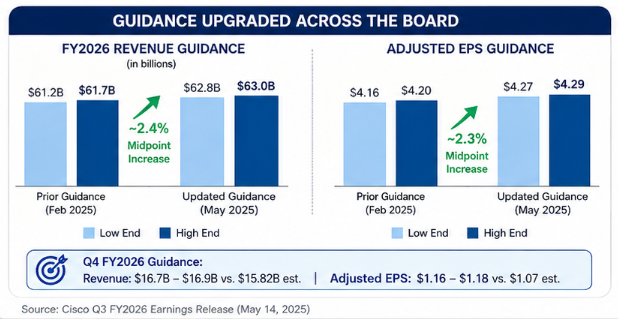
Cisco Systems, Inc.(CSCO.US) forecast fiscal Q4 revenue of $16.7 billion to $16.9 billion, far above Wall Street estimates of roughly $15.8 billion. Adjusted EPS guidance of $1.16 to $1.18 also came in well ahead of expectations.
The company also raised full-year fiscal 2026 revenue guidance to $62.8 billion-$63.0 billion, while projecting adjusted EPS of $4.27-$4.29, both comfortably above analyst estimates.
AI Demand Is No Longer Just About Nvidia
The biggest surprise from the report was Cisco’s aggressive AI order upgrade.
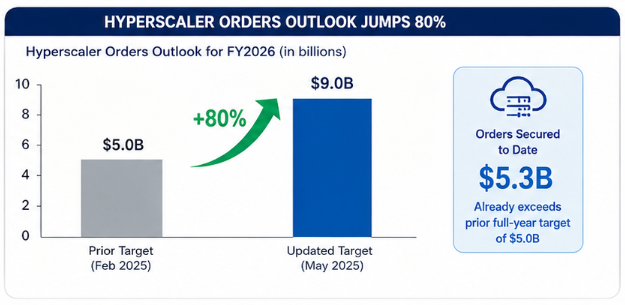
Management now expects orders from hyperscale cloud customers to reach $9 billion in fiscal 2026, up sharply from the prior $5 billion target — an 80% increase. Cisco said it has already secured $5.3 billion in such orders, surpassing its previous full-year target.
That signals AI infrastructure demand is rapidly expanding into networking, switches, routing, optical connectivity, and data-center architecture — areas where Cisco is increasingly positioning itself as a key beneficiary.
For investors, this changes the narrative.
Until recently, the AI infrastructure trade was largely concentrated around companies like NVIDIA Corporation(NVDA.US) and Broadcom Limited(AVGO.US). Cisco’s latest numbers suggest networking layers inside AI data centers are becoming a major spending category as hyperscalers race to build larger AI clusters.
Margins Slightly Soft, But Investors Focused on Growth
Cisco reported Q3 gross margin of 66%, slightly below expectations. Q4 margin guidance also came in a bit lighter than analysts anticipated.
The softer margin profile likely reflects a changing customer mix, with hyperscalers and large AI infrastructure projects typically carrying stronger pricing pressure than traditional enterprise networking deals.
Still, the market appeared willing to overlook modest margin concerns as long as AI-related revenue growth accelerates.
The company also reported remaining performance obligations (RPO) of $43.46 billion, slightly above estimates, signaling strong future revenue visibility backed by existing contracts.
Cisco Restructures Around AI, Cuts Nearly 4,000 Jobs
Alongside earnings, Cisco announced a major restructuring plan that will eliminate nearly 4,000 jobs, or less than 5% of its workforce.
The company expects up to $1 billion in pre-tax charges tied to severance and restructuring costs.
CEO Chuck Robbins said Cisco is reallocating resources toward areas with the strongest long-term demand, particularly AI infrastructure, cloud networking, cybersecurity, and software.
Investors largely viewed the layoffs as a strategic pivot rather than a sign of weakening demand.
What Investors Are Watching Next
Cisco’s earnings may mark another important shift in the AI trade.
The market is increasingly rewarding companies tied to “AI bottlenecks” — not just chips, but also networking, memory, optical infrastructure, power systems, and cloud architecture.
Cisco’s guidance upgrade and exploding hyperscaler orders suggest AI capex is broadening across the infrastructure stack, potentially creating new opportunities across the networking and communications sector.
Related Stocks and ETFs to Watch After Cisco’s Earnings
Cisco’s earnings reinforced a broader market theme: AI infrastructure spending is expanding beyond GPUs into networking, optical connectivity, servers, and cloud architecture. Investors are increasingly looking for “second-wave AI beneficiaries” tied to data-center buildouts.
| Company / ETF | Core Business | AI Infrastructure Exposure |
|---|---|---|
| Cisco Systems, Inc.(CSCO.US) | Enterprise networking, switches, routing, security | Hyperscaler networking, AI data-center connectivity |
| NVIDIA Corporation(NVDA.US) | AI GPUs and AI computing platforms | AI servers, accelerated computing infrastructure |
| Broadcom Limited(AVGO.US) | AI networking chips, custom ASICs, optical connectivity | Cloud networking and AI interconnect solutions |
| Arista Networks, Inc.(ANET.US) | High-speed cloud networking switches | AI cluster networking and cloud data centers |
| Hewlett Packard Enterprise Co.(HPE.US) | AI servers, hybrid cloud, networking | Enterprise AI infrastructure and server demand |
| Nokia Oyj Sponsored ADR(NOK.US) | Optical networking and telecom infrastructure | High-speed network transport and optical systems |
| Telefonaktiebolaget LM Ericsson Sponsored ADR Class B(ERIC.US) | 5G and network infrastructure | Mobile network traffic and infrastructure upgrades |
| Ciena Corporation(CIEN.US) | Optical transport and data-center interconnect | AI-driven bandwidth and optical connectivity demand |
| VanEck Vectors Semiconductor ETF(SMH.US) | Semiconductor ETF | Broad semiconductor and AI hardware exposure |
| Global X Arrfcl Intlgc & Tech ETF(AIQ.US) | AI-focused ETF | Diversified exposure across AI ecosystem |
Following Cisco’s results, shares of Hewlett Packard Enterprise Co.(HPE.US), Nokia Oyj Sponsored ADR(NOK.US), and Telefonaktiebolaget LM Ericsson Sponsored ADR Class B(ERIC.US) also moved higher in after-hours trading as investors rotated into broader AI infrastructure names.
If hyperscaler AI spending continues accelerating through 2026, investors may start treating networking infrastructure as the next major AI bottleneck trade — potentially benefiting companies across the broader communications and cloud hardware ecosystem.