

Stocks to Watch | Meta Spooks the Market: Buy the Dip in Semis or Revisit Mag7?
Meta Platforms META | 0.00 | |
PHLX Sox Semiconductor Sector Ishares SOXX | 0.00 | |
VanEck Vectors Semiconductor ETF SMH | 0.00 | |
Micron Technology, Inc. MU | 0.00 | |
Sandisk Corporation SNDK | 0.00 |
Subscribe to The Value Anchor Topic / The Trend Catcher Topic —unlock the full historical archive and never miss a weekly pick again.
Yesterday's reports indicating that Meta Platforms(META.US) may sell its excess AI computing capacity or offer model-access services have triggered a sharp market rotation. Following the news, semiconductor and AI hardware stocks suffered significant losses. Major ETFs like PHLX Sox Semiconductor Sector Ishares(SOXX.US) and VanEck Vectors Semiconductor ETF(SMH.US) fell by 6.5% and 5.4%, respectively, while memory chip stocks like Micron Technology, Inc.(MU.US) and Sandisk Corporation(SNDK.US) plunged around 10%. Neocloud GPU providers such as CoreWeave(CRWV.US) and NEBIUS(NBIS.US) also saw double-digit drops as Meta shifted from a potential client to a competitor.
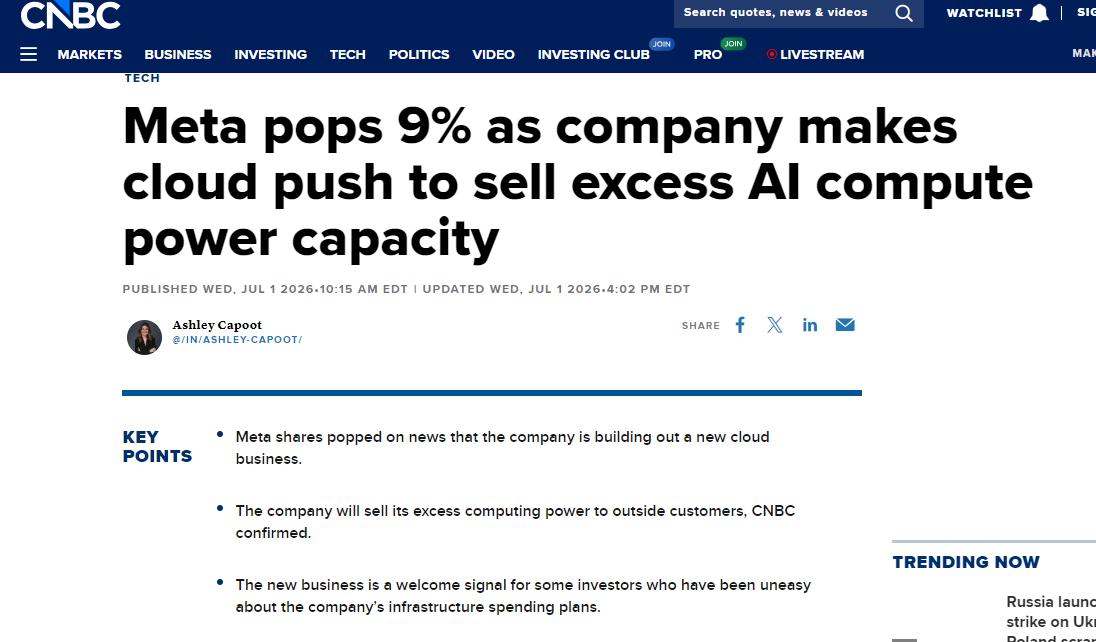
Conversely, the "Magnificent 7" (Mag7) largely rallied, with Meta surging nearly 9% and Alphabet Inc. Class C(GOOG.US) and Amazon.com, Inc.(AMZN.US) closing higher. This highlights a clear capital shift from semiconductor hardware toward cloud, software, and cash-flow-generating assets. By monetizing its idle AI infrastructure, Meta is addressing investor concerns over its massive capital expenditures.
Morgan Stanley estimates that successfully renting out computing power could boost Meta’s 2028 EPS by approximately 8%, providing a tangible return on its AI investments.
Mag7 Re-evaluation vs. Overcrowded Semi Trades
The core logic for revisiting the Mag7 lies in a structural shift in market positioning. According to a June Bank of America survey, a record 80% of fund managers consider "long global semiconductors" to be the most crowded trade, compared to just 12% for "long Mag7." As funds exit the highly congested AI hardware sector, tech giants with strong cash flows, platform moats, and valuation repair potential are becoming prime targets for reallocation.
However, investors are advised to weigh the specific risk-reward profiles within the Mag7:
- Apple Inc.(AAPL.US): Defensive, but facing margin pressures from rising memory costs.
- Microsoft Corporation(MSFT.US): Needs to prove its massive AI capex can convert into sustainable free cash flow via Azure and Copilot.
- Alphabet Inc. Class C(GOOG.US): Balancing its core search business while accelerating AI commercialization.
- Amazon.com, Inc.(AMZN.US): Focused on re-accelerating AWS to offset retail and AI infrastructure costs.
- Tesla Motors, Inc.(TSLA.US): Highly volatile, driven by narratives around autonomous driving and robotics.
- NVIDIA Corporation(NVDA.US): The structural AI winner, but heavily tied to the currently crowded semiconductor cycle.
Subscribe to The Value Anchor Topic / The Trend Catcher Topic —unlock the full historical archive and never miss a weekly pick again.
Looming Short-Term Liquidity Risks in July
The tech sector faces upcoming liquidity pressures in early July, driven by two massive capital events:
- SpaceX(SPCX.US) is joining the Nasdaq 100: Expected to generate roughly $4.3 billion in passive buying, which will require index funds to trim existing holdings.
- SK Hynix’s US ADR Listing: The global HBM leader aims to raise up to $29.4 billion. As investors flock to this pure-play HBM asset, it could dilute the scarcity premium of competitors like Micron and drain liquidity from major semiconductor ETFs as fund managers rebalance their portfolios.
Memory Sector: Mixed Signals from Inventory and Price Data
The semiconductor sell-off largely reflects a loosening of highly concentrated positions, prompted by Meta's news, which raised market questions about potential AI compute oversupply and future chip procurement. However, current industry data presents a nuanced picture rather than a definitive end to the hardware cycle:
- Inventory Levels: According to a Morgan Stanley tracker, Q1 semiconductor supply chain inventory days increased by 9 days—lower than the typical seasonal increase of 19 days, though total inventory remains 33 days above the historical median. The memory segment specifically is healthier, with some metrics tracking below historical medians, indicating easing inventory pressure but not yet an industry-wide active restocking phase.
- Price Trends: TrendForce forecasts show memory price hikes are continuing, but the slope is flattening. Traditional DRAM prices are projected to rise 13%-18% quarter-over-quarter in Q3 (supported by server and AI-related demand). Meanwhile, NAND flash price growth is decelerating notably, expected to increase by 10%-15% in Q3, down from a massive 55%-60% surge in Q2.
- Capex vs. Supply Lag: Massive capital expenditures do not translate to immediate oversupply due to construction and equipment lead times. New capacities from major players like SK Hynix and Micron (including US plants and HBM packaging facilities) are not expected to materially alter the supply-demand balance in 2026. However, as this new capacity comes online in 2027 and beyond, market focus is expected to shift away from "shortage-driven price hikes" toward long-term contracts, HBM market share, and capex return rates, which may increase stock volatility.
Conclusion & Market Outlook
In summary, the market is undergoing a structural reallocation. Capital is shifting from overcrowded semiconductor and AI hardware trades back toward large-cap tech platforms (the Mag7) that offer strong cash flows, platform moats, and potential for valuation repair. In the near term, investors must navigate potential liquidity shocks in early July driven by major market events like SpaceX's index inclusion and SK Hynix's ADR listing.
For the semiconductor and memory sectors, the narrative is transitioning. As new fab capacities gradually come online toward 2027, the simplistic "shortage-driven price hike" storyline will fade. Going forward, market pricing will increasingly rely on fundamental execution metrics—such as return on capital expenditure (ROCE), HBM market share, long-term contracts, and supply discipline. Consequently, investors should brace for higher stock volatility within the sector as the valuation logic evolves.