

Stocks to Watch | Panic or Healthy Reset? Tech Momentum Factor Drops 40% in 17 Days - What Is This AI Selloff Really About?
PHLX Semiconductor SOX | 0.00 | |
Goldman Sachs Group, Inc. GS | 0.00 | |
Bank of America Corp BAC | 0.00 | |
VanEck Vectors Semiconductor ETF SMH | 0.00 | |
PHLX Sox Semiconductor Sector Ishares SOXX | 0.00 |
The AI trade has suffered one of its sharpest corrections since the generative AI boom began, pushing the PHLX Semiconductor(SOX.US) into a technical bear market and triggering widespread selling across memory, semiconductor, and AI infrastructure stocks. While headlines have centered on slowing AI capital expenditure and valuation concerns, market data suggests that positioning and leverage—not deteriorating fundamentals—have been the primary drivers of the recent drawdown.
A Familiar Pattern in the AI Cycle
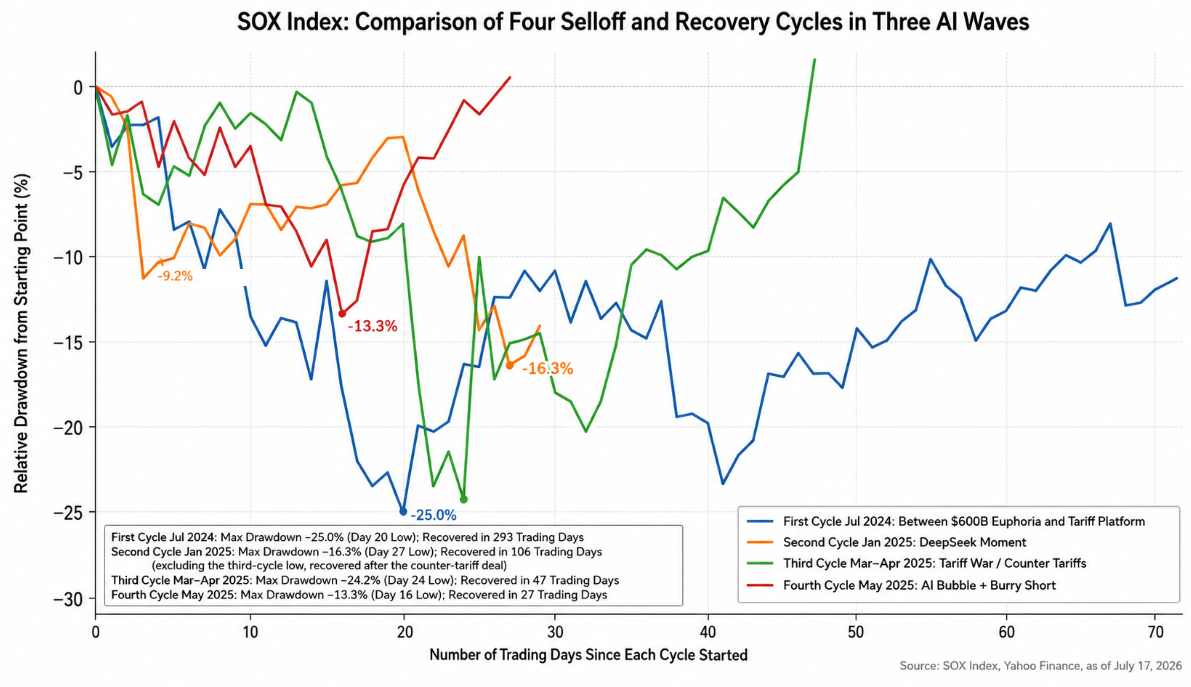
Including the current episode, the AI sector has experienced five major corrections over the past three years. Although each was sparked by a different negative narrative, several characteristics have remained remarkably consistent.
Previous corrections averaged roughly a 20% decline, typically bottomed within about 20 trading days, and each recovery phase became progressively shorter than the previous one. The first correction required nearly 293 days to recover, while subsequent rebounds shortened to approximately 106 days, 47 days, and 27 days, respectively.
This suggests that despite increasingly frequent sentiment shocks, the market has historically shown a faster ability to absorb negative narratives as investors gain greater confidence in the long-term AI investment cycle.
Structural Selling Has Dominated This Correction
Unlike a traditional earnings-driven downturn, this selloff appears to have been amplified by structural market factors.
According to Goldman Sachs Group, Inc.(GS.US), its technology momentum basket—tracking high-momentum technology, media and telecom stocks—declined approximately 40% from its peak in just 17 trading days, marking the fastest and deepest drawdown on record. The bank attributes the decline primarily to crowded positioning and concentrated leverage rather than weakening corporate fundamentals.
Memory-related stocks have accounted for roughly two-thirds of the broader semiconductor decline, reflecting how heavily investors had concentrated exposure in one of the strongest-performing segments of the AI supply chain.
At the same time, volatility has become unusually dispersed. Individual semiconductor stocks have experienced significantly larger price swings while broader market indices have remained relatively stable, illustrating that risk has become increasingly concentrated at the stock level rather than across the entire market.
Korea's Deleveraging Offers an Important Clue
One of the clearest indicators of the recent correction has emerged from South Korea, one of the world's largest memory semiconductor markets.
Third-party market data shows that Korean margin balances have fallen back to levels last seen in April. Assets held in leveraged semiconductor and Korea-focused ETFs have reportedly declined from roughly $53 billion in mid-June to around $27 billion, nearly halving within weeks.
Market flow data also suggests a classic deleveraging process:
- Retail investors were forced to reduce positions through margin liquidations.
- Domestic institutions temporarily became net buyers.
- Foreign investors continued selling while some retail buying reappeared later in the week.
Taken together, these signals indicate that much of the excessive leverage accumulated during the AI rally may already have been unwound, although the process may not be fully complete.
Similar leverage reduction has also been observed in China's margin financing market, where financing balances have retreated toward June lows.
Capital Spending Remains the Core Debate
Despite the violent price action, the market's fundamental question has remained largely unchanged:
Will hyperscale AI infrastructure investment continue expanding?
The latest correction accelerated after concerns emerged over whether cloud providers might slow AI capital expenditure, particularly following speculation surrounding AI infrastructure utilization and memory capacity expansion.
Yet several fundamental indicators continue to point toward resilient AI investment trends.
Bank of America Corp(BAC.US) recently increased its forecast for global AI data center capital expenditure to approximately $851 billion in 2026, while maintaining expectations for continued growth into 2027. The bank also highlighted continued growth in AI token consumption and long-term cloud service provider contract backlogs, suggesting enterprise AI demand remains healthy.
This divergence between improving long-term demand indicators and weakening near-term market sentiment explains why investors remain sharply divided over the sector's outlook.
Earnings Now Become the Ultimate Test
With much of the recent decline driven by expectations rather than confirmed deterioration, attention is rapidly shifting toward corporate earnings.
Upcoming reports from major hyperscale cloud companies are expected to provide the market with its first direct evidence regarding:
- AI infrastructure spending plans;
- Returns on cloud AI investment (ROI);
- Future demand for semiconductor and memory suppliers.
These results could influence sentiment across the broader AI ecosystem, including U.S. semiconductor manufacturers, Korean memory producers, optical networking suppliers, PCB manufacturers, and related infrastructure companies.
In other words, the market narrative is gradually shifting from speculation toward measurable fundamentals.
What Investors May Be Watching
Rather than focusing solely on daily price volatility, market participants are likely to monitor several broader developments over the coming weeks:
- Whether leverage unwinding in Korea has largely concluded;
- Whether AI capital expenditure guidance remains intact during earnings season;
- Whether valuation compression has sufficiently reduced positioning risks;
Whether macro events—including central bank meetings and policy developments—introduce additional volatility.
The answers to these questions are likely to determine whether the recent correction proves to be a temporary reset within the broader AI cycle or evolves into a more prolonged period of consolidation.
Related ETFs And Stocks
Risk Disclosure: Leveraged ETFs (including 2x and 3x products) are designed to track daily returns rather than long-term performance. Due to daily rebalancing and compounding effects, they may experience significant performance decay during periods of heightened volatility, making them considerably riskier than traditional ETFs, especially when held over extended periods.
This article is for market commentary and educational purposes only and should not be construed as investment advice or a recommendation to buy or sell any security.