

Stocks to Watch | Tesla Q1 Earnings Loom! The Ultimate Test in Transitioning from Automaker to AI Giant: Kicking Off the Battle at the $400 Mark?
Tesla Motors, Inc. TSLA | 0.00 | |
SAMSUNG ELECTRONICS CO SSNLF | 0.00 | |
PANASONIC CORP PCRFY | 0.00 | |
BHP Group Ltd Sponsored American Depositary Receipt Repr 2 Shs BHP | 0.00 | |
STMicroelectronics NV Sponsored ADR RegS STM | 0.00 |
Tesla Motors, Inc.(TSLA.US) will release its Q1 2026 financial report after the market closes on April 22. This is not just a quarterly scorecard, but a critical window to validate its transition from a traditional automaker to an AI and robotics technology company.
Institutions expect Tesla to achieve a revenue of $22.34 billion in Q1 2026, a year-over-year increase of 15.54%, and an earnings per share (EPS) of $0.223, up 85.75% year-over-year. (The above data is based on US-GAAP.)
I. Traditional Business Under Pressure: Auto Deliveries and Energy Storage Both Miss Expectations, Inventory and Gross Margin in Focus
- Auto Business: The Red Light is On
Although Tesla's earnings report has not yet been officially released, the preliminary delivery data has already poured cold water on the market. Data shows that Tesla's Q1 deliveries were only 358,000 vehicles, not only dropping 14% quarter-over-quarter, but also falling short of Wall Street's consensus estimate of about 370,000 vehicles. Despite the Shanghai Gigafactory delivering 213,000 vehicles in the first quarter—bucking the trend with a 23.5% year-over-year increase—it failed to reverse the weakness of the overall global delivery volume.
The decline in delivery data is primarily due to the expiration of the U.S. federal tax credit at the end of September 2025, which dealt a blow to U.S. EV demand. Furthermore, intensified competition in the European market has seen traditional automakers and Chinese EV brands continuously squeezing Tesla's market space.
Even more severe is the inventory backlog. Tesla's production for the quarter reached 408,400 vehicles, creating an inventory gap of over 50,000 units compared to deliveries, hitting a four-year high. Investors will focus heavily on how management plans to digest this inventory through price cuts, promotions, or capacity adjustments, and whether the auto business's gross margin will break down. Deutsche Bank analysts point out that, excluding regulatory credit revenue, the Q1 auto gross margin is expected to fall back to around 14.7% from 17.9% in the previous quarter.
- Energy Storage Deployments Fall Far Short of Expectations: Short-Term Fluctuation or Trend Reversal?
The energy storage business has historically been a bright spot in Tesla's earnings, but Q1 energy storage deployments were only 8.8 GWh, far below the market expectation of 14.4 GWh. While some Wall Street analysts (such as Deutsche Bank) believe this shortfall is likely attributable to timing fluctuations in order deliveries and expect quarter-over-quarter improvements in subsequent quarters, the market remains concerned about whether this signals a reversal in the growth trend. Management's adjustments to the full-year energy storage deployment guidance during the earnings call will directly impact the valuation expectations for this business.
II. AI and Robotics: AI5 Chip Successfully Taped Out, Robotaxi and Optimus Mass Production Progress in the Spotlight
The market's valuation of Tesla is effectively split into two major parts: the auto and energy storage base business serves as the foundation, while the pace of realization for FSD software subscriptions, the Robotaxi network, and the Optimus humanoid robot determines Tesla's valuation elasticity.
On the eve of the earnings release, Elon Musk personally announced on April 15 that the AI5 chip had completed its tape-out, marking a milestone event for Tesla's in-house AI chips. The chip boasts 2500 TOPS of computing power per unit—a 40-fold performance increase over the previous-generation AI4—and will provide core computing support for FSD, Robotaxi (Cybercab), and the Optimus humanoid robot.
According to industry norms, a 12 to 18-month testing and validation period is required after tape-out. It is expected to enter small-batch trial production by the end of 2026 and large-scale mass production by mid-2027, directly corresponding to the commercialization milestones of Cybercab and Optimus.
In this earnings report, the market will focus on three major AI advancements:
First, global FSD mileage and regulatory approval progress, which is a prerequisite for Robotaxi deployment. The recent regulatory breakthrough for FSD in Europe serves as a shot in the arm. On April 11, the Netherlands announced it had taken the lead in approving the FSD Supervised version for road use, clearing a key hurdle for Tesla to open up the EU market.
Second, the advancement of Cybercab. Tesla's new autonomous taxi fleet is currently operating in Austin, Texas, and San Francisco, but it is difficult to know exactly how many are fully autonomous and how many are remotely operated. Although Tesla promised to expand autonomous taxis to seven new cities, one-third of 2026 has already passed, and this goal has yet to be achieved.
Third, the small-batch production timeline and cost targets for Optimus V3. Musk stated that Gen 3 is the first design oriented towards mass production. The first production line is scheduled to start before the end of 2026, with a long-term planned annual capacity of 1 million units. UBS analysts project that Tesla will only be able to produce 5,000 units by 2027, and 30,000 units by 2030. This earnings report may provide updates on internal Optimus factory deployments and a specific mass production schedule.
Additionally, the market also hopes Musk might reveal information regarding a SpaceX IPO. For Tesla investors, the pressure from SpaceX's IPO-related capital diversion is real.
III. The "Hidden Landmines" of Earnings Night: Capital Expenditure
During the January 2026 earnings call, Tesla management indicated that 2026 capital expenditures are expected to exceed $20 billion. Compared to Tesla's capex of approximately $8.5 billion in 2025 and a peak of only $11.3 billion in 2024, the 2026 spending is nearly double the historical peak. This $20 billion will primarily be invested in six new factories, AI computing power, and the Robotaxi/Optimus fleets.
Tesla's balance sheet remains robust. As of the end of 2025, the company held over $44 billion in cash and investments, sufficient to support massive capital expenditures. However, Barclays warned that Tesla's Terafab and 100GW solar projects were not included in the original capex guidance. If Q1 capex jumps significantly or full-year guidance exceeds $20 billion, this could turn free cash flow negative.
On March 30, the official TeslaAI account announced the official launch of the Terafab super chip factory project. According to disclosures, the Terafab project is planned to have an annual production capacity of 100 billion to 200 billion advanced AI and memory chips, with a total estimated investment of $20 billion. Bloomberg analysis pointed out that Terafab will go through a long cycle from groundbreaking to full production, raising doubts about whether the $20 billion budget will be enough to cover it.
During the April 22 earnings call, investors will be watching: Will the $20 billion capital expenditure guidance be maintained? Will Musk disclose more capex details and capacity planning for Terafab? How is Q1 free cash flow?
Furthermore, because the commercialization of Robotaxi and Optimus will still take years, high capital expenditures will pressure short-term free cash flow. If Musk cannot clearly articulate "when we will start making money through Robotaxi" during this call, the market's tolerance for this massive cash burn might be tested.
IV. Analyst Divergence and Technical Analysis
Currently, financial analysts have immense divergence on Tesla's price target (ranging from $25.28 to $600, averaging $403.13). The core debate remains whether Tesla is a "pure EV company" or an "AI re-rating platform." Currently, about 43% of institutions rate it a Buy, 36% a Hold, and 20% a Sell.
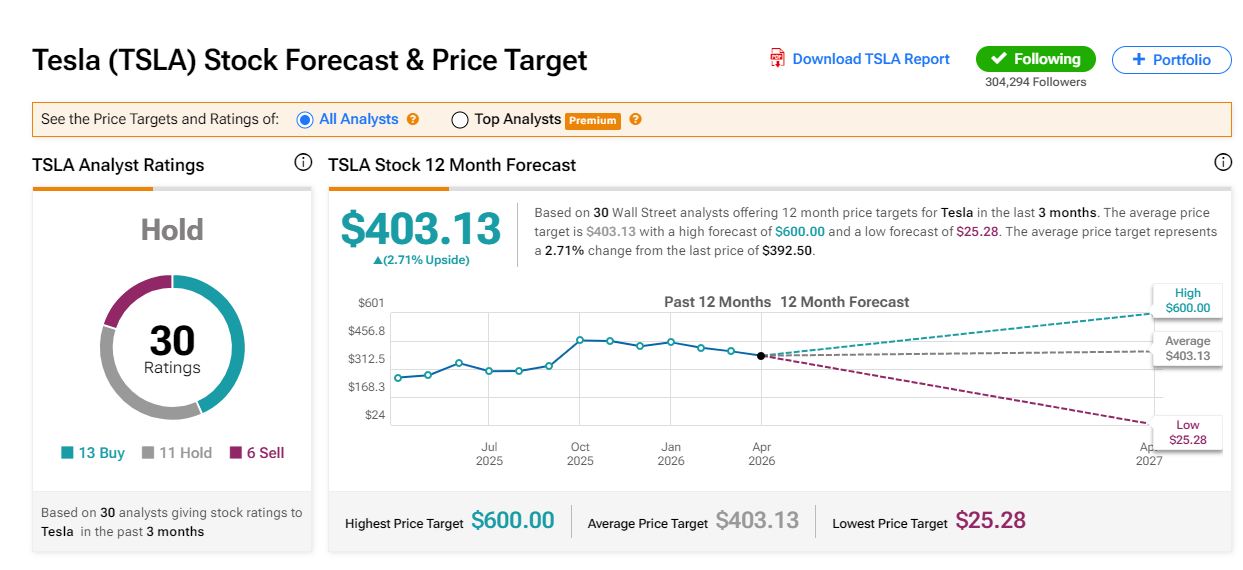
After Tesla released its delivery data in early April, JPMorgan reiterated an "Underweight" rating in a tracking report with a price target of only $145. Additionally, several institutions recently lowered their price targets for Tesla; among them, Deutsche Bank lowered its target from $500 to $465, and TD Securities lowered its target from $519 to $490.
Barclays raised its price target for the company from $275 to $360, while Wedbush remains firmly bullish, steadfastly maintaining a $600 price target. Analyst Dan Ives emphasizes that the AI era is the most important chapter of Tesla's growth story.
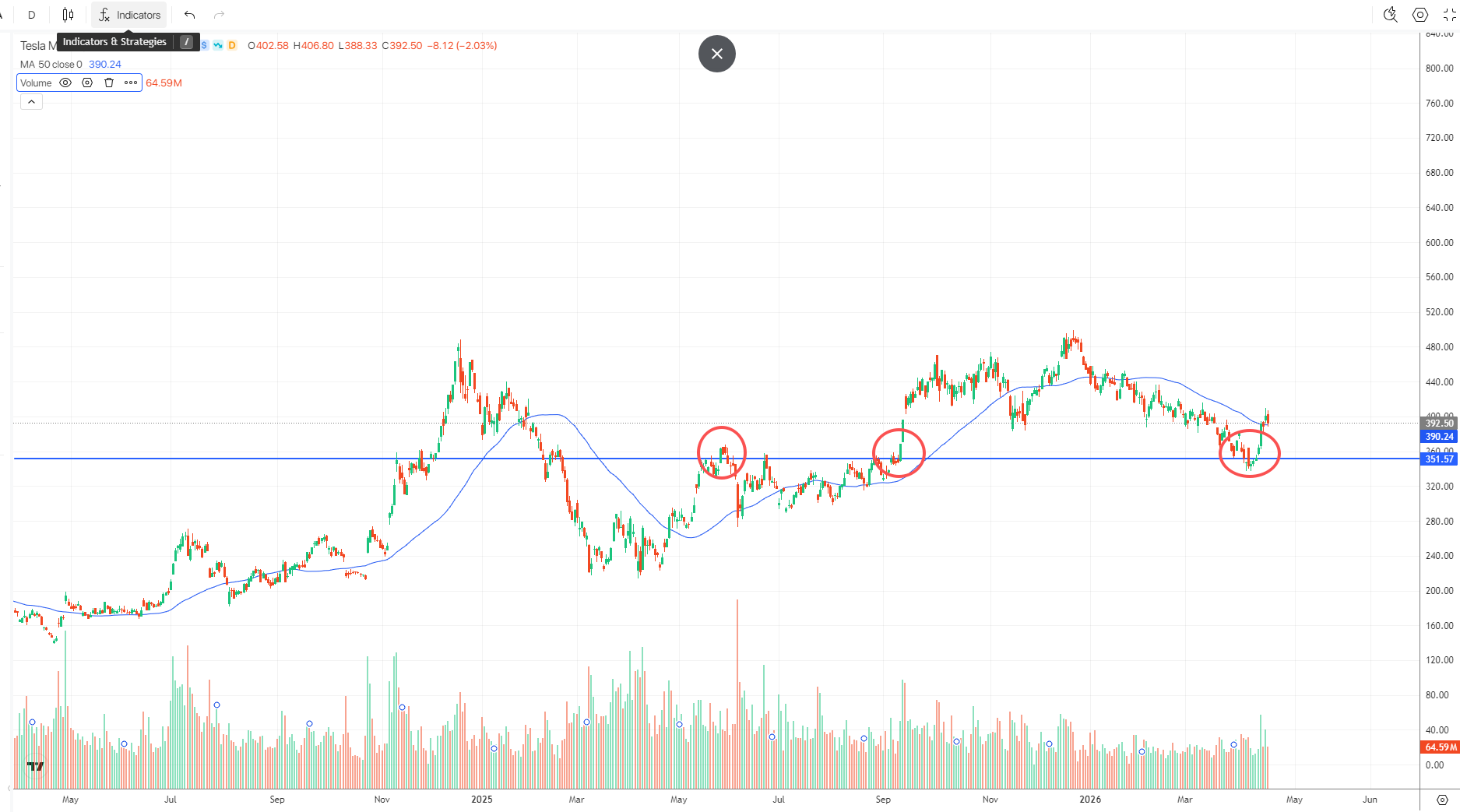
From a technical perspective, Tesla's stock price pulled back from a recent high of nearly $500 to around $350 before the previous rally, then began to rebound, moving back above the 60-day moving average. The current stock price faces a critical tug-of-war at the $400 mark.
On an annual basis, Tesla's stock is still down year-to-date, indicating that the medium-term trend has not fully reversed. If the stock can stabilize at $400 and break out above $420 on heavy volume, it will confirm a medium-term uptrend; conversely, if it loses the $390 level post-earnings, it may retest previous lows.
V. Focus on Related Investment Targets
With Tesla's earnings approaching, what other concept stocks related to Tesla's supply chain are worth watching?
- Battery Pack
SAMSUNG ELECTRONICS CO(SSNLF.US)
BHP Group Ltd Sponsored American Depositary Receipt Repr 2 Shs(BHP.US)
STMicroelectronics NV Sponsored ADR RegS(STM.US)
- Thermal Management
Texas Instruments Incorporated(TXN.US)
Modine Manufacturing Company(MOD.US)
- Smart Cockpit and ADAS
ON Semiconductor Corporation(ON.US)
Mobileye Global, Inc. Class A(MBLY.US)
Advanced Micro Devices, Inc.(AMD.US)
- Chassis and Body
- Interior and Exterior
Magna International Inc.(MGA.US)
Avery Dennison Corporation(AVY.US)
- Tesla Robotaxi Related Companies
Uber Technologies,Inc.(UBER.US)
WeRide Inc. Sponsored ADR(WRD.US)
Baidu, Inc. Sponsored ADR Class A(BIDU.US)
Here are Tesla-related ETFs investors can follow:
| Ticker | ETF Name |
|---|---|
| AXS TSLA BEAR DAILY ETF(TSLQ.US) | Direxion Daily TSLA Bear 2X Shares |
| Direxion Shares ETF Trust Direxion Daily TSLA Bear 1X Shares(TSLS.US) | Direxion Daily TSLA Bear 1X Shares |
| GRANITESHARES 1.25X LONG TESLA DAILY ETF(TSL.US) | GraniteShares 1.25x Long TSLA Daily ETF |
| Direxion Shares ETF Trust Direxion Daily TSLA Bull 2X Shares(TSLL.US) | Direxion Daily TSLA Bull 1.5X Shares |
Are you optimistic about Tesla's earnings performance this quarter? Feel free to leave a comment and discuss.