

Stocks to Watch | Trump Brings Top CEOs to China — Boeing, Apple, Tesla, Micron and ASML in Focus, and These Stocks Could Be the Biggest Movers
Tesla Motors, Inc. TSLA | 0.00 | |
Apple Inc. AAPL | 0.00 | |
The Boeing BA | 0.00 | |
BlackRock BLK | 0.00 | |
Blackstone BX | 0.00 |
Key Takeaways
- US and China are expected to discuss rare earths, chips, and semiconductor equipment, and announce major commercial agreements in trade, aviation, and supply chains
- The delegation, comprised of 16 business executives, aimed to facilitate Chinese purchases of products such as American aircraft and agricultural products
- Talks may extend rare earths truce, Boeing hopes for historic jet order
- Nvidia CEO Jensen Huang not attending, focus is on agriculture and aviation
President Donald Trump’s upcoming visit to China is shaping up less like a traditional diplomatic summit and more like a high-stakes corporate roadshow.
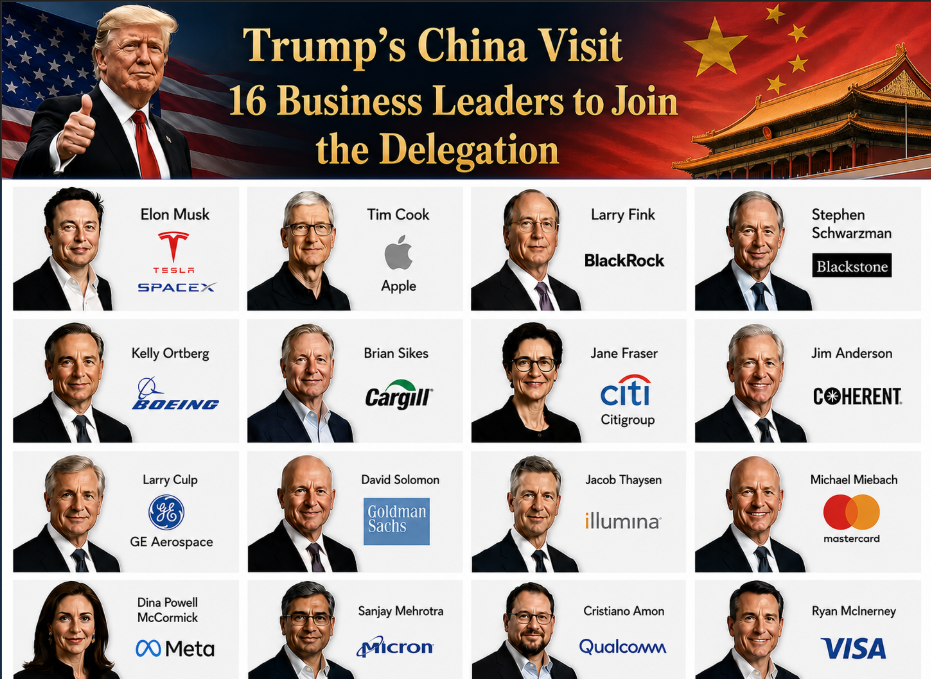
The delegation reportedly includes CEOs from Tesla Motors, Inc.(TSLA.US), Apple Inc.(AAPL.US), Boeing Company(BA.US), BlackRock, Inc.(BLK.US), Blackstone Inc.(BX.US), Citigroup Inc.(C.US), Micron Technology, Inc.(MU.US), QUALCOMM Incorporated(QCOM.US), Visa(V.US), Mastercard Incorporated Class A(MA.US), and other major companies. They are some of America’s most influential CEOs: Elon Musk, Tim Cook, Larry Fink, Stephen Schwarzman, Kelly Ortberg, David Solomon and others spanning tech, finance, aviation, payments, agriculture and industrials.
In addition, according to Reuters, Brian Sikes, CEO of agricultural giant Cargill, Jim Anderson, CEO of optics and photonics technology company Coherent Corp.(COHR.US), and Jacob Thaysen, CEO of gene sequencing company Illumina, Inc.(ILMN.US), will also be accompanying him. Dina Powell McCormick of Meta Platforms(META.US) is also on the list.
Cisco Systems, Inc.(CSCO.US) CEO Chuck Robbins, although invited by the White House, will be unable to attend this week due to the company's earnings release, according to a company spokesperson.
But one absence stands out above all: NVIDIA Corporation(NVDA.US) CEO Jensen Huang.
That omission may reveal the real story behind the trip — and why investors are increasingly cautious about semiconductor stocks after one of the strongest rallies since the dot-com era.
The Real Agenda: Trade, Aviation and Supply Chains — Not AI Chips
According to Reuters and Semafor, the White House’s priority for this visit is agriculture, aviation and broader commercial trade ties, rather than advanced semiconductor negotiations.
What Both Sides Want
US priorities
Reports suggest Washington’s goals include:
- Securing Chinese purchases of US aircraft and agricultural products
- Stabilizing rare earth supply chains
- Reducing trade tensions ahead of the election cycle
- Supporting major US corporations operating in China
China’s priorities
China is likely focused on:
- Easing US semiconductor and equipment restrictions
- Maintaining stable trade conditions
- Expanding access to advanced manufacturing technology
- Increasing foreign investment and commercial cooperation
One key issue investors are watching is whether negotiations could eventually touch advanced semiconductor equipment exports involving ASML Holding NV ADR(ASML.US).
Boeing May Be the Biggest Immediate Winner
According to Reuters and Bloomberg, Boeing Company(BA.US) and Chinese counterparts have discussed a potential aircraft order involving hundreds of planes, including 737 MAX jets. If completed, it would mark China’s first major Boeing order since 2017.
For Boeing stock, such a deal would:
- Improve long-term delivery visibility
- Strengthen cash-flow expectations
- Signal improving US-China commercial relations
- Help restore confidence after years of geopolitical and operational setbacks
GE Aerospace(GE.US) could also benefit indirectly through engine demand tied to aircraft deliveries.
Apple and Tesla Are Focused on Stability
For Apple Inc.(AAPL.US) and Tesla Motors, Inc.(TSLA.US), the key issue is not necessarily winning new contracts — it is avoiding further deterioration in US-China relations.
China remains:
- A critical manufacturing base for Apple
- Tesla’s largest production hub outside the US
- One of the world’s most important EV and smartphone markets
Tim Cook and Elon Musk joining the delegation sends a strong signal that both companies want policy stability above all else.
Any reduction in tariff risk or export-control escalation could support sentiment around:
However, both companies also face structural risks from rising Chinese domestic competition and supply-chain diversification trends.
Why Semiconductor Investors Are Nervous
The summit arrives after a massive rally in AI and semiconductor shares. The PHLX Semiconductor(SOX.US) recently posted its strongest 25-day surge since 2000.
But Gavekal Research CEO Louis-Vincent Gave warned that any future deal involving rare earth access and semiconductor equipment could weaken long-term chip pricing power if China expands advanced manufacturing capacity.
He also argued that geopolitical tensions and Middle East instability could pressure data-center investment and complicate global monetary policy.
Nvidia’s Absence Sent a Message
NVIDIA Corporation(NVDA.US) CEO Jensen Huang’s exclusion stood out because of his increasingly visible relationship with the Trump administration and his recent participation in overseas diplomatic trips.
Reuters reported that semiconductors were simply not the core focus of this visit.
For investors, that suggests:
- The US is still unlikely to loosen advanced AI chip restrictions soon
- Semiconductor policy remains strategic leverage in US-China negotiations
- Expectations for rapid normalization of Nvidia’s China business may be overly optimistic
What Investors Should Watch
The summit’s biggest market implications are likely to center on:
- Boeing Company(BA.US) aircraft orders
- Rare earth supply agreements
- US-China trade tone
- Future semiconductor export restrictions
In the near term, industrial and trade-linked companies may benefit more directly from the trip than AI chipmakers.
For semiconductor stocks, the key question is whether geopolitics begins to outweigh AI-driven earnings momentum in determining valuations.