

Stocks to Watch | Washington Just Dropped $2B into Quantum Stocks. Move Over AI, This is the Next Geopolitical Megatrade
IBM Corp IBM | 0.00 | |
Globalfoundries GFS | 0.00 | |
D-Wave Quantum QBTS | 0.00 | |
Rigetti Computing RGTI | 0.00 | |
Quantinuum QNT | 0.00 |
Subscribe to The Value Anchor Topic / The Trend Catcher Topic —unlock the full historical archive and never miss a weekly pick again.
Quantum computing — long viewed as a high-risk, long-duration technology theme — has suddenly moved closer to the center of U.S. industrial policy.
The latest catalyst: the U.S. Department of Commerce plans to channel more than $2 billion in support to selected quantum firms under the CHIPS and Science Act, with participating companies offering minority equity stakes in return. The announcement triggered a sharp rally across publicly traded quantum names, reigniting speculation that quantum may become the next strategic technology race after semiconductors and AI.
But beneath the rally, questions remain: Who truly benefits? Are startups gaining enough scale? Could giants like IBM dominate? And which suppliers, chipmakers, defense contractors, and cloud companies may see spillover effects?
Why The U.S. Is Backing Quantum Now
The funding initiative highlights Washington’s growing concern over maintaining technological leadership versus China and other countries in areas tied to:
- Cryptography & cybersecurity
- Defense simulations
- AI acceleration
- Materials science
- Drug discovery
- Financial modeling
- National security infrastructure
Unlike prior CHIPS Act grants, some quantum funding comes with government equity participation, potentially creating a new model where federal support resembles strategic investment rather than subsidies.
This could mark the beginning of a longer quantum industrial buildout, especially as lawmakers consider renewing the National Quantum Initiative with recurring annual funding.
Funding Winners: IBM Emerges As The Biggest Beneficiary
Among announced allocations:
| Ticker / Company | The Gov't Check | The Real Story (The "Why") | Risk Level |
|---|---|---|---|
| IBM Corp(IBM.US) | ~$1 Billion | Re-inventing itself as the TSMC of Quantum infrastructure. Big winner. | 🔵 Low (Backed by $14B FCF) |
| D-Wave Quantum(QBTS.US) / Rigetti Computing, Inc.(RGTI.US) | ~$100M each | Survival runway extended. Pure-play microcaps with extreme volatility. | 🔴 High (Pre-revenue) |
| IonQ, Inc.(IONQ.US) | $0 | The Shocking Omission. Missed the list but buying up supply chains. | 🟡 Medium (Sentiment risk) |
| Quantinuum(QNT.US) | ~$100M | Primed for a massive $12.7B IPO. The ultimate industry benchmark. | 🔥 Watch This Space |
IBM: From Research Leader To Infrastructure Provider?
IBM Corp(IBM.US) appears positioned beyond merely developing quantum processors.
The company plans to invest another $1 billion into "Anderon," a quantum venture intended to process superconducting wafers, potentially serving outside customers as well.
That matters because quantum commercialization increasingly depends not only on algorithms or qubits—but also on manufacturing capacity, similar to the semiconductor ecosystem.
IBM’s advantages:
- Nearly $69B trailing revenue
- Roughly $14B free cash flow
- Existing enterprise/government relationships
- Ability to absorb years of R&D spending
Unlike startups, IBM does not rely on equity issuance to survive.
The tradeoff: even major quantum success may represent a relatively small share of IBM’s total business.
Public Quantum Stocks: Rally First, Commercialization Questions Later
D-Wave Quantum(QBTS.US)
Strengths:
- Commercial quantum annealing focus
- Existing cash reserves
- Government relationships may deepen
Risks:
- Additional funding may have less transformational effect because liquidity was already improving
- Long-term profitability remains uncertain
Rigetti Computing(RGTI.US)
Strengths:
- Specialized in superconducting systems
- Federal support could extend development runway
- May improve supply-chain access
Risks:
- Scaling superconducting architectures remains technically difficult
- Competition against IBM and large-cap incumbents
Rigetti may experience one of the larger relative impacts because of its smaller size.
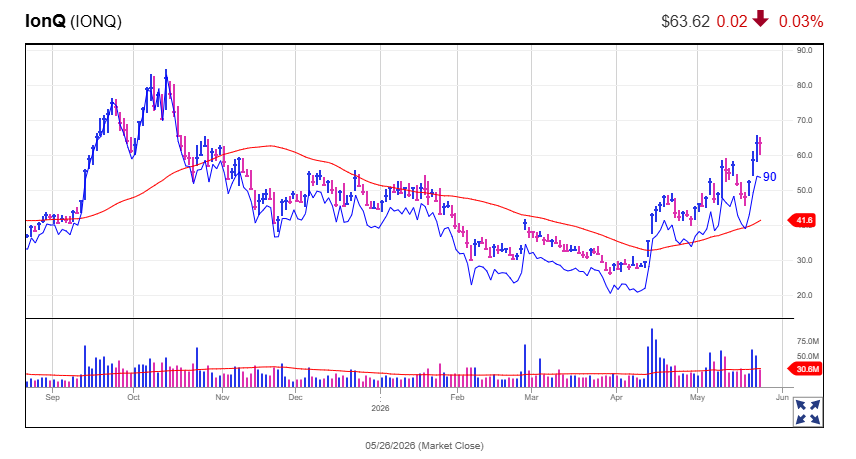
IonQ(IONQ.US)
Notably absent from funding announcements.
Possible explanations:
- Trapped-ion approach depends less on wafer fabrication
- Larger market capitalization than some peers
- Different infrastructure requirements
IonQ still may benefit indirectly through:
- Sector-wide sentiment improvement
- Rising institutional interest
- Ecosystem expansion
Recent acquisition activity, including the purchase of SkyWater Technology(SKYT.US), suggests IonQ continues building vertically.
Why Were Google And Microsoft Left Out?
The omission of large-cap tech players attracted attention.
Alphabet / Google Quantum
Alphabet A(GOOGL.US) shook the market in late 2024 with its Willow quantum processor, renewing enthusiasm around superconducting approaches.
Alphabet C(GOOG.US) also continues expanding research infrastructure.
Yet companies with substantial balance sheets may have less incentive to accept equity dilution tied to federal funding.
Microsoft
Microsoft(MSFT.US) unveiled new quantum hardware earlier in 2025.
Like Google, Microsoft may prefer self-funded development rather than government-linked ownership structures.
The Next Big Event: Quantinuum IPO
One emerging catalyst is the expected IPO of: Quantinuum(QNT.US)
Expected metrics:
Potential valuation: up to ~$12.7B
Planned ticker: QNT
Existing backing from Honeywell(HON.US)
Government funding support included
The listing could become a major benchmark for quantum valuations.
A successful IPO may lift sentiment toward the broader quantum group.

Supply Chain: Quantum Isn’t Only About Quantum Stocks
The bigger investment theme may extend beyond pure-play quantum names.
1. Semiconductor Foundries & Manufacturing
Potential beneficiaries:
- Globalfoundries(GFS.US)
- SkyWater Technology(SKYT.US)
- Advanced materials suppliers
- Cryogenic hardware providers
Quantum hardware requires highly specialized fabrication.
2. Cloud Infrastructure & AI Platforms
Potential indirect beneficiaries:
- Amazon.com(AMZN.US) (AWS quantum services)
- Microsoft(MSFT.US)
- Alphabet C(GOOG.US)
Quantum access today is often delivered via cloud platforms.
3. Defense & Government Contractors
Potential exposure:
- Aerospace firms
- Cybersecurity vendors
- National security contractors
Government procurement could become a long-term growth channel.
4. Advanced Cooling & Cryogenics
Superconducting quantum systems require ultra-low temperatures.
Companies involved in:
- Cryogenic systems
- Vacuum technologies
- Specialized materials
may gradually gain importance.
Near-Term Outlook: Momentum Is Rising, Revenue Still Isn’t
Despite surging share prices, most pure-play quantum firms continue to generate:
- Minimal revenue
- Significant operating losses
- Heavy dependence on external funding
The industry remains largely pre-commercial.
For investors, the central question is shifting from “Will quantum work?” to “Who controls the infrastructure once it does?”
The latest U.S. funding announcement suggests Washington may already be placing early bets on that answer.
Bottom line: Quantum computing has moved from speculative frontier technology toward strategic industrial policy. The winners may ultimately include not only quantum startups—but foundries, cloud platforms, defense contractors, and manufacturing suppliers powering the ecosystem beneath them.