

The AI Ecosystem Showdown: Oracle and Broadcom Earnings Highlight ‘Google Chain’ vs. ‘OpenAI Chain’ Rivalry
Broadcom Limited AVGO | 0.00 | |
Taiwan Semiconductor Manufacturing Co., Ltd. Sponsored ADR TSM | 0.00 | |
Amkor Technology, Inc. AMKR | 0.00 | |
Marvell Technology MRVL | 0.00 | |
Celestica Inc. CLS | 0.00 |
As Wall Street shifts capital, investors scrutinize Broadcom's ASIC dominance and Oracle's mounting debt ahead of their respective quarterly reports.
Oracle Corp. and Broadcom Inc. are slated to release their latest quarterly earnings this week, providing a critical gauge for investors amidst a widening strategic divergence in the global artificial intelligence landscape. The competition is increasingly framed as a contest between the "Google Chain"—spearheaded by Alphabet Inc.'s new Gemini 3 model and proprietary Tensor Processing Unit (TPU) ecosystem—and the "OpenAI Chain," which relies heavily on cloud computing capacity from providers like Oracle and GPUs from Nvidia Corp.
Earnings Expectations
Oracle is scheduled to announce its second-quarter results for fiscal year 2026 after the market close today (December 10). The LSEG analyst consensus projects the company will report revenue of $16.22 billion, representing a year-over-year increase of 15.4%.
Broadcom will follow suit, reporting its fiscal fourth-quarter results after the market closes on Thursday (December 11). Bloomberg analysts anticipate Broadcom's Q4 revenue will climb 24.5% year-over-year to $17.5 billion, with adjusted earnings per share (EPS) expected to rise 31% to $1.87.
Historically, Oracle's stock has seen an average price movement of ±13.4% following its last four earnings announcements, with a 50% chance of a post-report rally, according to TipRanks. Broadcom has historically experienced an average move of ±10.9%, with a 75% probability of an upside movement.
The Market Shift
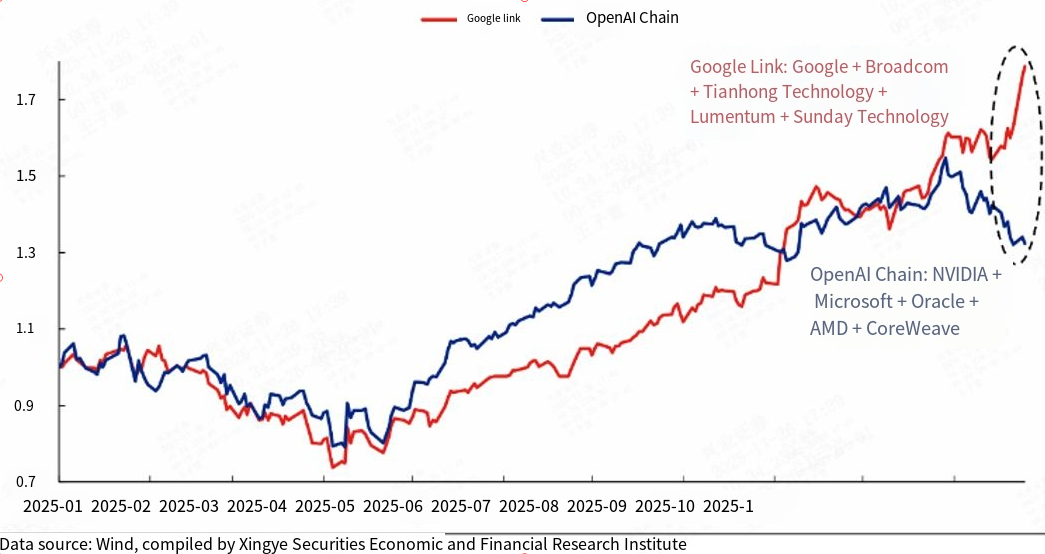
Over the past month, institutional capital has begun to migrate away from the OpenAI-aligned cohort and toward the Google ecosystem. Companies closely linked to the OpenAI chain, including Oracle, CoreWeave, and chipmakers like Advanced Micro Devices (AMD) and Nvidia, have experienced collective stock declines, alongside Microsoft Corp. and SoftBank Group, which holds an 11% stake in OpenAI.
In contrast, Google’s upward momentum has not only propelled its own stock to near-record highs but has also boosted related firms such as Broadcom, Lumentum Holdings, and TTM Technologies. Year-to-date in 2025, a basket of OpenAI-related stocks has achieved a 74% return, but this performance is significantly eclipsed by the 146% surge in Google-related stocks. The technology-heavy Nasdaq 100 Index, for comparison, has appreciated by 22% over the same period.
Oracle Under Scrutiny
As a core cloud computing partner to OpenAI and the second-largest purchaser of Nvidia cards, Oracle's stock has plummeted more than 35% since hitting an all-time high in September. This decline is largely attributed to escalating investor concern over the company’s expanding debt load and its ability to service that debt. According to Citi, Oracle has become the largest issuer of investment-grade bonds among non-financial corporations.
Investors reviewing the Q2 report will prioritize management’s commentary regarding the company's debt profile, cash flow situation, capital expenditure plans, and the status of its partnership with OpenAI. Analysts emphasize the timeline for Oracle to restore positive free cash flow, noting that a robust report on order growth could lead to a stock rebound, given its current relatively low valuation.
Broadcom's ASIC Dominance
Broadcom, which reports Thursday, has maintained strong momentum, seeing its share price soar 75% year-to-date. The company’s central role in the “Google ecosystem” as the core supplier for ASIC chips—specifically, assisting in the design and manufacturing of Google’s TPUs—has cemented its position. Google utilized its proprietary TPUs to train the cutting-edge Gemini 3 model.
As market discussions on an "AI bubble" intensify, an earnings beat and optimistic guidance from Broadcom this week could reinforce investor confidence in the current AI cycle and act as a key indicator for the sustainability of AI capital expenditures into 2026.
Wall Street Perspectives
Goldman Sachs: The firm raised its price target on Broadcom to $435 from $380, positioning the company as potentially the most crucial "armorer" in the AI boom.
Jefferies: Analysts named Broadcom a top stock pick, noting that the market is "rediscovering" the immense potential of the ASIC chip market, with sustained demand for Google’s TPUs signaling a market "inflection point."
Citi (on Oracle): Citi is bullish heading into Oracle’s earnings, arguing that market concerns regarding debt default risk are "overstated." The firm posits that demand for AI infrastructure is broadening beyond a few top players, benefiting Oracle's differentiated OCI cloud offering.
CITIC Securities: The brokerage suggests that the Google AI supply chain has the potential to become one of the most elastic segments in the AI hardware sector in 2026, driven by Google's expansion from "renting compute" to potentially "selling chips" with its self-developed TPUs.
Related Investment Targets Worth Watching
TPU Supply Chain Concept Stocks | |
Design & Manufacturing | |
Taiwan Semiconductor Manufacturing Co., Ltd. Sponsored ADR(TSM.US) | |
Modules & Racks | |
Networking & Cabling | |
| Source: Sahm; Data as of: 2025.12.10 | |
AI Cloud Service Provider Concept Stocks | |
Hyperscalers | Oracle Corporation(ORCL.US) |
| Meta Platforms(META.US) | |
| Alphabet Inc. Class A(GOOGL.US) | |
| Amazon.com, Inc.(AMZN.US) | |
Neocloud | CoreWeave(CRWV.US) |
| Nebius Group(NBIS.US) | |
| Applied Digital(APLD.US) | |
| Galaxy Digital Inc. Ordinary Shares - Class A(GLXY.US) | |
| Source: Sahm; Data as of: 2025.12.10 | |
The "Google Ecosystem" vs. "OpenAI Ecosystem" Core Company Showdown!
Which quarterly report are you more bullish on—Oracle or Broadcom?
Feel free to share your thoughts in the comments.