

Trading Wisdom | Topping the US Charts with 338.42% Returns! How Did This Top Trader Achieve It?
S&P 500 index SPX | 0.00 | |
Tadawul All Shares Index TASI.SA | 0.00 | |
PowerShares QQQ Trust,Series 1 QQQ | 0.00 | |
NASDAQ IXIC | 0.00 |
Mark Minervini, a legendary trader, top global trader, and bestselling author of the Super Performance series, grew a trading account from thousands to millions in just five years, achieving an annual return of 220% during that period. With only one quarter of losses, his total return reached an astounding 36,000%. He gained widespread recognition after winning the 1997 U.S. Investment Championship with a remarkable annual return of 155%.
Notably, in the 2021 U.S. Investment Championship, Minervini reclaimed the championship title with a staggering 338.42% return. He explained, "I came here to demonstrate trading, not to make money."
Looking at his trading history, over his nearly 40-year career, Minervini's win rate is less than 50%, yet he has achieved extraordinary trading results. So, where does his trading edge come from?
In 1983, Mark Minervini bought his first stock and made a significant profit. The stock was Allis-Chalmers, a forklift and tractor manufacturer, purchased at around $4 per share, near its 52-week low.
"I thought to myself, stock investing is really easy," Minervini recalled.
But the market soon taught him humility. Despite making some profits in his early years, his losses grew larger. By the late 1980s, he had lost all the money in his account.
In early 1990, Minervini took a break from trading to reflect on what he had done wrong to incur such significant losses. He studied trading prodigy Jesse Livermore and read numerous books on stock analysis. Eventually, Minervini identified his two biggest weaknesses: letting small losses become large ones and lacking investment criteria.
From then on, Minervini's trading improved dramatically. His trades rarely resulted in losses, and he stopped betting on cheap, heavily beaten-down stocks. For him, the days of significant losses were over.
A new set of trading rules was born, which he still follows today. Minervini explained, "I cut my losses small every time they appear. If the market wants to beat me, it has to kill me first."
Studying How to Win
Minervini believes you can change the trajectory of your life by learning from the best. Reading thousands of books was how he moved from the wrong side of trading to success. His humble beginnings did not define his future.
He invested his last $500 in himself, using the remaining cash to buy books and attend courses by motivational speakers and life coaches. He read Dale Carnegie's classic How to Win Friends and Influence People. He even snuck into a university library in New Haven, Connecticut, pretending to be a student.
"I would photocopy entire books for a penny a page and bring them home," Minervini said. Today, his personal library contains 4,000 books, all of which he has read—some dozens of times. He reads not necessarily for pleasure but to understand how other successful people achieved their goals. "I digested this knowledge to become the person I wanted to be."
Minervini developed his investment strategy by studying stock market legends. He notes that just as aspiring athletes can learn from Olympic gold, silver, and bronze medalists, stock pickers can learn a great deal from top traders.
"If you study an Olympic gold medalist, you’ll find similarities in their diet, training, and mindset. You look at successful individuals or stocks and ask, 'What do they have in common?' That’s the valuable information," Minervini said.
The Core Trading Pattern: "VCP Formation"
VCP stands for "Volatility Contraction Pattern," one of Mark Minervini's core trading strategies, detailed in his book Trade Like a Stock Market Wizard.
The principle behind the VCP formation is the law of supply and demand in practice. It represents an orderly transition of a stock from weak to strong hands, as institutional investors actively buy the stock, replacing weaker investors. Once weak investors are eliminated, even a small amount of demand can easily push the stock price higher due to the lack of supply. During the volatility contraction phase, market supply diminishes, and more long-term buyers step in while short-term sellers decrease.
This pattern occurs during Stage 2 of a stock's trend—the uptrend. After a price increase of 30%, 40%, 50%, or even higher, the stock begins to consolidate. Through back-and-forth movements, the price range from high to low gradually narrows, typically with 2–6 contractions. With each contraction in the VCP, the stock price becomes tighter, indicating reduced supply. From left to right, the magnitude of corrections decreases, and price volatility gradually diminishes, accompanied by a significant drop in trading volume.
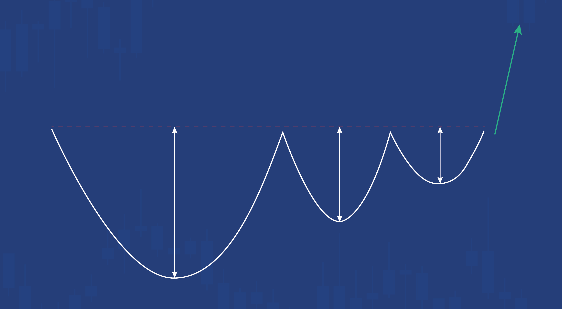
Minervini compares the VCP formation to wringing a wet towel. After the first squeeze, the towel still holds water. Another squeeze extracts more water. Continuing to wring the towel yields less and less water each time until it becomes dry and light. Similarly, with each contraction in the VCP, the stock price becomes "tighter," meaning supply decreases, much like the towel being wrung dry. After several contractions, the stock becomes "lighter" and easier to move in one direction than when there was abundant supply.
For traders familiar with technical analysis, this pattern can be seen as a consolidation pattern within a larger uptrend, commonly resembling a descending flag or triangular convergence pattern. Minervini favors the "right-angled triangle" convergence pattern with parallel upper boundaries. According to other trading experts, such "triangular convergence patterns" are highly likely to break out in the direction of the parallel lines.
The "pivot point" of this pattern is Minervini's recommended optimal entry point. Simply put, as the stock consolidates, the volatility range and trading volume gradually decrease, signaling an impending breakout. Minervini suggests entering during the consolidation phase, specifically at the third or fourth low point, before the breakout. With the protection of an established uptrend, the probability of the stock rising increases significantly.
According to Minervini's strategy, if using the VCP formation as an entry strategy, the stop-loss can theoretically be set at the previous low, as such patterns often exhibit "higher lows," meaning the price bottoms are continually rising.
The underlying principle of the VCP pattern can be imagined as the interaction between retail investors and professional traders in the supply-demand market. When retail investors rush to sell due to price increases, price volatility expands. As the market reaches the trough of the wave, experienced investors begin accumulating shares, quickly driving prices higher. This process repeats cyclically.
The transfer of shares from weak to strong hands forms multiple waves, known as "contractions." These contractions become progressively smaller over time, indicating diminishing selling pressure and stabilizing share ownership. As the VCP pattern contracts to its final stage, trading volume dries up. At this point, traders should watch for "a strong breakout with heavy volume surpassing previous highs and reaching new highs, which often presents an excellent buying opportunity."
Using Rules to Enhance Profitability
Minervini says that to become an exceptional trader, you must respect risk. You must consider how much you could lose in a trade, not just how much you could make. Consistently making money from trading requires discipline and skill.
Minervini's Four Rules:
- Specialize. You can't be good at everything. "Master one strategy or style. I can't shift gears like a car—being a value investor one moment, a short-term day trader the next, then a swing trader, and back to a growth stock investor."
- Avoid significant losses, and never average down. Don't allow yourself to become accustomed to losing or buy more shares as the price falls.
- Increase position size only when the odds of winning are favorable.
- Focus only on high-quality stocks/assets. "I focus on stocks that are performing well. I want my stocks to rise immediately, so I choose those with high Relative Strength (RS) scores. This automatically places you in the category of quality stocks."
Be a "Caboose," Not the Engine
Minervini says he never tries to outsmart or beat the market, which he refers to as the "engine." He believes it's best to be a "caboose" and let the market "pull me in its direction."
Being a trend follower is beneficial. Minervini says, "I never try to catch the exact bottom and rarely catch the exact top. Like a fish, I don't eat the head or the tail; the premium meat in the middle is enough for me."
Minervini advises aspiring traders that to live the life you truly want, you must remain true to your passions and prioritize them. Sacrifices must be made. He assures, "For Olympic gold medalists, winning gold is their top priority. It's not a secondary goal in their lives; it's number one."
Things Minervini Avoids in Trading:
- Forced trades without a plan, lacking discipline, or making impulsive changes to the plan.
- Chasing overextended stocks.
- Trading sizes that are mathematically unsustainable or emotionally burdensome in the long run.
- Lacking the patience to wait, leading to overtrading.
- Failing to define one's own trading model.
- Not taking profits on large gains in time, even allowing them to turn into losses.
- Poorly managing break-even points or exiting too early, stifling the trade's potential.
- Not scaling into positions gradually, being overly aggressive before the direction is confirmed.
- Failing to cut losses, or worse, averaging down or engaging in revenge trading.
- Having unrealistic short-term expectations, lacking patience and commitment to improve the process.
- Being completely unaware of one's own trading data.
Becoming a Great Trader Like Mark Minervini
Today, Minervini, who started with just a few thousand dollars, is one of America's top stock traders. He achieved tremendous gains in the 1990s and was interviewed and recognized by Jack Schwager, author of Stock Market Wizards: Interviews with America's Top Stock Traders. Schwager wrote, "Minervini outperformed the PhDs trying to design trading systems to beat the market."
Minervini says that for an aspiring trader, the best thing is to experience significant losses early on. Failure teaches you a great deal about the stock market and instills respect for risk. "As a trader, without a risk management plan, you are as good as dead."
Conclusion
From nearly losing everything to becoming a legendary trader in the stock market, Minervini has set numerous records and consistently achieved outstanding personal returns. His journey is marked by years of perseverance and repetitive practice. What’s truly remarkable is that, to this day, Mark remains active in global investment markets. Despite having achieved financial freedom, his passion for trading continues unabated—a quality that commands immense respect.