

TSMC Q2 Revenue Locked In to Beat! Gross Margin Nearing 70%: How to Position for Post-Earnings Volatility?
Taiwan Semiconductor Manufacturing Co., Ltd. Sponsored ADR TSM | 0.00 | |
NVIDIA Corporation NVDA | 0.00 | |
Broadcom Limited AVGO | 0.00 | |
Advanced Micro Devices, Inc. AMD | 0.00 | |
Arm Holdings ARM | 0.00 |
Taiwan Semiconductor Manufacturing Co., Ltd. Sponsored ADR(TSM.US) is set to release its Q2 financial results for the 2026 fiscal year. Serving as a bellwether for the global semiconductor industry and counting AI giants like NVIDIA Corporation(NVDA.US), Broadcom Limited(AVGO.US), and Advanced Micro Devices, Inc.(AMD.US) among its top clients, TSMC is expected to validate the continued robust demand across the AI supply chain.
Locked-In Revenue Growth Beating Expectations
S&P analysts project TSMC’s Q2 revenue to hit NT$1.26 trillion, representing a massive 35.31% year-over-year increase, with net profit anticipated to surge by 57% YoY. The company's recent monthly sales data revealed that June revenue reached NT$442.68 billion (+6.2% MoM), bringing cumulative Q2 revenue to NT$1.27 trillion (+36% YoY), which has already surpassed Bloomberg analysts' estimates.
Historically, TSMC has consistently beaten EPS expectations over the past four quarters. Earnings releases have triggered an average stock price fluctuation of ±3.14% (max gain +3.25%, max drop -4.4%), with a 50% probability of an intraday rise.
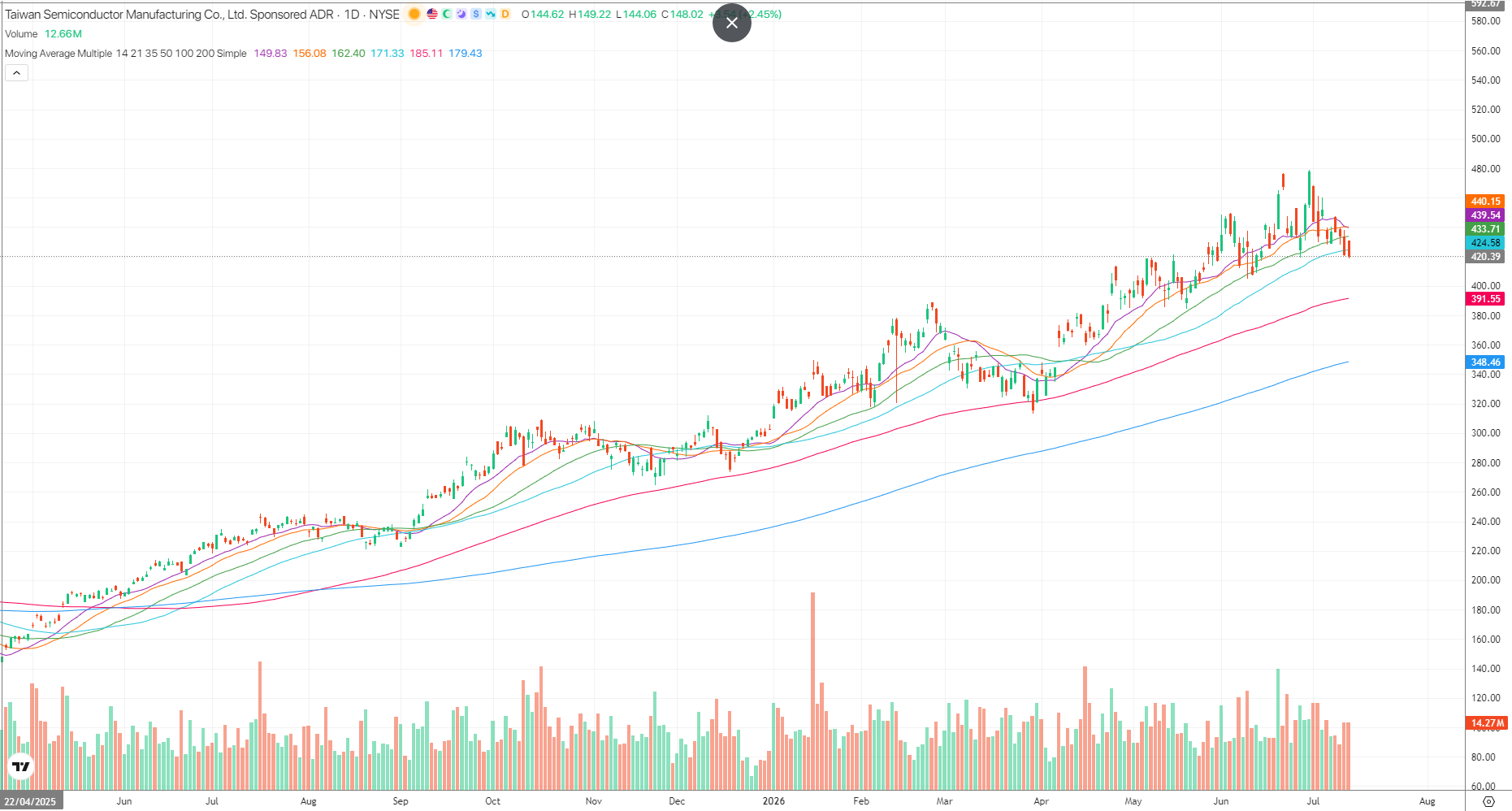
Three Key Focus Areas in the Q2 Earnings Call:
1. Will Gross Margin Hit a New High?
With Q2 revenue already priced in, investors are shifting their focus to gross margin—a key valuation anchor. Wall Street generally estimates Q2 gross margins to be at the higher end of guidance (67%). However, optimistic projections from JPMorgan suggest it could reach as high as 69.5% (approaching 70%).
According to JPMorgan forecasts:
- Q2 Gross Margin (69.5%): Driven by improved capacity utilization, rush orders boosting unit prices, and enhanced production efficiency.
- Q2 Revenue QoQ (+6%~8%): Constrained by 3nm capacity, which has already hit its supply ceiling.
- 2026 & 2027 Revenue Growth (+35% & +30% in USD, respectively): Primarily driven by AI demand, the introduction of the 2nm node, and the scale-up of advanced packaging. Supply limits dictate the growth ceiling.
- 2026–2028 Cumulative Capex ($190 Billion): Aggressive expansion fueled by surging AI computing demand.
- Target Price (NT$3,100): Implying an upside potential of approximately 54%.
Note: If the actual gross margin falls below the median guidance, market reactions could turn negative despite the revenue beat.
2. Will Forward Guidance Be Raised Again?
TSMC has already raised its guidance twice this year. Major Wall Street banks, including Citi, predict another upward revision in profitability and target prices during the upcoming call. The continuous upgrades in full-year guidance reflect management's confidence in a prolonged AI hardware construction cycle. Sentiment during the earnings call is expected to have a more significant impact on the stock price than the standalone Q2 numbers.
3. Meaningful Progress on 2nm Mass Production
TSMC officially announced that its N2 (2nm) process will enter mass production in Q4 2025. Current data suggests an N2 yield rate of approximately 78% and a monthly capacity of roughly 35,000 wafers, with a year-end target of 140,000 wafers/month—exceeding early market expectations of 100,000. Investors will closely monitor management's remarks on the capacity and quality of this advanced node.
Options Strategy: Expected ±5.6% Volatility
Data from MarketChameleon indicates an implied post-earnings stock move of ±5.62%. Given that TSMC's stock has recently retraced over 10% from its AI-driven highs, investors seeking to capitalize on a potential earnings boost while managing risks might consider the following options strategies:
- Bull Call Spread (Buy a lower-strike call and sell a higher-strike call): Betting on a "moderate rise" while avoiding the high costs and deep drawdowns associated with naked calls in a high-IV environment.
- Covered Call (Hold the underlying stock + Sell a call option with a strike price above your cost): For investors with limited expectations for stock price upside, looking to exchange a portion of limited upside room for downside "protection."
(Disclaimer: The above options strategies do not constitute investment advice. Options trading involves time-value decay, severe IV fluctuations, and liquidity risk. Earnings and major events can cause gap-downs, directly triggering loss zones.)
Related Stocks and ETFs in Focus
The broader AI and semiconductor ecosystem will likely move in tandem with TSMC's results. Key sectors and tickers to watch include:
- Chips: NVIDIA Corporation(NVDA.US), Arm Holdings(ARM.US), QUALCOMM Incorporated(QCOM.US), Broadcom Limited(AVGO.US), Advanced Micro Devices, Inc.(AMD.US), Marvell Technology(MRVL.US), Analog Devices, Inc.(ADI.US)
- Semiconductor Equipment: Applied Materials, Inc.(AMAT.US), Lam Research Corporation(LRCX.US), KLA(KLAC.US), Teradyne, Inc.(TER.US), ASML Holding NV ADR(ASML.US)
- Utilities/Power: Vistra Corp.(VST.US), NRG Energy, Inc.(NRG.US), First Solar, Inc.(FSLR.US), Enphase Energy, Inc.(ENPH.US)
- Servers: Dell Technologies, Inc. Class C(DELL.US), Super Micro Computer, Inc.(SMCI.US)
- Software/Cloud: Microsoft Corporation(MSFT.US), Alphabet Inc. Class A(GOOGL.US), Meta Platforms(META.US), Nutanix(NTNX.US), Palantir(PLTR.US)
- Leveraged TSMC ETFs: Direxion Daily TSM Bull 2X Shares(TSMX.US), GraniteShares 2x Long TSM Daily ETF(TSMU.US), YieldMax TSM Option Income Strategy ETF(TSMY.US) / Direxion Daily TSM Bear 1X ETF(TSMZ.US), Defiance Daily Target 2X Short TSM ETF(STSM.US)