

U.S.-China Tensions Flare: Is Your Portfolio Safe? A Look at Big Tech's Hidden Vulnerability
Oracle Corporation ORCL | 0.00 | |
Amazon.com, Inc. AMZN | 0.00 | |
Microsoft Corporation MSFT | 0.00 | |
NVIDIA Corporation NVDA | 0.00 | |
Alphabet Inc. Class A GOOGL | 0.00 |
An escalation in U.S.-China trade tensions has served as a stark reminder to investors: in a world fraught with geopolitical friction, a company's geographical revenue stream is a critical risk factor.
A deep dive into the tech industry's titans reveals a significant reliance on their domestic market, a characteristic that acts as both a protective moat and a potential vulnerability.
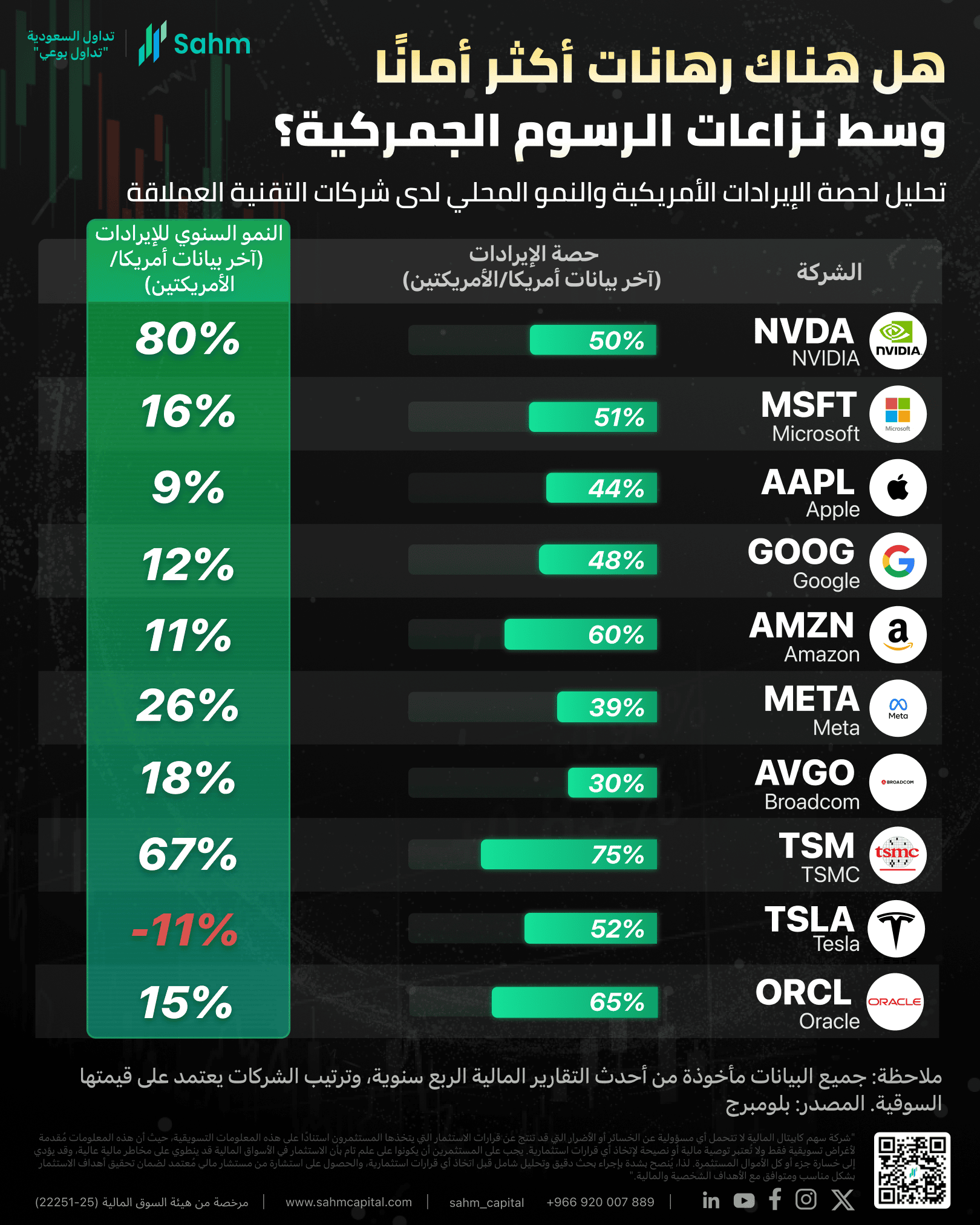
In the face of renewed trade disputes, which have seen the NASDAQ(IXIC.US) tumble 3.56% on Oct. 10, investors are increasingly seeking shelter in companies with strong domestic foundations. This has turned the spotlight on a particular subset of the technology sector: firms that are not only market leaders but also draw a substantial portion of their revenue from North America.
Mega-Cap Tech: A Double-Edged Sword of Domestic Strength and Foreign Exposure
The latest financial reports from the ten largest U.S.-listed technology firms underscore that for most, domestic demand is the primary growth engine. However, the picture is not entirely uniform, with some big names having significant vulnerabilities to a deteriorating trade relationship with China.
Titans with Tremendous U.S. Growth:
- Oracle Corporation(ORCL.US) leads the pack in domestic reliance, deriving a massive 65% of its business from the U.S., providing a stable foundation with 15% year-over-year growth. This is supported by durable spending from defense, healthcare, and public sector clients.
- Amazon.com, Inc.(AMZN.US) sees North America as its undisputed profit engine, accounting for about 60% of revenue. Growth is centered on recapturing retail margins and expanding AWS AI services to a predominantly domestic enterprise client base.
- Microsoft Corporation(MSFT.US) has the U.S. accounting for 51% of its sales and a healthy 16% annual growth. This resilience is anchored by strong enterprise cloud adoption and the monetization of AI-powered Copilot services.
- NVIDIA Corporation(NVDA.US) is firmly powered by the American market, with 50% of its revenue from the U.S. and a staggering 80% year-over-year domestic growth. This is primarily driven by the voracious demand from U.S. hyperscalers and AI cloud providers.
- Alphabet Inc. Class A(GOOGL.US) sees the U.S. constituting 48% of its revenue, fueled by a recovery in digital advertising and momentum in its Cloud division, which is heavily concentrated among American enterprises.
- Meta Platforms(META.US) highlights its dependence on American advertiser budgets with a 39% revenue share from the U.S. & Canada, growing at a strong 26% year-over-year.
- Taiwan Semiconductor Manufacturing Co., Ltd. Sponsored ADR(TSM.US) is overwhelmingly dependent on North America, which makes up 75% of its sales and grew an astonishing 67% year-over-year, driven by insatiable demand from U.S. platforms for HPC and AI chips.
- Broadcom Limited(AVGO.US), while global, sees demand signals originating in the U.S., which represents 30% of its sales. Growth is led by AI networking and custom silicon for American tech giants.
Companies with Notable China Exposure:
- Apple Inc.(AAPL.US) presents a mixed picture. While the Americas represent 44% of its revenue, its 16% exposure to China is a significant factor for investors to consider. The company's fortunes are tied to a Chinese market that is both cyclical and highly sensitive to policy shifts.
- Tesla Motors, Inc.(TSLA.US) faces a complicated situation. The U.S. accounts for 52% of its sales but saw an 11% year-over-year decline. Simultaneously, its significant 19% exposure to a competitive and policy-driven Chinese market also showed a 7% contraction. Its growth story now leans heavily on energy storage and progress in full self-driving technology.
- NVIDIA Corporation(NVDA.US), despite its strong U.S. growth, still has roughly 6% of its revenue coming from China, which represents a vulnerability as export controls cap near-term upside.
- Taiwan Semiconductor Manufacturing Co., Ltd. Sponsored ADR(TSM.US)'s China business has contracted, but it still represents 9% of its revenue.
The All-American Moat: Software and "Neo-Cloud" Champions
Beyond the mega-caps, a cohort of software and "neo-cloud" companies offers a more insulated, U.S.-first revenue model. These firms may appeal to investors aiming to minimize exposure to international trade disputes.
- Palantir(PLTR.US) is a prime example, with the U.S. now accounting for a staggering 73% of its revenue, and growing at a blistering 68% year-over-year. This growth is fueled by the successful conversion of its Artificial Intelligence Platform (AIP) pilots into paid deployments across commercial and government sectors. With negligible exposure to China, key metrics for investors to watch are the AIP conversion rate, the addition of new U.S. enterprise clients, and margin expansion.
- CrowdStrike(CRWD.US) also showcases a strong domestic focus, with the U.S. representing 67% of its revenue and growing at a solid 20% year-over-year. The company's growth is driven by upselling its Falcon platform and securing key federal contracts. With immaterial China exposure, investors are closely monitoring module adoption rates, net retention, and the U.S. public-sector pipeline.
- CoreWeave(CRWV.US) stands out as an almost pure-play on American AI infrastructure. The U.S. constitutes 95% of its revenue, which has seen an explosive 210% year-over-year growth based on the rapid expansion of its take-or-pay GPU capacity. While revenue concentration is high—with Microsoft as its largest customer—key variables include the pace of power infrastructure build-out and new GPU deliveries.
- Nebius Group(NBIS.US) has over half of its revenue coming from the U.S., with growth tied to multi-year, dedicated AI infrastructure agreements. Its exposure to China is minimal. Catalysts for investors to watch include the ramp-up of its New Jersey data center, its financing cadence, and overall utilization rates.
- Netflix, Inc.(NFLX.US) finds its monetization momentum anchored in the U.S. & Canada (UCAN), which represents 44% of its revenue and grew 15% year-over-year. Key drivers are the penetration of its domestic ad-tier, pricing power, and the live events funnel. With negligible China exposure, the growth trajectory of advertising revenue, the U.S. content slate, and average revenue per user (ARPU) are the critical watch items.
As geopolitical tensions continue to create market volatility, a company's revenue geography will remain a paramount concern for investors. While the tech giants continue to be major players, a closer look at U.S.-centric software and cloud companies may offer a more insulated path to growth in these uncertain times.