

Warsh Sworn In Tomorrow: Will the Fed Transition Trigger a Market Correction? How to Hedge
Dow Jones Industrial Average DJI | 0.00 | |
NASDAQ IXIC | 0.00 | |
S&P 500 index SPX | 0.00 | |
Ultrapro Short QQQ Proshares SQQQ | 0.00 | |
Ultrapro Short DOW 30 Proshares SDOW | 0.00 |
Subscribe to The Value Anchor Topic / The Trend Catcher Topic —unlock the full historical archive and never miss a weekly pick again.
As Kevin Warsh prepares to be sworn in as the new Chairman of the Federal Reserve on May 22 by President Donald Trump, Wall Street is asking one multi-trillion-dollar question: Will the new regime derail the historic bull market?
U.S. equities have been on a tear, with the Dow Jones Industrial Average(DJI.US) recently shattering the 50,000 milestone and the NASDAQ(IXIC.US) and S&P 500 index(SPX.US) up over 10% and 7% for the year, respectively. But if history is any guide, a changing of the guard at the central bank often brings turbulence.
The "New Chair" Market Curse
According to Wind data, U.S. stocks have historically suffered pullbacks shortly after every new Fed Chair takes office.
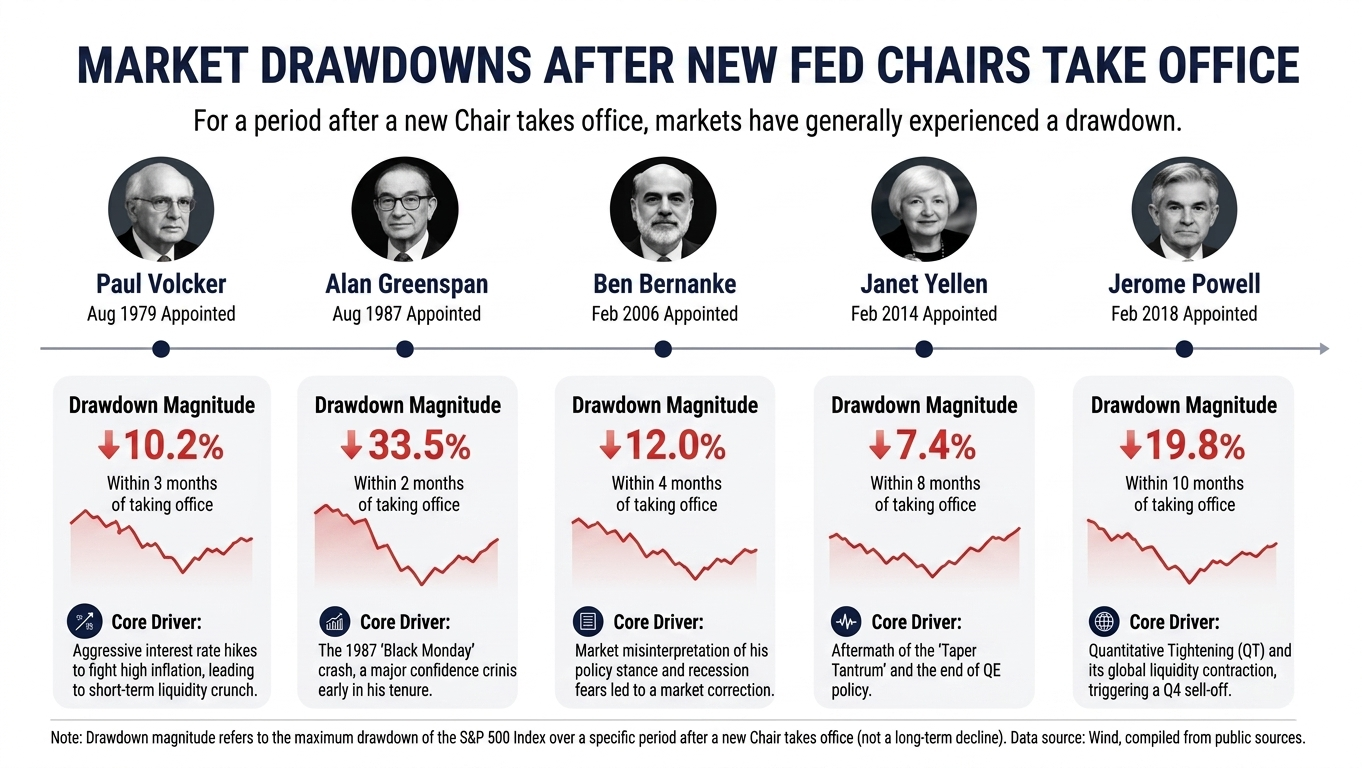
When Alan Greenspan took the reins in 1987, the market famously suffered "Black Monday," with the Dow plunging 22.6% in a single day without any obvious negative catalysts. More recently, within the first 10 months of Jerome Powell’s tenure in 2018, the S&P 500 tumbled nearly 20%. Paul Volcker, Ben Bernanke, and Janet Yellen all saw similar market pullbacks in their early months.
A recent Barclays report notes that since 1930, the S&P 500 has averaged maximum drawdowns of 5%, 12%, and 16% in the first, third, and sixth months of a new Fed Chair's term, respectively.
Why did US stocks generally decline in the short term after a change of Federal Reserve chair? Analysts believe this is mainly due to the uncertainty surrounding the monetary policy path, leading to a restructuring of expectations, and risk aversion caused by market unfamiliarity with the successor's policy style. Institutions point out that a change of leadership implies potential adjustments to monetary policy stance and pace of tightening or easing, changes in global liquidity expectations, and market speculation on changes in interest rates and balance sheet reduction policies, thus triggering valuation fluctuations. DBS Bank believes that the so-called short-term decline following a change of leadership largely reflects investors' concerns about the uncertainty of the successor's monetary policy. Unless the successor explicitly states before taking office that they will implement monetary policies unfavorable to the stock market, in the short term, investors are simply experiencing some risk aversion due to a lack of complete understanding of the new chair's specific policies.
Who is Kevin Warsh?
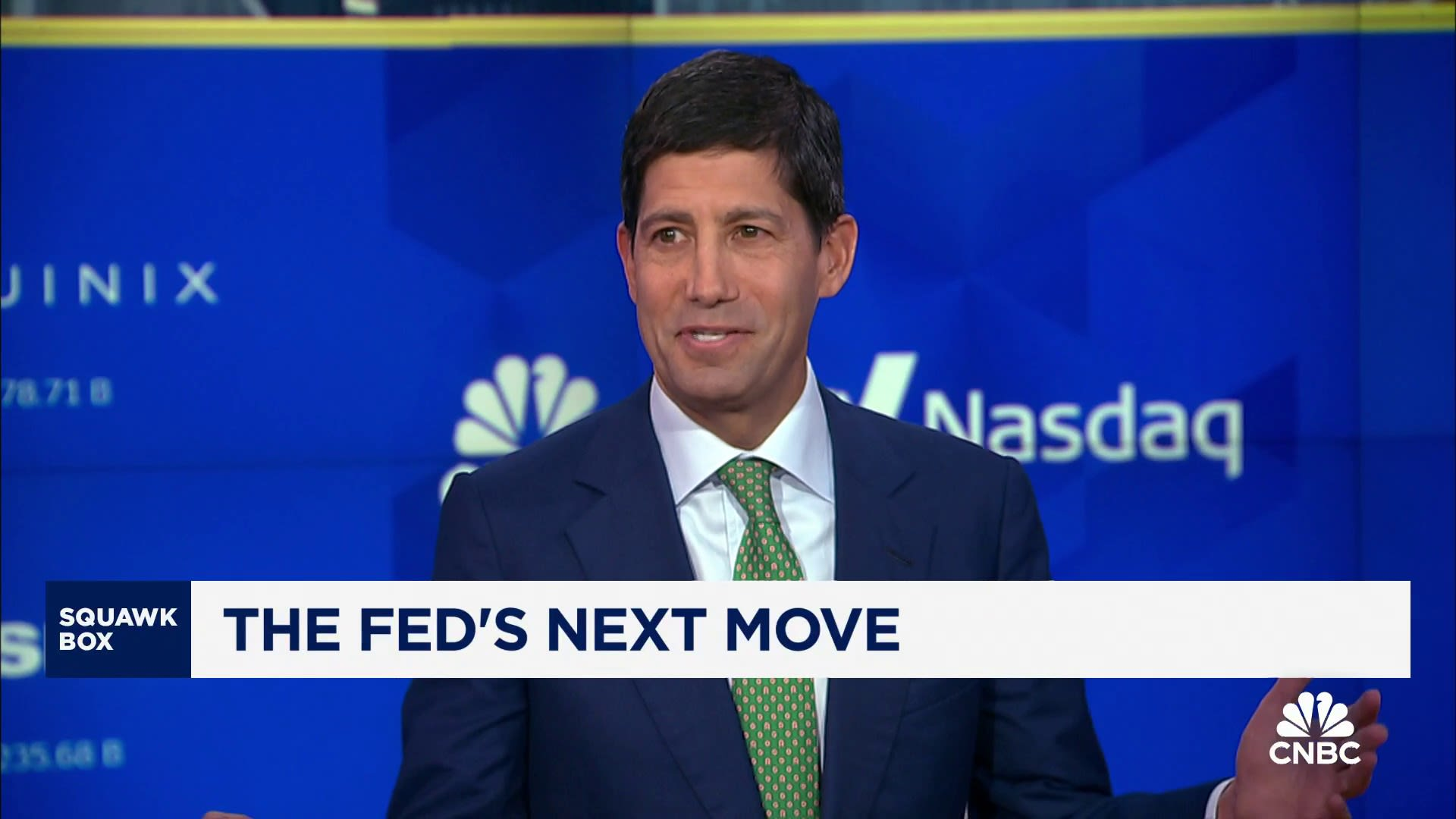
At 55, Warsh is widely regarded as an elite triple-threat with deep ties across politics, business, and academia. Armed with a Stanford undergraduate degree and a Harvard Law doctorate, Warsh previously served as a presidential economic aide under George W. Bush, became the youngest Fed governor in history at 35, and worked as an M&A executive at Morgan Stanley.
Crucially, Warsh is viewed as a close ally of the incoming administration. His father-in-law, billionaire Estée Lauder heir Ronald Lauder, has been a close friend of President Trump for over 60 years.
The Blueprint: A Radical Policy Overhaul
Confirmed by the Senate in a 54-45 vote, Warsh is pitching himself as an institutional reformer. His policy framework is built on three disruptive pillars:
1. Rewriting the Inflation Math:
Warsh has heavily criticized the Powell administration's reliance on Core PCE (which strips out food and energy) as a lagging and flawed metric. Instead, he advocates for the "Trimmed Mean" inflation rate, which excludes extreme price swings to reflect broader economic trends. According to Bank of America, Warsh's preferred 12-month trimmed mean is a cool 2.3%, compared with the 3% Core PCE. This lower metric—coupled with his belief that the Artificial Intelligence (AI) boom is a massive disinflationary force—gives Warsh the theoretical runway to cut rates earlier and faster than Powell's "inflation-fighting first" stance would allow.
2. The "Cut + QT" Paradox:
Warsh is floating a highly controversial dual mandate: cutting interest rates while aggressively shrinking the Fed's $7.5 trillion balance sheet. While markets expect 1 to 3 rate cuts (25-50 basis points) under his watch, he also aims to roll off over $1 trillion in assets through next year to fix what he calls a "dangerously bloated" balance sheet that distorts financial markets.
This strategy is already facing a stress test. The bond market has aggressively repriced in recent weeks, sending the 30-year Treasury yield briefly past 5% (the highest since 2007) and the 2-year yield surging above 4%. Essentially, the bond market has already "hiked" rates for Warsh, questioning the viability of his simultaneous easing and tightening plan.
Subscribe to The Value Anchor Topic / The Trend Catcher Topic —unlock the full historical archive and never miss a weekly pick again.
3. Killing the "Dot Plot"
Warsh believes the Fed talks too much. He argues that over-communication and forward guidance make the market dangerously dependent on central bank "spoilers." His solution? Scrap the dot plot, reduce the frequency of press conferences, and speak with one unified voice. While intended to return flexibility to the Fed, critics warn that reducing transparency could actually amplify market anxiety.
The Investor Playbook
For investors worried that the "New Chair Curse" will strike again, Wall Street is mapping out several defensive strategies:
Inverse ETFs for the Bears: For those looking to capitalize on a tech or broader market pullback, leveraged inverse ETFs like Ultrapro Short QQQ Proshares(SQQQ.US), Ultrapro Short DOW 30 Proshares(SDOW.US), Proshares Trust Ultrapro Short S&P500(SPXU.US), and Proshares Trust Pshs Ulshrus2000 (Post Rev Split)(TWM.US) are in focus. Semiconductor bears might look at Daily Semiconductor Bear 3x Shares(SOXS.US).
A Warning on Leverage: Because leveraged ETFs reset daily, they suffer from "volatility decay" in sideways markets. For a cleaner short strategy without the compounding bleed, analysts suggest taking a page from "Big Short" investor Michael Burry by buying Put Options on sector ETFs like PHLX Sox Semiconductor Sector Ishares(SOXX.US) or shorting them directly.
The Defensive Rotation: Historically, when the broader market struggles, defensive sectors shine. Investors can seek shelter in traditional safe havens like Healthcare (Healthcare Select Sector SPDR(XLV.US)), Consumer Staples (Spdr Select Sector Fund - Consumer Staples(XLP.US)), and Utilities (Spdr Select Sector Fund - Utilities(XLU.US)). Additionally, Vanguard's Value ETF (Vanguard Value ETF(VTV.US)) could offer outperformance through high-dividend, undervalued companies if broader valuations take a hit.